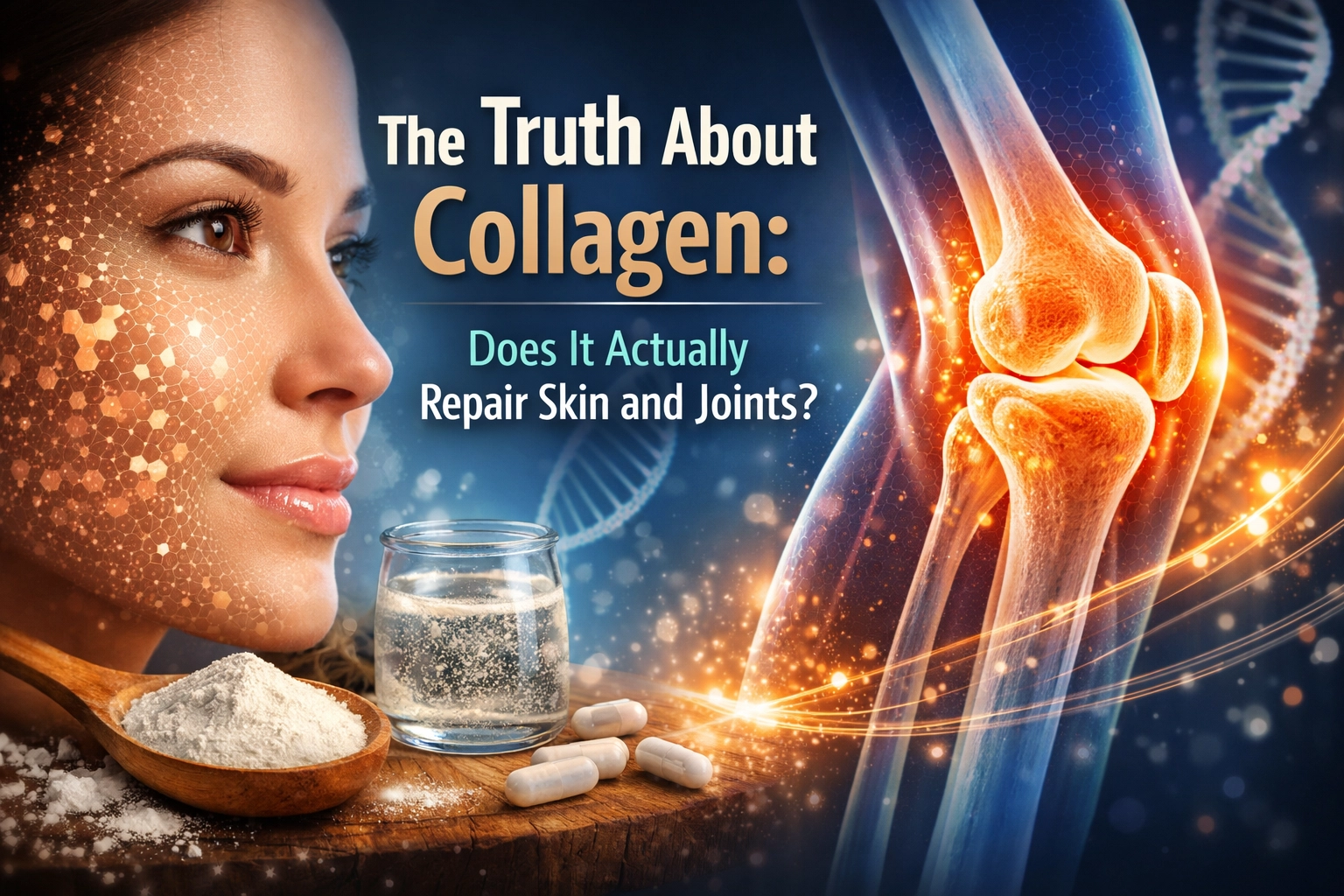
Collagen is no longer just a buzzword found on the back of expensive eye creams. By 2026, it has grown into a multi-billion-dollar industry spanning powders, "glow" waters, and even collagen-infused coffee. But as the marketing grows louder, the scientific community remains divided. Does swallowing a scoop of bovine hide or fish scales actually translate to fewer wrinkles and smoother knees, or are we simply consuming expensive protein?
To understand if collagen works, we have to look past the labels and examine the biochemistry of protein absorption, the specific signaling pathways of fibroblasts, and the latest clinical data from the last two years.
What Exactly is Collagen? The Biological Scaffolding
Collagen is the most abundant protein in the human body, accounting for roughly 30% of our total protein mass. It is a structural protein, meaning its primary job is to provide shape, strength, and elasticity to tissues. Think of it as the "glue" that holds your body together: specifically your skin, joints, tendons, ligaments, and even your gut lining.
Structurally, collagen is unique. It consists of three polypeptide chains wrapped around each other in a tight "triple helix" formation. This structure gives it incredible tensile strength. However, this same structure makes raw collagen (like the kind found in a tough piece of steak) very difficult for the body to digest. This is why the supplements you see on shelves are hydrolyzed.
The Importance of Hydrolysis
Hydrolysis is a chemical process that breaks down the long, tough collagen fibers into smaller chains called collagen peptides. These peptides have a lower molecular weight, making them "bioavailable." When you consume hydrolyzed collagen, your body doesn't just transport those peptides directly to your face. Instead, your digestive system breaks them down into individual amino acids: predominantly glycine, proline, and hydroxyproline.

The Skin Deep Debate: Can You Eat Your Way to Fewer Wrinkles?
The most common claim for collagen is its ability to reverse skin aging. In the past, skeptics argued that because collagen is broken down during digestion, it couldn't possibly affect the skin specifically. However, recent research suggests a more complex "signaling" mechanism.
The Mechanism: Signaling Fibroblasts
When collagen peptides enter the bloodstream, they may act as a signal to the body. Your "fibroblasts": the cells responsible for producing collagen in the dermis (the deep layer of the skin): detect these high concentrations of collagen-specific amino acids. This "tricks" the body into thinking there is a massive breakdown of collagen occurring, which triggers the fibroblasts to ramp up natural production.
What the 2026 Data Says
A comprehensive meta-analysis updated in early 2026, which looked at 26 randomized controlled trials (RCTs) involving over 1,700 participants, provided the following insights:
| Metric | Outcome | Clinical Significance |
|---|---|---|
| Skin Hydration | Significant Improvement | High (p < 0.00001) |
| Skin Elasticity | Significant Improvement | High (p < 0.00001) |
| Wrinkle Depth | Moderate Reduction | Visible after 56-90 days |
| Firmness | Variable Improvement | 27% to 58% of participants |
Despite these numbers, leading dermatologists remain cautious. While the data shows statistical improvement, the visual difference may be subtle. A 10% increase in skin hydration is biologically significant but might not be the "facelift in a jar" that marketing suggests.
Joint Repair and Cartilage: Is It More Than a Placebo?
While skin gets the most attention, the use of collagen for joint health: specifically Type II collagen: is arguably more scientifically compelling for athletes and the aging population.
Your joints are cushioned by articular cartilage, which is primarily composed of Type II collagen. As we age, or through repetitive stress, this cartilage thins, leading to osteoarthritis and general joint pain.
Type II Collagen and Oral Tolerance
Recent studies suggest that small doses of undenatured Type II collagen may work through a process called oral tolerance. Instead of just providing "building blocks," it interacts with the immune tissues in the gut (Peyer's patches). This interaction helps "train" the immune system to stop attacking its own joint collagen, reducing inflammation and potentially slowing the degradation of cartilage.
Clinical Observations for Joints:
- Reduced Activity-Related Pain: Athletes taking 5g–10g of collagen peptides daily reported significantly less joint pain during exercise after 12 weeks.
- Osteoarthritis Support: Some studies indicate that collagen is as effective as glucosamine and chondroitin in managing stiffness and physical function.

Navigating the Types: Which One Do You Actually Need?
There are at least 28 different types of collagen in the body, but 90% of your body’s collagen consists of Types I, II, and III. When shopping for a supplement, the "Type" determines the intended outcome.
- Type I: The most abundant. Found in skin, tendons, and bone. This is the "beauty" collagen.
- Type II: Found specifically in cartilage. This is the "joint" collagen.
- Type III: Found in muscles, organs, and large arteries. Usually found alongside Type I in bovine supplements.
Comparison of Common Collagen Sources
| Source | Primary Types | Best For | Pros/Cons |
|---|---|---|---|
| Bovine (Cow) | I & III | Skin, Gut, Muscle | Affordable, widely available. |
| Marine (Fish) | I | Skin, Hair, Nails | Superior absorption due to smaller particle size. |
| Chicken | II | Joint Health, Cartilage | Specific for arthritis and joint repair. |
| Vegan "Collagen" | N/A | Boosting synthesis | Not actual collagen; usually just the amino acids and Vitamin C. |
The 2026 Skepticism: Why Experts Are Still Wary
While the clinical trials mentioned above show promise, January 2026 saw a wave of pushback from the medical community. The core of the skepticism lies in study funding and biological priority.
Many collagen studies are funded by the companies that sell the supplements, which can introduce bias. Furthermore, the body is a master of prioritization. If you are protein-deficient, your liver will take the amino acids from your collagen supplement and send them to your vital organs or muscles long before it sends them to your forehead to fix a wrinkle.
The "Expensive Urine" Argument: If your diet is already high in protein (meat, eggs, beans, dairy), you may already have all the amino acids necessary for collagen synthesis. In this case, additional collagen supplementation might not offer any extra benefit.
How to Maximize Your Collagen Results
If you decide to supplement, you can't just rely on the powder alone. Collagen synthesis is a complex biological process that requires several "co-factors."
- Vitamin C: This is the most critical co-factor. Without Vitamin C, the body cannot stabilize the triple helix structure of collagen. If you are deficient in Vitamin C, your collagen production will stall, regardless of how much powder you take.
- Copper & Zinc: These minerals play a role in the "cross-linking" of collagen fibers, which gives them their strength.
- Sun Protection: UV radiation is the "collagen killer." It activates enzymes called matrix metalloproteinases (MMPs) that chop up your existing collagen. Taking a supplement while tanning is like trying to fill a bucket with a hole in the bottom.
- Consistency: Most studies show that benefits do not appear until the 8-to-12-week mark.
The Verdict: Is It Worth It?
Based on the 2026 landscape of nutritional science, here is the bottom line:
- For Skin: If you have the budget and are looking for a subtle boost in hydration and elasticity, a marine collagen supplement is backed by a decent amount of data. However, it will not replace a solid skincare routine and sun protection.
- For Joints: There is strong evidence that collagen (especially Type II or high-dose peptides) can reduce pain and improve mobility in those with joint wear and tear.
- For General Health: If you already hit your daily protein targets (0.8g to 1g per pound of body weight), a collagen supplement is likely an unnecessary luxury.
Collagen isn't magic, but it isn't snake oil either. It is a functional food that, when used correctly and consistently, provides the specific signaling molecules your body needs to maintain its structural integrity as you age.
Author Bio: Malibongwe Gcwabaza
Malibongwe Gcwabaza is the CEO of blog and youtube and a dedicated health and wellness strategist. With a focus on longevity and functional fitness, Malibongwe spends his time deconstructing complex medical research into actionable insights for the modern professional. He believes that the future of health lies in personalized bio-monitoring and evidence-based supplementation. When he isn't analyzing clinical trials, he is experimenting with zone 2 training and metabolic flexibility protocols.
About the Author