
Heat therapy isn't a new trend: humans have been sweating in small, hot rooms for thousands of years. But in 2026, the conversation has shifted from simple relaxation to "hormetic stress." We are no longer just sitting in heat; we are looking for the specific biological triggers that extend healthspan and optimize recovery.
The debate usually boils down to two heavyweights: the Traditional Dry Sauna (the Finnish gold standard) and the Infrared (IR) Sauna (the high-tech biohacker favorite). While both make you sweat, the physiological pathways they use: and the results they deliver: are surprisingly different.
The Physics of Sweat: Convection vs. Radiation
To understand which sauna is better for your specific goals, we have to look at how they actually heat your body.
Traditional Dry Saunas (The Convection Method)
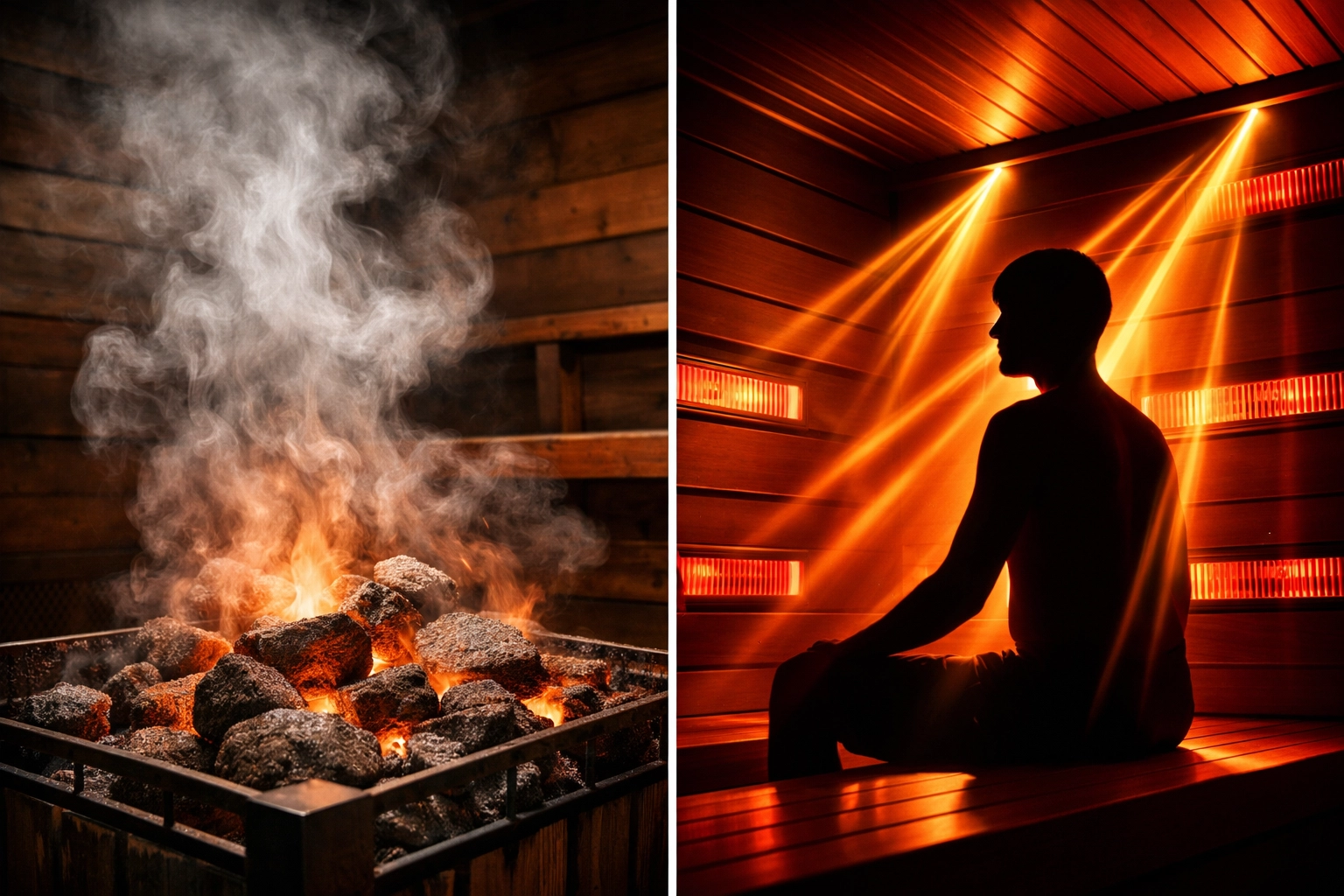
Traditional saunas use a heater (electric or wood-burning) to raise the air temperature, usually between 170°F and 210°F (77°C – 100°C). Often, water is poured over hot stones to create "löyly" (steam), which increases the perceived heat. In this environment, your body is heated from the outside in. The hot air hits your skin, and your core temperature rises as a secondary response.
Infrared Saunas (The Radiant Method)
Infrared saunas don't care much about the air. They use infrared lamps to emit electromagnetic radiation that is absorbed directly by the skin. This allows the sauna to operate at a much lower temperature: typically 110°F to 150°F (43°C – 65°C): while still raising your core temperature significantly. It’s the difference between standing in the sun on a cold day (Infrared) versus sitting in a preheated oven (Traditional).
A Side-by-Side Comparison
| Feature | Traditional Dry Sauna | Infrared Sauna |
|---|---|---|
| Operating Temp | 170°F – 210°F | 110°F – 150°F |
| Heat Mechanism | Convection (Heats the air) | Radiation (Heats the body directly) |
| Humidity | Low (unless water is added) | Very Low |
| Preheat Time | 30–45 minutes | 10–15 minutes |
| Scientific Backing | Decades of longitudinal data | Emerging, smaller-scale studies |
| Primary Benefit | Cardiovascular & Longevity | Recovery & Targeted Detox |
Cardiovascular Health: The "Exercise Mimetic"
One of the most profound benefits of heat therapy is its impact on heart health. When you enter a high-heat environment, your heart rate increases, and your blood vessels dilate (vasodilation). This creates a physiological state similar to moderate-intensity aerobic exercise.
The Finnish Advantage
Traditional saunas have a massive head start in the research department. A landmark study published in JAMA Internal Medicine followed over 2,300 Finnish men for 20 years. The results were staggering:
- Those who used a sauna 4–7 times per week had a 63% lower risk of sudden cardiac death compared to those who used it once a week.
- The risk of all-cause mortality was significantly reduced in frequent users.
Because traditional saunas reach much higher temperatures, they trigger a more intense cardiovascular response. The extreme heat forces the heart to pump harder to move blood to the skin for cooling, which improves arterial stiffness and blood pressure.
The Infrared Alternative
Infrared saunas also improve cardiovascular markers, but the stress is "gentler." This makes IR saunas an excellent choice for individuals with heat sensitivity or those recovering from certain cardiac events who cannot handle the 200°F intensity of a Finnish sauna. 2026 research indicates that Far-Infrared (FIR) therapy effectively improves endothelial function: the ability of your blood vessels to relax and contract.
Muscle Recovery and Pain Management
If you are an athlete or a high-performance individual, your choice of sauna might depend on how much "deep tissue" work you need.
Infrared for Depth:
Infrared light (specifically mid and far-infrared) can penetrate up to 3–4 cm into the body. This deep penetration is believed to stimulate blood flow directly within the muscle tissue, helping to clear metabolic waste like lactate more efficiently. Many 2026 recovery protocols for professional athletes now prioritize IR saunas immediately following high-intensity training to reduce DOMS (Delayed Onset Muscle Soreness).
Traditional for Heat Shock Proteins (HSPs):
The higher heat of a traditional sauna is more effective at triggering Heat Shock Proteins. These are molecular chaperones that prevent protein aggregation and help repair damaged proteins within our cells. HSPs play a massive role in preventing muscle atrophy and supporting longevity. If your goal is cellular "cleanup" (autophagy) and long-term muscle maintenance, the traditional route might have the edge.

The Detoxification Myth vs. Reality
"Detoxing" is a buzzword that often lacks scientific rigor. However, we can look at sweat composition to find some truth.
Traditional saunas produce a sweat that is largely water (about 95-97%). Because infrared saunas heat the body directly and penetrate deeper, some studies suggest that the sweat produced in an IR environment contains a higher concentration of heavy metals (like arsenic, cadmium, and mercury) and fat-soluble toxins.
While your liver and kidneys do 99% of the heavy lifting for detoxification, sweating is a legitimate secondary pathway. If you are specifically looking to reduce your "toxic load" from environmental pollutants, the deep-penetrating heat of an infrared unit is likely more efficient.
Neurological Benefits: Mood and Brain Health
Both sauna types are potent tools for mental health, but they work through different mechanisms.
- Dynorphins and Endorphins: The intense heat of a traditional sauna causes the brain to release dynorphins (which make you feel slightly uncomfortable). To compensate, the brain then increases its sensitivity to and production of endorphins. This is why you feel a "sauna high" after a session.
- BDNF Production: Both types of heat stress have been shown to increase levels of Brain-Derived Neurotrophic Factor (BDNF). Think of BDNF as "Miracle-Gro" for your brain: it supports the growth of new neurons and improves cognitive function.
- Cortisol Reduction: Infrared saunas are often cited as being more "relaxing" because the environment is less hostile. The lower temperature allows for longer sessions where you can meditate or read, leading to a significant drop in cortisol (the stress hormone).

Practical Considerations for 2026
When choosing which one to install in your home or look for at your gym, consider these logistical factors:
EMF Exposure
A common concern with modern Infrared saunas is Electromagnetic Fields (EMF). In 2026, high-quality IR saunas are designed with "Ultra-Low EMF" technology. Always check the manufacturer's third-party testing. Traditional saunas have virtually zero EMF issues because they rely on simple heating elements or wood.
Time and Energy
Traditional saunas take a long time to heat up. If you're a busy professional, the 45-minute wait for a Finnish sauna might be a dealbreaker. Infrared units are usually ready in 10-15 minutes and use significantly less electricity.
The "Social" Aspect
Traditional saunas are built for the Finnish concept of community. They are usually larger and involve the ritual of the steam. Infrared saunas are often smaller, solo units designed for a "biohacking" session where you might also be using red light therapy or listening to a podcast.
Which One Should You Choose?
Choose a Traditional Dry Sauna if:
- Your primary goal is maximum longevity and cardiovascular health.
- You enjoy extreme heat and the ritual of steam.
- You want the most scientifically proven method for reducing the risk of dementia and heart disease.
Choose an Infrared Sauna if:
- You want targeted muscle recovery and pain relief.
- You cannot tolerate extreme heat or have respiratory issues triggered by steam.
- You want a quick, energy-efficient session you can do daily with minimal setup.
- You are interested in the specific benefits of light therapy and deep-tissue penetration.
Conclusion
In the battle of Infrared vs. Traditional, there isn't a "loser." Both utilize the power of thermal stress to trigger beneficial biological adaptations. If you have the luxury of choice, alternating between the two: using Traditional for the "hormetic hit" and longevity, and Infrared for recovery and relaxation: is the ultimate 2026 wellness strategy.
Whatever you choose, the most important metric is consistency. Aim for at least 2–3 sessions per week, staying hydrated and listening to your body's signals.
About the Author: Malibongwe Gcwabaza
Malibongwe Gcwabaza is the CEO of blog and youtube, a premier digital hub dedicated to dissecting the future of health, wellness, and human performance. With a background in executive leadership and a passion for data-driven biohacking, Malibongwe focuses on making complex longevity science accessible to everyone. He spends his free time testing the latest in recovery tech and exploring the intersection of traditional wisdom and modern biological research.
About the Author