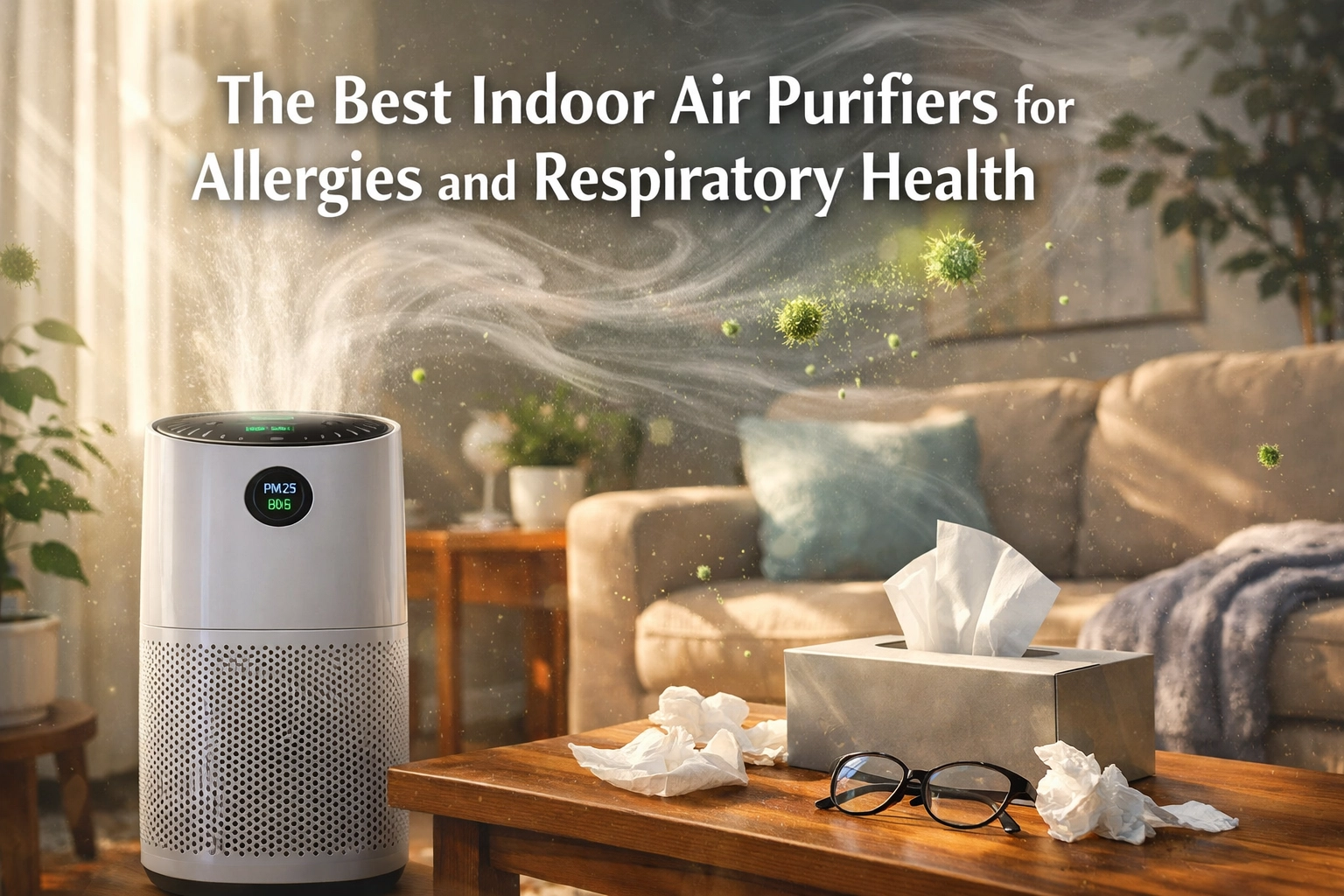
We spend roughly 90% of our lives indoors. While we obsess over the purity of our water and the organic labels on our food, the 11,000 liters of air we breathe every single day often go ignored. In 2026, with the rise of urban density and the increasing frequency of environmental irritants, indoor air quality (IAQ) has moved from a "nice-to-have" for allergy sufferers to a critical pillar of longevity and respiratory health.
If you struggle with seasonal allergies, asthma, or general respiratory fatigue, a standard retail-grade air filter probably isn't cutting it. To truly "bio-hack" your environment, you need to understand the technical metrics that separate marketing hype from medical-grade filtration. This guide dives deep into the science of Clean Air Delivery Rates (CADR), the evolution of HEPA technology, and the top-performing purifiers currently dominating the market.
The Science of Filtration: Why 0.3 Microns Isn't Enough Anymore
For decades, the industry standard has been "True HEPA," which captures 99.97% of particles down to 0.3 microns. While this is effective for most dust and pollen, it misses a significant portion of ultra-fine particles (UFPs) and viruses that sit in the 0.1-micron range.
In 2026, the gold standard has shifted toward dual-stage filtration that combines mechanical capture with electrostatic charging. This allows the purifier to trap smaller particles without requiring a filter so dense that it kills airflow and spikes your energy bill.
Key Metrics to Master
Before you buy, you must understand these three data points:
- CADR (Clean Air Delivery Rate): This measures how many cubic feet of air the unit can scrub per minute (cfm). You want separate scores for Smoke, Dust, and Pollen.
- ACH (Air Changes per Hour): For allergy relief, you should aim for a minimum of 4.8 ACH. This means the unit cycles the entire volume of air in your room every 12.5 minutes.
- PM Sensors: Modern units use lasers to detect Particulate Matter. Look for "PM1" sensing capabilities, this detects the smallest, most dangerous particles that can enter the bloodstream through the lungs.

Top Purifiers of 2026: Categorized by Performance
Choosing a purifier is not a one-size-fits-all decision. The unit that works for a 150 sq. ft. bedroom will be virtually useless in an open-concept living area.
1. The Powerhouse for Large Living Spaces: Blue Pure 211i Max
If you have a large living room or an open-plan office, the Blue Pure 211i Max is currently the industry leader. It is engineered for high-volume turnover without the "jet engine" noise levels common in older industrial units.
- Performance: Covers 674 sq. ft. every 12.5 minutes.
- CADR Ratings: Pollen 450 cfm / Dust 452 cfm / Smoke 435 cfm.
- Technology: Uses HEPASilent™ technology, which combines mechanical filtration with an electrostatic charge. This allows the filter fibers to be less dense, resulting in 55% more clean air and 50% less energy consumption than traditional HEPA filters.
- Sensor Suite: Tracks PM1, PM2.5, and PM10, giving you a granular view of exactly what kind of pollution is entering your home.
2. The Bedroom Specialist: Blue Pure 511i Max
Sleep is the most critical period for respiratory recovery. If you wake up with a "stuffy" nose or a scratchy throat, your bedroom air is likely the culprit. The 511i Max is designed specifically for low-noise, high-efficiency filtration in smaller spaces.
- Noise Level: Starts at a whisper-quiet 19 dB (quieter than a human rustling leaves).
- Safety Features: A compact, rounded design with no sharp edges, making it ideal for nurseries or homes with pets.
- Efficiency: Despite its size, it maintains a Pollen CADR of 174 cfm, ensuring that seasonal triggers are removed before they hit your pillow.
3. The Comprehensive All-Rounder: Blue Pure 311i+ Max
This is the "Goldilocks" of air purifiers, perfect for master bedrooms or medium-sized living rooms (up to 525 sq. ft.). It includes GermShield technology, which actively monitors your filter for bacterial growth and kills viruses even when the unit is on standby. This is a massive leap forward for those concerned about mold spores or lingering bio-aerosols.
Technical Comparison: 2026 Top Tier Models
| Feature | Blue Pure 511i Max | Blue Pure 311i+ Max | Blue Pure 211i Max | Oransi AirMend 200H |
|---|---|---|---|---|
| Ideal Room Size | <250 sq. ft. | 300 – 500 sq. ft. | 600+ sq. ft. | 400 – 600 sq. ft. |
| Max CADR (Pollen) | 174 cfm | 446 cfm | 450 cfm | 350 cfm |
| Min Noise Level | 19 dB | 23 dB | 23 dB | 21 dB |
| Smart App Control | Yes | Yes | Yes | No (Manual) |
| Sensors | PM 2.5 | PM 1, 2.5, 10 | PM 1, 2.5, 10 | PM 2.5 |
| Filtration Tech | HEPASilent™ | HEPASilent™ | HEPASilent™ | True HEPA |
Advanced Features: Beyond Simple Dust Collection
The Rise of Gas and Odor Shielding
Standard HEPA filters are excellent at stopping particles, but they are useless against gases like formaldehyde (found in furniture glue) or VOCs (volatile organic compounds) from cleaning products. To combat this, look for models with Activated Carbon or proprietary technology like OdorFence.
The Blue Signature series, for example, uses a multi-stage process that neutralizes odors at the molecular level. If you live in an urban area with heavy traffic or near industrial zones, this carbon layer is non-negotiable for protecting your long-term lung health.
Smart AI Integration and GEO
In 2026, air purifiers have entered the "smart home" ecosystem. High-end units now use AI to predict air quality dips. For instance, if local weather data indicates a high pollen count or an approaching wildfire smoke plume, these units will pre-emptively increase their fan speed to "scrub" the home before the pollutants even reach your doorstep.
Placement Strategy: Where You Put It Matters
A common mistake is tucking an air purifier into a corner or behind a couch. For maximum efficiency, follow these placement rules:
- 360-Degree Intake: Ensure there are at least 12 inches of clearance around the unit. Obstructions significantly reduce the CADR.
- Elevation: For general allergens, keeping the unit on the floor is fine. However, if you are targeting smoke or fine dust, elevating the unit to table height can capture particles that linger mid-air.
- The "Closed Loop" Rule: For a purifier to reach its rated ACH (Air Changes per Hour), doors and windows must remain closed. Leaving a window open while running a purifier is like running an air conditioner with the door open: you’re trying to clean the whole neighborhood.
Maintenance: The "Hidden" Cost of Clean Air
A filter is only as good as its remaining surface area. Once the pores are clogged, the motor has to work harder, increasing noise and energy draw.
- Pre-filters: Most 2026 models feature washable fabric pre-filters. These catch large hair and dust bunnies. Wash these every 2-4 weeks to extend the life of your main HEPA filter.
- Filter Lifespan: Advanced units like the Blue Signature series now offer doubled filter lifetimes (up to 12 months), but you should always replace them immediately when the indicator light triggers.
Final Thoughts: Air Quality as a Longevity Currency
Investing in a high-quality air purifier isn't just about stopping a sneeze; it’s about reducing systemic inflammation. Chronic exposure to PM2.5 has been linked to everything from cardiovascular disease to cognitive decline. By controlling your indoor environment, you are giving your immune system a break, allowing it to focus on cellular repair rather than fighting off constant environmental stressors.
Whether you opt for the industrial power of the Blue Pure 211i Max or the precision of an Oransi AirMend, the key is to match the technical specs to your specific environment. Clean air is the foundation of the "Centenarian Decathlon": if you want to be healthy at 100, you need to start breathing better today.
About the Author: Malibongwe Gcwabaza
Malibongwe Gcwabaza is the CEO of blog and youtube and a leading voice in the 2026 Longevity movement. With a background in health-tech integration and bio-monitoring, Malibongwe focuses on how environmental optimization influences human healthspan. He is a frequent speaker on the intersection of AI, wellness, and functional fitness, helping thousands of people navigate the complex world of modern health technology.
About the Author