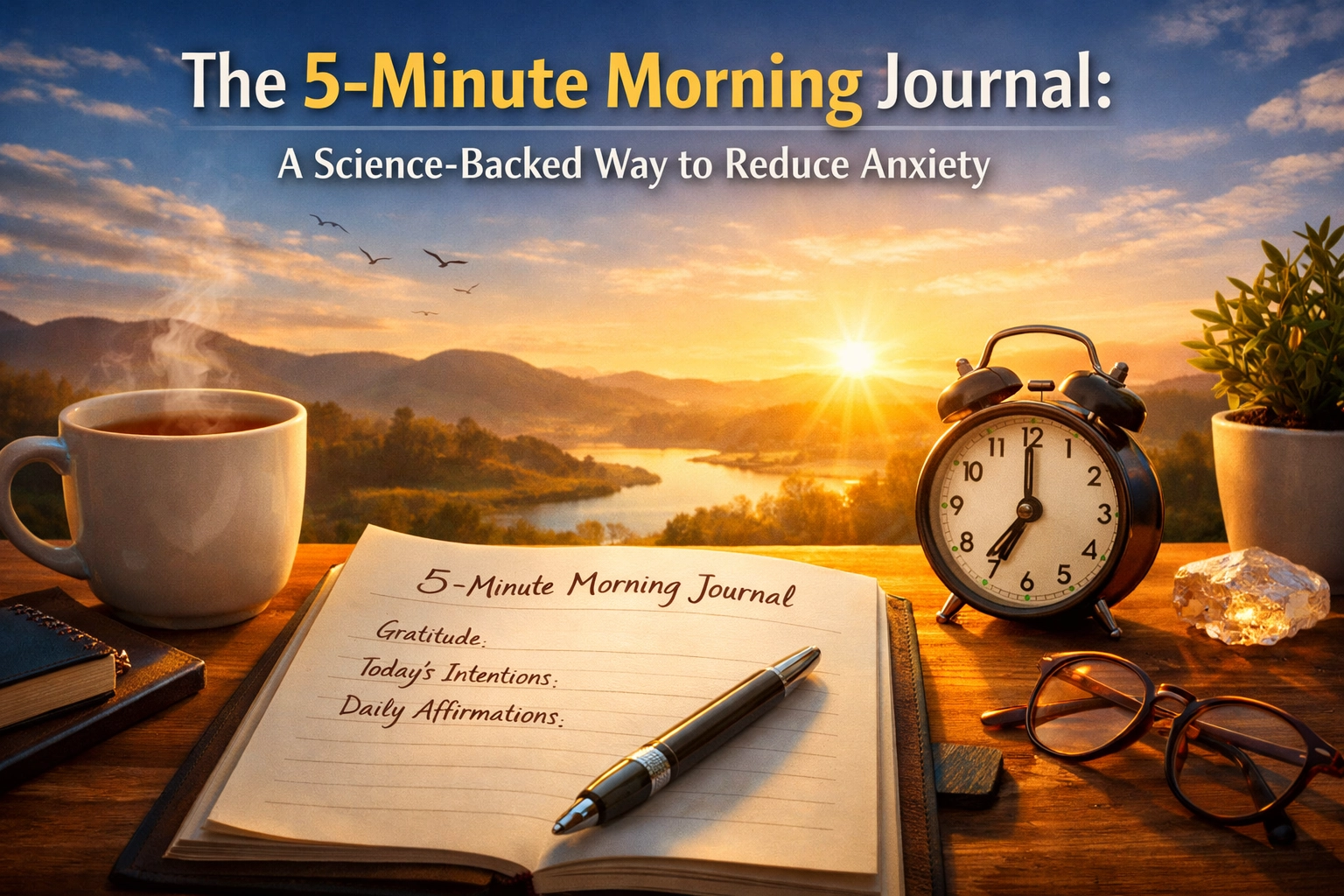
Most people wake up and immediately surrender their cognitive sovereignty to a smartphone. Within 30 seconds of opening your eyes, your brain is flooded with notifications, global catastrophes, and work emails. This triggers an immediate spike in cortisol: the primary stress hormone: on top of the natural "Cortisol Awakening Response" (CAR) that occurs as you wake.
By the time you've finished your first cup of coffee, your nervous system is already in a state of hyper-arousal. The 5-minute morning journal isn't just a "feel-good" habit; it is a tactical intervention designed to intercept this stress response and re-route your neural pathways toward focus and emotional stability.
The Neurobiology of Morning Anxiety
Anxiety in the morning is rarely about a single event. It is usually the result of the HPA (Hypothalamic-Pituitary-Adrenal) axis overcompensating for the transition from sleep to wakefulness. When we experience "morning dread," our amygdala: the brain’s smoke detector: is firing at a high frequency, scanning for threats.
Research in psychoneuroendocrinology shows that individuals who engage in structured expressive writing exhibit lower levels of salivary cortisol. By externalizing the "noise" in your head onto paper, you are performing a process known as Cognitive Offloading. This reduces the load on your working memory, allowing your prefrontal cortex (the CEO of your brain) to take back control from the reactive amygdala.

The 2026 "3-2-1" Framework for Deep Anxiety Reduction
Generic journaling: writing "I feel stressed": often leads to rumination, which can actually increase anxiety. To achieve a therapeutic effect, your journaling must be structured. In 2026, we’ve moved beyond long-form "Dear Diary" entries toward high-efficiency protocols.
The 3-2-1 Morning Framework is designed to take exactly five minutes while hitting the three pillars of neurological recovery: Perspective, Intent, and Catharsis.
1. Three Beats of Radical Gratitude (60 Seconds)
This isn't about being "thankful for sunshine." To trigger a dopamine and serotonin release, you must be specific.
- Bad example: "I'm grateful for my health."
- Science-backed example: "I'm grateful for the way the cold water felt on my face this morning because it made me feel instantly awake."
- The Goal: Shift the brain from a "scarcity mindset" to a "safety mindset."
2. Two Intentions for Cognitive Clarity (60 Seconds)
Anxiety thrives on ambiguity. By defining exactly what a "win" looks like for the day, you eliminate the "choice paralysis" that fuels mid-morning panic.
- Intent 1: A work-related objective (e.g., "Complete the draft for the longevity project").
- Intent 2: A self-regulation objective (e.g., "Take three deep breaths before every meeting").
3. One "Brain Dump" Anxiety Release (3 Minutes)
This is the most critical step for anxiety reduction. You must identify the "Single Point of Friction" for the day. Write down the one thing that is making your chest feel tight. Once it is on paper, your brain no longer has to loop the thought to "remind" you of the threat.
| Element | Focus Area | Neurological Benefit |
|---|---|---|
| Gratitude | Ventromedial Prefrontal Cortex | Increases Serotonin; counters negativity bias. |
| Intentions | Executive Function | Reduces "decision fatigue" and lowers cortisol. |
| Brain Dump | Amygdala Down-regulation | Physicalizes abstract fears; stops rumination loops. |

Why Analog Trumps Digital for Mental Fitness
In an era of AI-integrated note-taking and voice-to-text, the humble pen and paper remain the superior tool for anxiety management. This is due to Haptic Feedback and the "Encoding Hypothesis."
When you write by hand, the brain receives complex tactile feedback. This involves a much larger network of neural activity than typing. Studies have shown that the physical act of forming letters slows down the thought process just enough to prevent the "racing thoughts" associated with anxiety. It forces a linear progression of ideas.
Furthermore, using a digital device for journaling introduces the risk of "Context Switching." A single notification on your tablet while you are trying to de-stress can negate the entire session by re-triggering the sympathetic nervous system.
Data-Driven Insights: The Impact of Journaling on HRV
For the biohackers and fitness enthusiasts, the most compelling evidence for morning journaling lies in Heart Rate Variability (HRV). HRV is the gold standard metric for measuring autonomic nervous system balance.
Data from wearable users in 2025-2026 consistently shows that individuals who practice structured morning reflection have a higher "Recovery Score" and a more balanced HRV. By calming the nervous system early, you increase your "Stress Buffer," meaning you can handle more physical and mental load throughout the day without hitting a breaking point.

Overcoming the "Blank Page" Syndrome
The biggest barrier to consistency is the friction of starting. To turn this into a permanent habit, use Habit Stacking, a concept popularized in behavioral psychology.
- The Trigger: Your morning coffee or tea.
- The Action: While the coffee brews or during the first three sips, the journal is already open on the table.
- The Minimum Viable Effort: If you are in a rush, write just one sentence for each category. Consistency is more important than depth during the habit-formation phase.
Advanced Prompts for High-Stress Days
If you wake up in a state of high-functioning anxiety, swap the 3-2-1 method for these targeted prompts:
- "What is a story I am telling myself right now that might not be true?"
- "If I had half the energy I have now, what is the one thing I would still get done?"
- "What is one thing I can control in the next hour?"

Common Pitfalls to Avoid
- Self-Censorship: Your journal is not for an audience. If you are worried about someone reading it, you won't be honest. If your brain dump feels "ugly" or "irrational," that means it’s working. You are clearing the "cache" of your mind.
- 追求 Perfectionism: Don't worry about grammar or handwriting. This is a biological tool, not a literary exercise.
- Skipping Days: If you skip a day, don't compensate by writing twice as much the next day. Just get back to the 5-minute protocol immediately.
The 24-Hour Loop: Morning vs. Evening
While the morning journal focuses on priming and reduction, an evening journal focuses on processing and closure. For those with severe anxiety or insomnia, combining the 5-minute morning journal with a 2-minute "Evening Review" creates a closed-loop system for the brain.
In the evening, simply list three things that went well. This helps transition the brain from the "doing" mode of the day to the "being" mode required for deep, restorative sleep.

Summary: Your Tactical Morning Checklist
To begin your journey toward a low-anxiety 2026, follow this protocol starting tomorrow:
- Acquire a dedicated physical journal (dot grid or blank).
- Place it where you drink your morning beverage.
- Set a timer for 5 minutes.
- Execute the 3-2-1 Framework:
- 3 Specific Gratitudes.
- 2 Clear Intentions.
- 1 Brain Dump/Anxiety Release.
- Close the book and move into your day with cognitive sovereignty.
Anxiety is often just the brain's way of asking for a plan. Give it the plan it needs in five minutes, and it will leave you alone for the other 1,435 minutes of the day.
About the Author: Malibongwe Gcwabaza
Malibongwe Gcwabaza is the CEO of blog and youtube and a leading voice in the 2026 longevity and bio-optimization movement. With a background in strategic leadership and a passion for functional wellness, Malibongwe focuses on bridging the gap between high-performance business tactics and neuro-biological health. He advocates for "simple yet deep" interventions that allow busy professionals to reclaim their mental clarity and physical vitality. When not analyzing the latest in GEO or metabolic flexibility, he can be found practicing what he preaches: Zone 2 training and, of course, his daily 5-minute morning journal.
About the Author