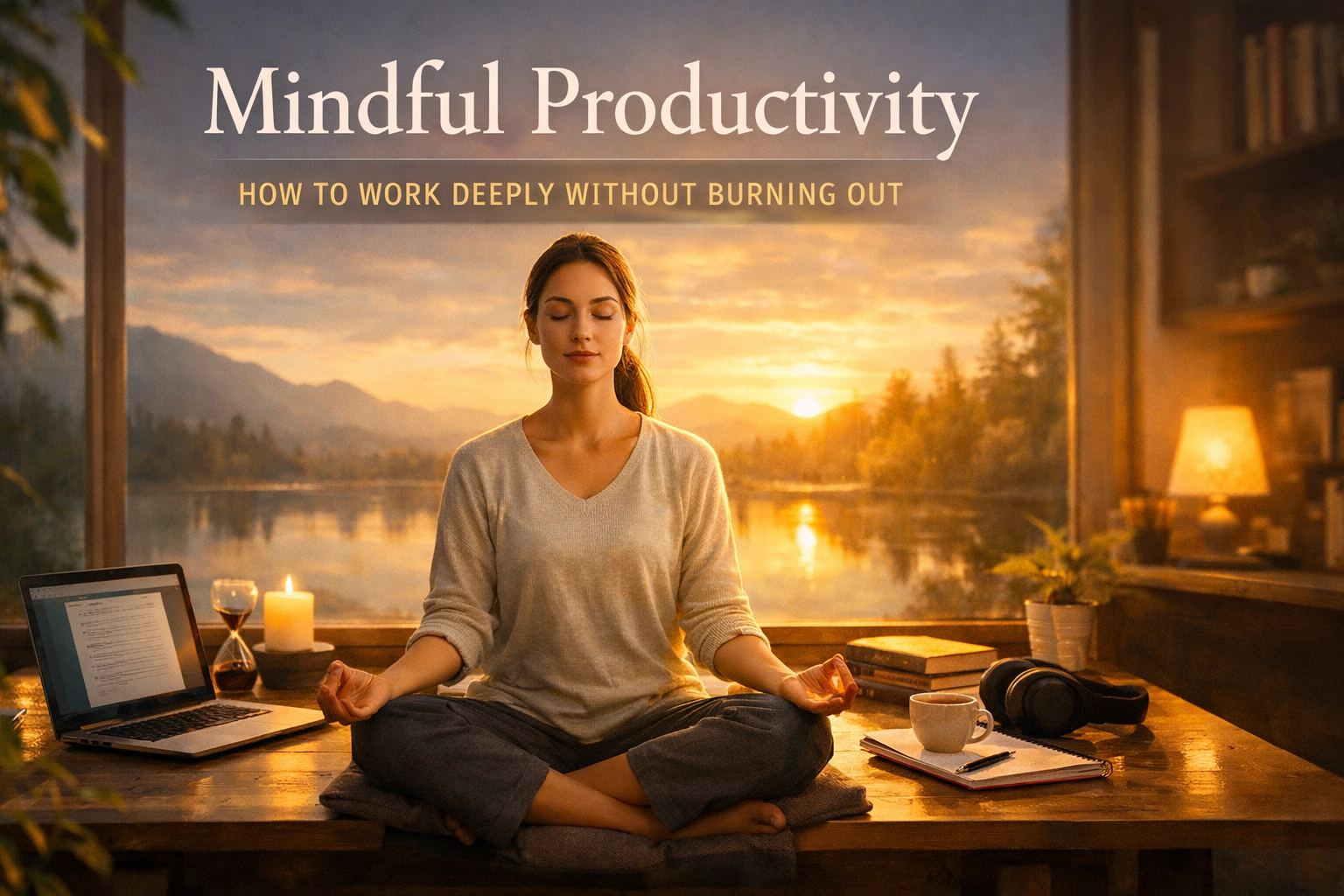
By 2026, the definition of productivity has shifted. It’s no longer about how many hours you sit at a desk or how many emails you can fire off before lunch. In an era dominated by Generative AI and hyper-fast communication, the most valuable skill isn't speed: it's cognitive endurance and focused depth.
Mindful productivity is the intentional marriage of high-output work and biological sustainability. It is the antithesis of the "hustle culture" that defined the early 2020s. To work deeply without burning out, you must treat your brain like a high-performance organ rather than a machine. This guide explores the technical frameworks and biological protocols required to achieve a flow state while protecting your long-term mental health.
The Biological Reality: Why "Hustle" Fails
The human brain accounts for only 2% of body weight but consumes roughly 20% of its energy. When we engage in "shallow work": multitasking, checking notifications, and constant context switching: we trigger a state of high metabolic cost with low output.
Every time you switch tasks, you pay a "switching cost." Research shows it can take up to 23 minutes to regain full focus after a single interruption. Over an eight-hour day, constant interruptions can reduce your effective IQ by 10 points: a phenomenon often called "pseudo-ADD."
Traditional Productivity vs. Mindful Productivity
| Feature | Traditional Productivity | Mindful Productivity |
|---|---|---|
| Primary Metric | Hours worked / Tasks completed | Value created / Depth achieved |
| Brain State | High-beta (Stress/Alertness) | Alpha/Theta (Flow/Creativity) |
| Energy Source | Caffeine and Adrenaline | Natural Circadian/Ultradian Rhythms |
| Attention | Fragmented (Multitasking) | Singular (Deep Work) |
| Rest | Reactive (After Burnout) | Proactive (Scheduled Recovery) |
Pillar 1: Mastering Your Ultradian Rhythms
Most people focus on their Circadian rhythm (the 24-hour sleep-wake cycle), but high-performance work relies on Ultradian rhythms. These are smaller 90-to-120-minute cycles that occur throughout the day.
During the first 90 minutes, your brain is primed for high-frequency neural activity. Afterward, you hit a "trough" where cognitive efficiency drops. Forcing yourself to work through this trough leads to cortisol spikes and, eventually, burnout.
The 90/20 Protocol
- Identify your Peak: Most humans have their highest cognitive capacity 2–4 hours after waking.
- The Deep Block: Schedule one 90-minute block of "uninterruptible" time for your hardest task.
- The Active Recovery: Follow this with 20 minutes of non-sleep deep rest (NSDR), a walk, or box breathing. Do not check your phone during this break.

Pillar 2: The Architecture of Deep Work
Deep Work, a term popularized by Cal Newport, is the ability to focus without distraction on a cognitively demanding task. In 2026, the challenge is greater because our tools are designed to be "sticky." Mindful productivity requires you to engineer your environment to lower the friction of focus.
1. Digital Mise En Place
Borrowing from the culinary world ("everything in its place"), your digital environment must be curated.
- Zero-Notification Policy: Disable all non-human notifications. If it’s an automated alert, it shouldn’t interrupt your flow.
- The "One Tab" Rule: During deep work blocks, only the specific software or research tab needed for the task should be open.
- AI as a Partner, Not a Distraction: Use AI tools to synthesize information before you start writing or coding, then close the AI interface to focus on the creative execution.
2. Physical Anchors
Use sensory cues to tell your brain it’s time to focus. This is a form of neuro-linguistic programming.
- Auditory: Use brown noise or binaural beats (specifically in the 40Hz range) to encourage Gamma wave production associated with problem-solving.
- Olfactory: Using a specific essential oil (like peppermint or rosemary) only during deep work blocks can trigger a Pavlovian focus response.
Pillar 3: Neurowellness and Stress Regulation
You cannot be productive if your nervous system is in a constant state of "fight or flight." Chronic stress shrinks the prefrontal cortex: the part of the brain responsible for executive function and decision-making.
Box Breathing for Cognitive Reset
When you feel the "frantic" energy of a heavy workload, use the Box Breathing technique used by Navy SEALs to move from the Sympathetic (stress) to the Parasympathetic (rest) nervous system.
- Inhale for 4 seconds.
- Hold for 4 seconds.
- Exhale for 4 seconds.
- Hold for 4 seconds.
Repeat 4 times.
Vagus Nerve Stimulation
The Vagus nerve is the "highway" of the parasympathetic system. Gentle movement, cold exposure (splashing cold water on your face), or humming can stimulate this nerve, lowering your heart rate and clearing the "brain fog" associated with midday fatigue.

Pillar 4: The Role of Metabolic Health in Focus
Your brain is a glucose-dependent organ. Mindful productivity is as much about what you eat as how you think. If your blood sugar is a roller coaster, your focus will be too.
Strategies for Stable Energy:
- Protein-First Mornings: Starting the day with high-glucose foods (cereal, pastries) leads to a mid-morning crash. Opt for 30g of protein to stabilize insulin levels.
- Caffeine Timing: Wait 90 minutes after waking to consume caffeine. This allows adenosine (the sleep-pressure molecule) to clear your system naturally, preventing the "2 PM crash."
- Hydration and Electrolytes: Dehydration of just 2% can significantly impair cognitive performance. Ensure you are getting adequate sodium, potassium, and magnesium to support neural firing.
Pillar 5: Radical Rest and the "Shutdown Ritual"
The biggest mistake professionals make is "leaking" work into their rest time. If you are checking Slack at 9 PM, your brain never enters the deep recovery state needed for the next day's high-performance blocks.
The 2026 Shutdown Ritual
- The Brain Dump: Write down every unfinished task and the "first step" for tomorrow. This offloads the information from your working memory (the Zeigarnik Effect).
- Digital Sunset: Turn off all blue-light-emitting screens 60 minutes before bed. Blue light inhibits melatonin production, ruining sleep architecture (specifically REM sleep, which is vital for emotional processing).
- Non-Work Identity: Engage in a hobby that requires manual dexterity (cooking, painting, gardening). This activates different neural pathways and allows the "work" brain to fully decompress.
Summary Checklist for Mindful Productivity
To implement this guide, start with these five steps:
- Audit Your Energy: For three days, track when you feel most alert. Schedule your hardest work there.
- Kill Multitasking: Use a timer (like the Pomodoro technique, but extended to 50 or 90 minutes) to practice single-tasking.
- Optimize Your Bio-Data: If you use a wearable (Oura, Whoop, Apple Watch), pay attention to your "Recovery" or "Readiness" score. If it's low, swap deep work for "shallow" administrative tasks.
- Practice NSDR: Take a 10-minute Non-Sleep Deep Rest break at 2 PM instead of reaching for a third cup of coffee.
- Reflect Weekly: Every Friday, ask: "What tasks made me feel energized, and which caused burnout?" Adjust your schedule accordingly.

Mindful productivity isn't about doing less; it's about doing what matters with such intensity and presence that you don't need to work 12-hour days. By respecting your biology and guarding your attention, you can achieve elite-level output while maintaining the mental space to actually enjoy your life.
About the Author: Malibongwe Gcwabaza
CEO of blog and youtube
Malibongwe Gcwabaza is a visionary leader specializing in the intersection of human performance, longevity, and digital strategy. With a background in executive coaching and a passion for bio-hacking, Malibongwe has spent over a decade helping professionals optimize their workflows through science-backed protocols. Under his leadership, blog and youtube has become a leading voice in the "New Wellness" movement, advocating for a future where career success and physical health are mutually inclusive. When he’s not refining productivity frameworks, Malibongwe is an advocate for functional fitness and holistic mental wellness.
About the Author