For decades, the fitness industry told us that if you weren’t spending 60 minutes in the gym, you were essentially wasting your time. We were conditioned to believe in the "threshold" of exercise: that unless your heart rate stayed elevated for a significant duration, the physiological needle wouldn't move.
Recent longitudinal data is turning that old-school thinking on its head.
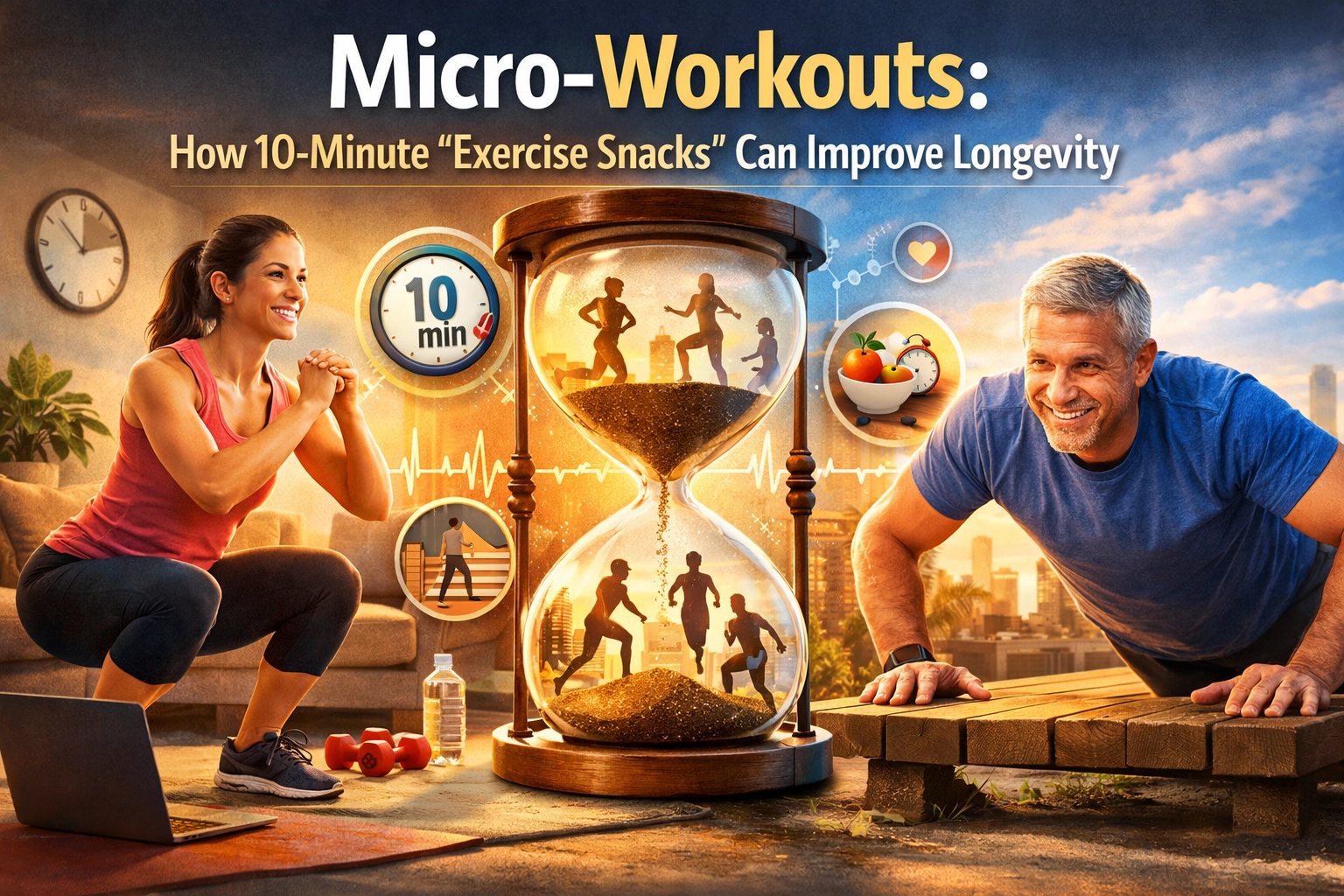
We are entering the era of the Micro-Workout, often referred to in clinical literature as "Exercise Snacks" or VILPA (Vigorous Intermittent Lifestyle Physical Activity). These are brief, 1-to-10-minute bursts of movement that, when performed consistently, offer longevity benefits that rival: and sometimes exceed: traditional steady-state cardio.
If you’re a busy professional or someone who finds the idea of an hour-long treadmill session soul-crushing, this is the most important shift in exercise science you need to understand.
The Science of "Exercise Snacking"
The term "Exercise Snacking" was popularized by researchers looking at how brief periods of activity impact metabolic health. The core premise is that the body’s physiological response to exercise isn’t just about total volume; it’s about the interruption of stasis.
A landmark 2017 study followed over 100,000 participants for nearly a decade. The findings were staggering: just three to four one-minute sessions of vigorous activity per day were associated with a 40% reduction in all-cause mortality and a 49% reduction in cardiovascular-related deaths.

Comparing Micro-Workouts to Traditional Training
To understand why 10 minutes can be as effective as 45 minutes, we have to look at mitochondrial adaptation and VO2 max.
| Metric | Traditional Workout (45-60 min) | Micro-Workout (10 min or less) |
|---|---|---|
| Primary Driver | Volume and Endurance | Intensity and Frequency |
| VO2 Max Impact | High | High (if intensity is maximal) |
| Metabolic Impact | Single glucose dip | Multiple glucose stabilizations |
| Cortisol Response | Potential for long-term elevation | Minimal to none |
| Adherence Rate | Medium (higher barrier to entry) | High (low time commitment) |
Why "Exercise Snacks" Work: The Technical Deep Dive
It seems counterintuitive that a 1-minute sprint or a 10-minute bodyweight circuit could change your cellular biology. However, the mechanisms at play are highly technical and robust.
1. The Interruption of Sedentary Physiology
Even if you hit the gym for an hour every morning, sitting for the next eight hours creates a state of "metabolic gravity." Prolonged sitting suppresses lipoprotein lipase activity (the enzyme that breaks down fat) and decreases insulin sensitivity.
Micro-workouts act as a "system reboot." A study published in the British Journal of Sports Medicine found that just two minutes of light activity every 30 minutes significantly improved postprandial glucose regulation. Essentially, you are clearing the pipes before they get clogged.
2. Mitochondrial Biogenesis
A study from McMaster University proved that one minute of maximum-intensity cycling within a 10-minute window (including warm-up/cool-down) produced the same mitochondrial improvements as 45 minutes of moderate-intensity cycling. These "bursts" stress the mitochondria just enough to trigger repair and growth without the systemic fatigue associated with long-duration cardio.
3. BDNF and Brain Longevity
Exercise is the most potent "nootropic" we have. Movement increases brain blood flow and stimulates the production of Brain-Derived Neurotrophic Factor (BDNF). BDNF is often described as "Miracle-Gro" for the brain. Short bursts of exercise are sufficient to spike BDNF levels, which enhances focus, memory, and long-term cognitive resilience against neurodegenerative diseases.

VILPA: The Longevity Secret Weapon
Vigorous Intermittent Lifestyle Physical Activity (VILPA) is the technical term for the movement you don’t even count as exercise. It’s running for the bus, carrying heavy groceries up three flights of stairs, or playing an intense game of tag with your kids.
A 2023 study published in The Lancet confirmed that even one minute of this type of activity: accumulated up to 10 minutes total throughout the day: reduced heart attack and stroke risk by 29% to 44%.
The "Helpful Content" takeaway here is simple: Longevity isn’t bought in a gym; it’s built in the margins of your day.
How to Build Your Micro-Workout Protocol
If you want to leverage "Exercise Snacks" for longevity, you need a strategy. Simply standing up isn't enough; you need to reach a specific intensity threshold.
The "Snack" Menu
Choose one of these three options to perform 3–5 times per day:
- The Metabolic Reset (1 Minute): Maximum intensity. Think mountain climbers, air squats, or sprinting up a flight of stairs. The goal is to feel out of breath by second 45.
- The Strength Circuit (5 Minutes): 10 push-ups, 15 air squats, 30 seconds of plank. Repeat for 5 minutes. No rest between movements.
- The Mobility Flow (10 Minutes): Perfect for the "Active Couch Potato." Focus on hip openers, thoracic spine rotations, and deep lunges to reverse the damage of sitting.
Implementing the 10-Minute Rule
Research suggests that if you can't do several 1-minute bursts, a single 10-minute session is your "Goldilocks" zone. It’s long enough to induce a meaningful cardiovascular response but short enough to fit between Zoom calls.

Data-Driven Insights: Is it Enough for Weight Loss?
While the longevity and cardiovascular data for micro-workouts are ironclad, the fat-loss data is more nuanced. If your goal is purely aesthetic weight loss, micro-workouts are a powerful supplement, but rarely a total replacement for total daily energy expenditure (TDEE) management.
However, micro-workouts are superior for muscle maintenance during a calorie deficit. By providing frequent "shocks" to the muscle tissue, you signal to the body that the muscle is necessary, preventing the catabolic breakdown that often happens with long-duration cardio.
The "Active Couch Potato" Warning
There is a growing body of research around the "Active Couch Potato" syndrome. This describes individuals who meet the WHO guidelines of 150 minutes of exercise per week but remain sedentary for the remaining 98% of their waking hours.
The data suggests that the negative impact of 8+ hours of sitting cannot be fully undone by a single 60-minute workout. This is where micro-workouts become a non-negotiable part of a longevity strategy. You must break up the sedentary blocks to maintain metabolic flexibility.

Final Thoughts: The Path to 100
Longevity is often framed as a series of expensive supplements and complex biohacks. In reality, the most effective tool we have is the manipulation of our own physiology through movement.
By shifting your perspective from "I don't have time to work out" to "I have 10 minutes to snack on exercise," you are effectively hacking your mortality risk. The cumulative effect of these small sessions creates a resilient cardiovascular system, a sharper brain, and a more efficient metabolism.
Start small. One minute. One flight of stairs. One set of push-ups. Your future self is counting on it.
Author Bio: Malibongwe Gcwabaza
Malibongwe Gcwabaza is the CEO of blog and youtube and a dedicated advocate for health optimization and performance. With a focus on data-driven wellness and sustainable lifestyle shifts, Malibongwe explores the intersection of biotechnology, exercise science, and longevity. His mission is to simplify complex health data into actionable strategies for the modern high-performer. When not analyzing the latest health trends, he can be found testing "exercise snacks" in between board meetings.
About the Author