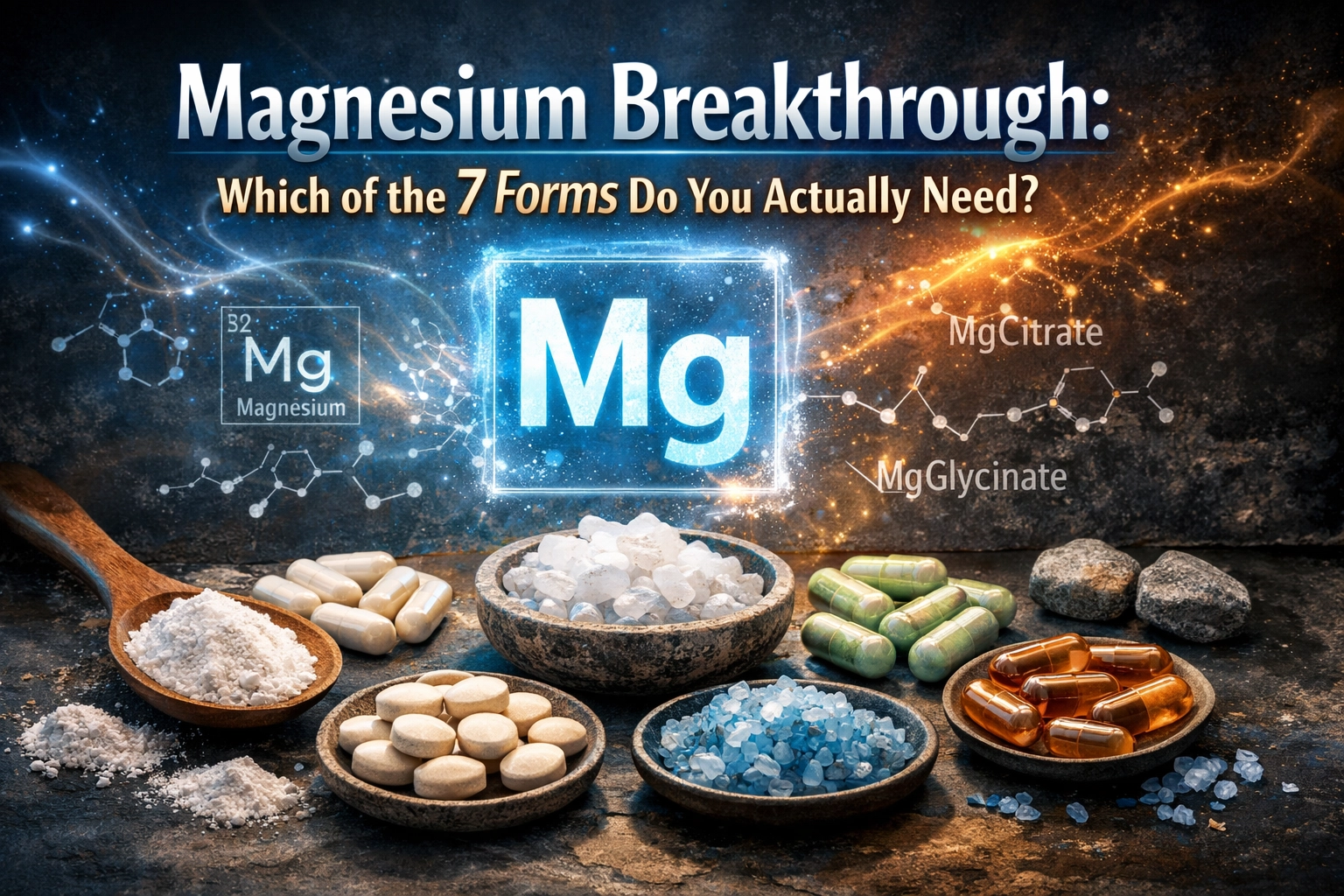
Magnesium is responsible for over 600 enzymatic reactions in the human body. By 2026, the scientific community has moved past the simple question of "Do I need magnesium?" to a much more nuanced one: "Which specific forms am I missing?"
Despite its abundance in nature, modern agricultural practices and soil depletion have made it nearly impossible to get optimal levels from diet alone. Furthermore, the "magnesium" you find on most drugstore shelves is often a low-quality oxide or sulfate that has an absorption rate as low as 4%. To truly optimize your healthspan, you need to understand the distinct "keys" that different magnesium chelates provide to different tissues.
In this deep dive, we are breaking down the seven essential forms of magnesium, the science behind their absorption, and how to structure your supplementation for maximum cellular impact.
The Absorption Crisis: Why One Form Isn't Enough
The biggest mistake in fitness and wellness supplementation is treating magnesium as a monolithic mineral. In reality, magnesium must be "chelated": bound to another molecule: to be absorbed by the gut and transported to specific organs.
Think of the chelating agent (like glycine, taurine, or malic acid) as a GPS coordinate. Depending on what the mineral is bound to, it will be directed toward your brain, your heart, your muscles, or your digestive tract. Taking only one form is like trying to unlock every door in a house with a single key; you might get into the front door, but you’ll be locked out of the bedroom and the kitchen.

The 7 Essential Forms of Magnesium
To achieve what biohackers call "Magnesium Breakthrough" status, you need a spectrum of forms. Here is the technical breakdown of the seven most bioavailable versions available in 2026.
1. Magnesium Bisglycinate (The Relaxation Specialist)
Bound to the amino acid glycine, this is arguably the most popular form for a reason. Glycine is a neurotransmitter that promotes relaxation and improves sleep quality.
- Target Tissue: Brain and Central Nervous System.
- Primary Benefit: Reducing cortisol, improving REM sleep, and lowering anxiety.
- 2026 Insight: New studies show bisglycinate is particularly effective at crossing the blood-brain barrier compared to cheaper alternatives.
2. Magnesium Malate (The ATP Catalyst)
Bound to malic acid, this form is a critical component of the Krebs cycle: the process your body uses to create cellular energy (ATP).
- Target Tissue: Muscle fibers and Mitochondria.
- Primary Benefit: Treating chronic fatigue, improving exercise endurance, and relieving muscle soreness.
- Concrete Example: If you find yourself hitting a "wall" during Zone 2 training, malate is the form that supports sustained oxidative phosphorylation.
3. Magnesium Taurate (The Heart Guardian)
Taurine is an amino acid that supports cardiovascular health. When bound to magnesium, it creates a potent synergy for the heart.
- Target Tissue: Vascular system and Heart muscle.
- Primary Benefit: Regulating blood pressure and protecting the arterial walls.
- Data Point: Clinical trials in late 2025 indicated that Taurate specifically helps in stabilizing arrhythmias in high-performance athletes.
4. Magnesium Citrate (The Metabolic Support)
While often used in high doses as a laxative, in smaller, chelated doses, citrate is excellent for metabolic health.
- Target Tissue: Digestive tract and Bloodstream.
- Primary Benefit: Supporting insulin sensitivity and preventing arterial calcification.
- Note: This form is highly bioavailable but should be balanced to avoid "disaster pants" (digestive urgency).
5. Sucrosomial Magnesium (The Absorption King)
A relatively new entry into the 2026 wellness market, this form uses a phospholipid bilayer (similar to a liposome) to protect the magnesium as it passes through the stomach.
- Target Tissue: Red Blood Cells (Systemic).
- Primary Benefit: Drastically higher absorption rates in individuals with "leaky gut" or compromised digestion.
- Unique Perspective: Research suggests Sucrosomial forms can increase magnesium levels in the blood up to 20% more effectively than glycinate.
6. Magnesium Chelate (The Recovery Specialist)
Often referred to as "elemental" chelate (usually bound to various amino acids), this form is specifically formulated for muscle tissue repair.
- Target Tissue: Skeletal muscle.
- Primary Benefit: Speeding up protein synthesis after resistance training.
7. Magnesium Orotate (The Longevity Molecule)
Orotic acid is a substance used by the body to create DNA and RNA. Orotate is often the most expensive form but is highly coveted by longevity enthusiasts.
- Target Tissue: Heart and DNA repair mechanisms.
- Primary Benefit: Enhanced tissue regeneration and improved cardiac output under stress.

Comparison Table: Which Form for Which Goal?
| Primary Goal | Recommended Form(s) | Bioavailability | Best Time to Take |
|---|---|---|---|
| Deep Sleep & Calm | Bisglycinate | Very High | 30-60m before bed |
| Exercise Performance | Malate, Orotate | High | Pre-workout |
| Heart Health | Taurate | Medium-High | With morning meal |
| Gut Health/Regularity | Citrate | Medium | Anytime |
| Fastest Total Uptake | Sucrosomial | Elite | Anytime |
| Chronic Pain/Fibromyalgia | Malate | High | Morning and Evening |
The Role of Cofactors: Why Magnesium Fails Without Help
Even if you take all seven forms, your body requires specific cofactors to actually utilize the mineral. Think of magnesium as the fuel and cofactors as the spark plugs.
- Vitamin B6 (Pyridoxal-5-Phosphate): This is the "escort" that pulls magnesium into the cell. Without B6, much of your supplement remains in the extracellular fluid and is eventually flushed out.
- Manganese: Essential for the enzymes that work alongside magnesium in bone formation.
- Humic & Fulvic Acid: These organic compounds act as natural ionophores, increasing the permeability of cell membranes so the mineral can actually get inside.

How to Test Your "Real" Magnesium Levels
Most doctors order a Serum Magnesium Test. This is almost entirely useless.
The body regulates blood magnesium levels very tightly; it will literally strip magnesium out of your bones and muscles to keep blood levels stable. By the time your serum levels look "low," you are already in a state of severe cellular depletion.
In 2026, the gold standard is the Magnesium RBC (Red Blood Cell) Test. This measures the amount of magnesium stored inside the cells over the last 3-4 months.
- Optimal Range: Look for 6.0 to 7.0 mg/dL. If you are at 4.0 or 5.0, you are technically in the "normal" range by old standards, but you are likely suffering from subclinical deficiency symptoms like eye twitches, cramps, or palpitations.
The 2026 Protocol: How to Supplement
If you are serious about optimizing your healthspan, don't just grab a random bottle. Follow this protocol:
- Start with a Full-Spectrum Blend: Use a product that combines all 7 forms. This ensures you aren't leaving any tissue "hungry."
- Dose for Stress: Your body "burns" magnesium under stress. If you had a high-intensity workout or a high-stress workday, increase your dose by 100-200mg.
- Avoid Absorption Blockers: Do not take your magnesium with high-phytic acid foods (like unsoaked grains) or alongside a high-dose Calcium supplement, as they compete for the same receptors.
- Listen to Your Bowels: If you experience loose stools, your body is telling you that you’ve reached the "saturation point" for that day. Back off slightly.
Final Thoughts
Magnesium is the foundational mineral for the modern human. Whether you are chasing a faster VO2 Max, trying to heal from chronic "inflammaging," or simply looking for a better night's sleep, the secret lies in diversity. By using a blend of all seven forms: supported by B6 and mineral cofactors: you move from "surviving" to "thriving" at a cellular level.
Author Bio: Malibongwe Gcwabaza
Malibongwe Gcwabaza is the CEO of blog and youtube and a dedicated advocate for functional fitness and longevity science. With a background in data-driven wellness, Malibongwe focuses on deconstructing complex physiological processes into actionable protocols for high-performers. When not researching the latest in bio-monitoring technology, he can be found practicing "The Centenarian Decathlon" and experimenting with advanced nutritional strategies to optimize healthspan. His mission is to bridge the gap between clinical research and everyday wellness.
About the Author