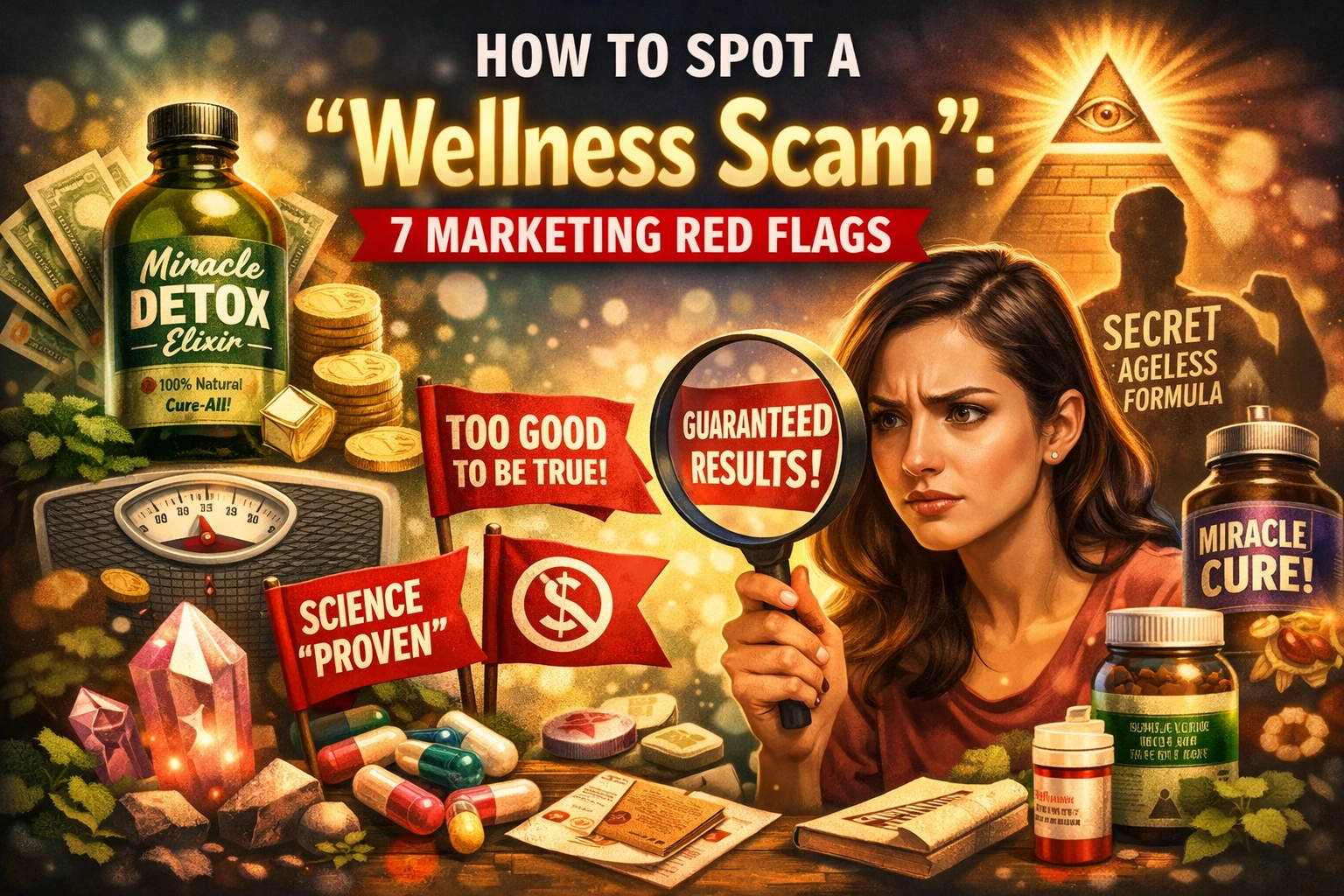
The global wellness industry is projected to exceed $7 trillion by the end of 2026. While this growth has brought us incredible breakthroughs in longevity, biotechnology, and personalized nutrition, it has also created a massive playground for bad actors. In an era where AI-generated influencers can shill supplements and deepfake videos can make it look like your favorite doctor is endorsing a "miracle" weight-loss gummy, the ability to discern fact from fiction is no longer just a skill: it is a necessity for your physical and financial health.
Modern wellness scams are sophisticated. They don't always look like "snake oil" anymore; they look like high-end clinical research, sleek SaaS platforms, and "bio-hacking" breakthroughs. To help you navigate this complex landscape, this guide breaks down the seven most critical marketing red flags used by predatory brands in 2026.
1. Miraculous Claims and Biological Impossibilities
The most common red flag remains the promise of "instant" or "miraculous" results. Human biology is a system of slow, adaptive changes. Whether you are looking at muscle hypertrophy, fat oxidation, or cognitive enhancement, the body requires time to respond to stimuli.
Scams frequently target pain points that people want fixed immediately: aging, weight, and chronic fatigue. If a product promises a "10lb weight loss in 3 days" or "reversing 20 years of aging in a week," it is ignoring the fundamental laws of physiology.
Realistic vs. Scammy Timelines: A Comparison
| Goal | Realistic Timeline (Evidence-Based) | Scammy Marketing Claim |
|---|---|---|
| Fat Loss | 0.5–2 lbs per week (Sustainable) | "Lose 15 lbs in 7 days without exercise" |
| Muscle Gain | 1–2 lbs of lean mass per month | "Pack on 10 lbs of muscle in 2 weeks" |
| Skin Renewal | 28–40 days (Cellular turnover cycle) | "Erase deep wrinkles overnight" |
| Gut Healing | 4–12 weeks (Microbiome shift) | "Instantly bloat-free in 24 hours" |
If the marketing bypasses the biological "waiting period," the only thing getting lighter is your wallet.
2. Pseudoscientific "Technobabble"
In 2026, scammers have moved beyond simple buzzwords to "technobabble": the use of complex, scientific-sounding language to mask a lack of actual data. By using terms like "quantum resonance," "cellular vibration," or "proprietary bio-frequency," brands attempt to bypass your critical thinking by making you feel like you aren't "smart enough" to understand the breakthrough.
Common Red-Flag Terms:
- "Toxin Flushing": Unless you have acute heavy metal poisoning or kidney failure, your liver and kidneys are already "flushing" toxins 24/7.
- "Resonance Alignment": Often used in "wearable energy" scams that have no electrical components.
- "Secret Proprietary Blend": While some companies protect formulas, most use this to hide "pixie-dusting": adding a tiny, ineffective amount of an expensive ingredient just to list it on the label.

3. The Transparency Gap: Missing Certificates of Analysis (COAs)
A professional, legitimate health company in 2026 should be an open book. With the rise of at-home testing and consumer-led bio-monitoring, there is no excuse for a brand to hide its testing data.
High-quality supplement brands provide a Certificate of Analysis (COA) from a third-party laboratory (like NSF, USP, or Informed-Sport). A COA proves that what is on the label is actually in the bottle and, more importantly, that the product is free from heavy metals, mold, and contaminants.
The Red Flag: If you ask a company for third-party lab results and they tell you the information is "confidential," "proprietary," or "currently being updated," walk away. Genuine transparency is the cornerstone of trust in the health space.
4. Artificial Urgency and High-Pressure Sales Tactics
Scammers rely on the "Amvgdala Hijack": triggering a fear response that overrides the logical prefrontal cortex. They do this through artificial scarcity and urgency.
You have likely seen these "Dark Patterns" in web design:
- Fake Countdown Timers: "Offer expires in 04:59!" (The timer resets if you refresh the page).
- Fabricated Social Proof: Pop-ups saying "Sarah from New York just bought 5 bottles!" These are often generated by simple scripts, not real sales.
- The "One-Time Offer" Trap: Claiming you can never get this price again to prevent you from leaving the site to do independent research.

5. The Rise of "Influencer-Washing"
In the past, we had celebrity endorsements. Today, we have "expert-washing." This occurs when a brand hires someone with a generic "Dr." title (who may be a doctor of a completely unrelated field) to stand in a lab coat and read a script.
Furthermore, the "Bio-Hacker Influencer" ecosystem is rife with undisclosed sponsorships. In 2026, AI deepfakes have made this worse. Scammers can now scrape footage of legitimate longevity experts and use AI to change their speech, making it appear as though they are endorsing a specific supplement.
How to verify:
- Check the expert's actual credentials on LinkedIn or university registries.
- Look for the "Paid Partnership" tag.
- Search for the expert's name + "scam" or "endorsement" to see if they have issued a statement denying involvement.
6. The "Natural" and "Organic" Fallacy
The "Appeal to Nature" is a logical fallacy that assumes anything "natural" is good and anything "synthetic" is bad. Scammers exploit this by using green packaging, images of leaves, and the word "organic" to imply safety.
The Reality Check:
- Cyanide is natural and organic.
- Lead is natural.
- Botulinum toxin (the most poisonous substance known) is natural.
A product being "natural" does not mean it is safe, effective, or regulated. Many of the most dangerous weight-loss supplements found by the FDA contain "natural" herbal stimulants that cause severe heart palpitations or liver damage. Always look for the specific chemical compound and its safety profile, not just the "natural" marketing fluff.

7. The Subscription Trap and "Free Trial" Scams
This is the most common financial red flag. A company offers a "free trial" where you only pay $4.95 for shipping. However, buried in the 5,000-word Terms and Conditions is a clause stating that by paying for shipping, you are agreeing to a monthly subscription of $99.99 that begins in 14 days.
These companies make it intentionally difficult to cancel, often requiring you to call a phone number that stays on hold for hours or sending you through a "cancellation maze" of 20+ pages.
The 2026 Checklist for Vetting a Wellness Brand
Before you hit "Buy Now," run the product through this checklist:
- Search the "WHOIS" Database: Check when the website was created. Many scam sites are less than 90 days old.
- Reverse Image Search: Take the "Before and After" photos and drop them into Google Images. You’ll often find the same photos used for 10 different products.
- Check the Refund Policy: Legitimate companies usually offer a 30-to-90-day money-back guarantee because they trust their product works.
- Examine the "Science" Page: Does it link to actual peer-reviewed studies on PubMed, or does it just link to other pages on their own website?
- Look for the "Third-Party Tested" Seal: Specifically NSF, USP, or BSCG.

Final Thoughts: Protecting Your Healthspan
In the pursuit of longevity and wellness, your most valuable asset isn't a supplement or a wearable: it's your skepticism. The "Ultimate Guide" to your health shouldn't be written by a marketing department; it should be built on a foundation of repeatable habits: sleep, movement, whole foods, and stress management.
When a new product claims to replace those fundamentals with a "secret hack," it is almost certainly a scam. Invest in the basics, and treat every marketing claim as "guilty until proven innocent" by hard data.
Author Bio: Malibongwe Gcwabaza
Malibongwe Gcwabaza is the CEO of blog and youtube and a leading voice in the 2026 health tech landscape. With over a decade of experience navigating the intersection of biotechnology and consumer wellness, Malibongwe is dedicated to debunking "junk science" and helping readers build a data-driven approach to longevity. When not auditing the latest bio-hacking trends, he focuses on high-performance athletics and metabolic health research.
About the Author