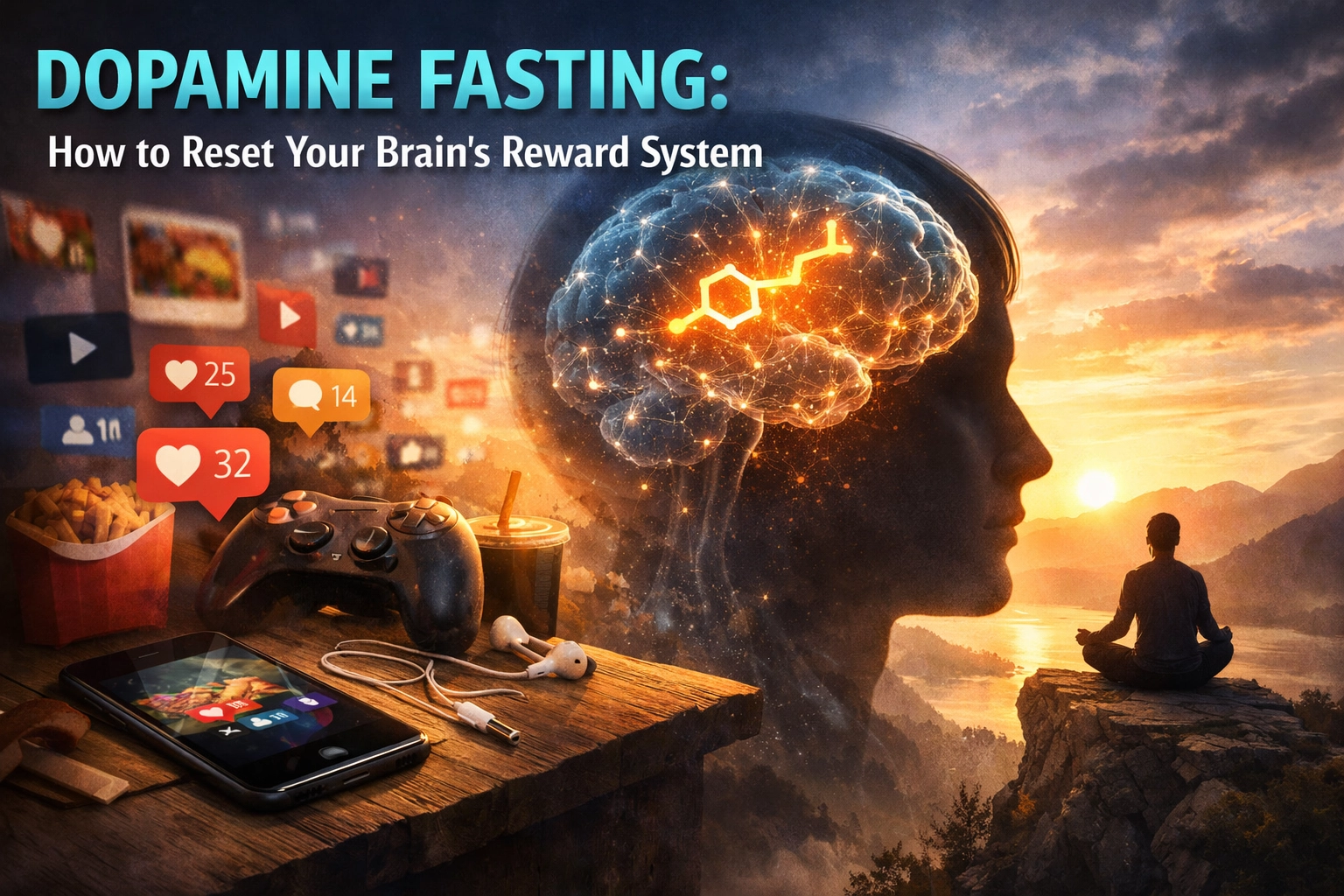
In 2026, we live in a world of "engineered hyper-stimulation." From AI-curated short-form video feeds that predict your next laugh to ultra-processed foods designed for "bliss point" consumption, our brains are under constant bombardment. If you find yourself scrolling through your phone while a movie plays in the background: and you’re still bored: you aren't lazy. Your reward system is likely suffering from "receptor downregulation."
This guide dives deep into the science of dopamine fasting (or more accurately, dopamine calibrating). We will explore how to reclaim your focus, reset your baseline for pleasure, and use the latest neurological research to build a more resilient mind.
The Neurobiology of Modern Craving
To understand why a "fast" is necessary, we have to look at how dopamine actually works. Contrary to popular belief, dopamine isn't the "pleasure molecule." It is the molecule of anticipation, motivation, and pursuit.
When you expect a reward (like a notification or a sugary snack), your brain releases a surge of dopamine. In the wild, this drove us to hunt and gather. In 2026, it drives us to check our smart-glasses every 15 seconds.
Tonic vs. Phasic Dopamine
Our brains maintain two types of dopamine levels:
- Tonic Levels: The steady "baseline" amount of dopamine circulating in your system. This dictates your general level of motivation and well-being.
- Phasic Spikes: Sharp, short-lived bursts of dopamine in response to immediate rewards.
The problem arises when we experience too many phasic spikes. To protect itself from over-stimulation, the brain reduces the number of available dopamine receptors ($D_2$ receptors). This is known as downregulation. When your receptors are downregulated, your tonic (baseline) level feels like a "low," leading to chronic boredom, lack of focus, and an inability to enjoy simple pleasures like a sunset or a long-form book.
What Dopamine Fasting Actually Is (and Isn't)
The term "Dopamine Fasting," popularized by Dr. Cameron Sepah, is often misunderstood. You cannot literally "fast" from dopamine: it is a vital neurotransmitter required for basic motor function and survival.
Instead, it is a clinical technique based on Cognitive Behavioral Therapy (CBT) called "stimulus control." The goal is to restrict specific behaviors that trigger impulsive, addictive-loop responses. By removing the high-intensity triggers, you allow your $D_2$ receptors to "upregulate" again, making you more sensitive to lower-intensity stimuli.
The 2026 High-Stimulus Trigger List
| Activity Category | Why it’s High-Stimulus | Impact on Focus |
|---|---|---|
| Algorithmic Feeds | Intermittent reinforcement (never knowing what's next). | High: Fragments attention span. |
| Digital Gambling/Trading | High financial stakes + visual "wins." | Extreme: Risks long-term receptor damage. |
| Ultra-Processed Foods | High fat/sugar combos that bypass satiety signals. | Moderate: Leads to "food noise" and brain fog. |
| Pornography | Novelty-seeking at an unnatural scale. | High: Distorts real-world intimacy. |
| Hyper-Productivity Tech | Constant pings from AI assistants and "urgent" tasks. | Moderate: Increases cortisol and anxiety. |
The Step-by-Step 2026 Protocol for a Reward Reset
If you feel "fried" or unable to complete deep-work tasks, a structured reset is necessary. We recommend a tiered approach based on your level of burnout.
Tier 1: The Daily Wind-Down (Beginner)
This is for maintenance.
- Duration: 2 hours before bed.
- The Rules: No screens (including wearables), no work-related thinking, and no snacking.
- The Goal: Lowering cortisol and allowing tonic dopamine to stabilize before sleep.
Tier 2: The 24-Hour Reset (Intermediate)
This should be performed once a month.
- Duration: One full weekend day (e.g., Sunday).
- The Rules: No internet, no phone, no TV, no caffeine, no processed sugar.
- Allowed Activities: Walking in nature, journaling with pen and paper, meditation, light stretching, and eating simple, single-ingredient foods.
- The Experience: You will feel intense boredom around hour four. This is the "healing crisis" where your brain begins to look for internal stimulation rather than external "hits."
Tier 3: The 72-Hour "Digital Detox" (Advanced)
This is for those experiencing significant burnout or "anhedonia" (the inability to feel pleasure).
- Duration: Friday evening to Monday morning.
- The Rules: Complete disconnection from all digital interfaces. Minimal talking, maximal solitude.
- Scientific Insight: Research suggests that 48–72 hours is the minimum threshold required for significant neuroplastic changes to begin in the prefrontal cortex.

Enhancing the Reset: Data-Driven Strategies
To make your dopamine fast more effective, you can pair it with biological "stacking" techniques that promote neuroplasticity.
- Cold Exposure: Taking a 2-minute cold plunge or cold shower has been shown to increase baseline (tonic) dopamine levels by up to 250%. Unlike the "spike and crash" of social media, this increase is sustained for several hours.
- Magnesium L-Threonate: This specific form of magnesium crosses the blood-brain barrier and supports synapse density, helping the brain "rewire" during the fast.
- The "Default Mode Network" Activation: When you stop consuming, your brain switches to the Default Mode Network (DMN). This is where creativity and "aha!" moments happen. By embracing boredom during your fast, you are literally training your brain to be more creative.
Common Pitfalls and How to Avoid Them
1. The "Rebound" Effect
Many people finish a 24-hour fast and immediately spend 5 hours on TikTok to "reward" themselves. This creates a massive dopamine spike that causes even deeper downregulation.
- Solution: Create a "re-entry plan." Decide ahead of time which apps you will allow back and for how long.
2. Extreme Isolation
Dopamine fasting shouldn't mean becoming a hermit. Healthy social interaction (face-to-face) releases oxytocin and stable levels of dopamine.
- Solution: Keep your fast focused on artificial stimulants, not human connection.
3. The "Productivity" Trap
Don't use a dopamine fast as just another way to "hack" your output. If the goal is always more work, you are still stuck in a stress-pursuit cycle.
- Solution: Focus on presence rather than performance.

Measuring Success: How Do You Know It’s Working?
You don't need a brain scan to know your reward system is recalibrating. Look for these signs:
- Increased "Subtle" Pleasure: You find yourself enjoying the taste of a plain apple or the sound of the wind.
- Improved Task Initiation: You no longer need to "get in the mood" or scroll for 20 minutes before starting a difficult work project.
- Reduced "Phantom Vibrations": You stop feeling like your phone is buzzing when it isn't.
- Better Emotional Regulation: You are less reactive to minor stressors or negative comments online.
Summary Checklist for Your First Fast
- Define your "No-Go" list: (e.g., No Instagram, No DoorDash, No Netflix).
- Stock up on "Low-Dopamine" essentials: Books, journals, high-quality tea, and simple whole foods.
- Alert your circle: Tell people you will be offline so you don't feel the "anxiety of the unanswered message."
- Embrace the Boredom: When the itch to check your phone hits, sit with it. Observe the physical sensation of the craving. It usually passes in 90 seconds.
Dopamine fasting is not about living a life of deprivation; it’s about reclaiming your sovereignty in an age of digital capture. By occasionally stepping away from the "noise," you give your brain the space it needs to remember how to find joy in the "signal."
Author Bio: Malibongwe Gcwabaza
CEO & Wellness Strategist
Malibongwe Gcwabaza is the founder and CEO of blog and youtube, a leading digital platform dedicated to the intersection of high-performance living and neurological health. With a background in organizational leadership and a passion for bio-monitoring, Malibongwe focuses on how humans can maintain their "edge" in an increasingly automated and hyper-stimulated world. He believes that the most valuable currency in 2026 is not data, but focused attention. When he isn't researching longevity protocols, he can be found practicing "The Centenarian Decathlon" or exploring the latest in neuro-athletic training.
About the Author