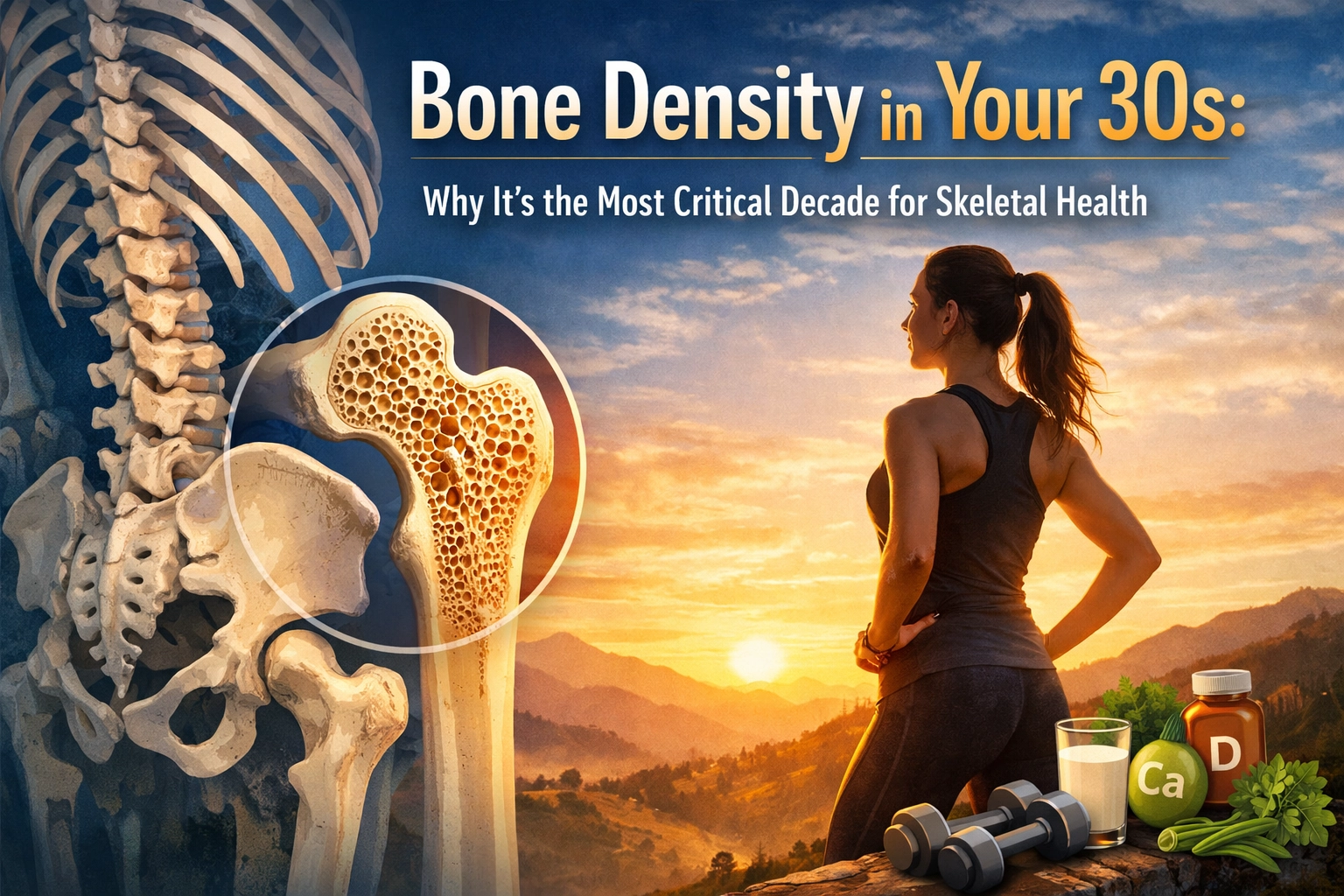
Most people don’t think about their bones until something snaps. We treat our skeleton like the frame of a house: hidden, sturdy, and permanent. But in reality, your bones are living tissue, more like a high-yield savings account than a static piece of lumber. By the time you hit your 30s, you’ve reached a biological crossroads. This is the decade where the "deposits" to your bone bank slow down, and the "withdrawals" begin to accelerate.
If your 20s were about building your skeletal foundation, your 30s are about defending it. In the world of longevity science in 2026, we now recognize that bone density is one of the strongest predictors of healthspan. If you lose the "skeletal war" in your 30s, you are essentially pre-ordering a fracture in your 70s.
The Biology of the Tipping Point: Peak Bone Mass (PBM)
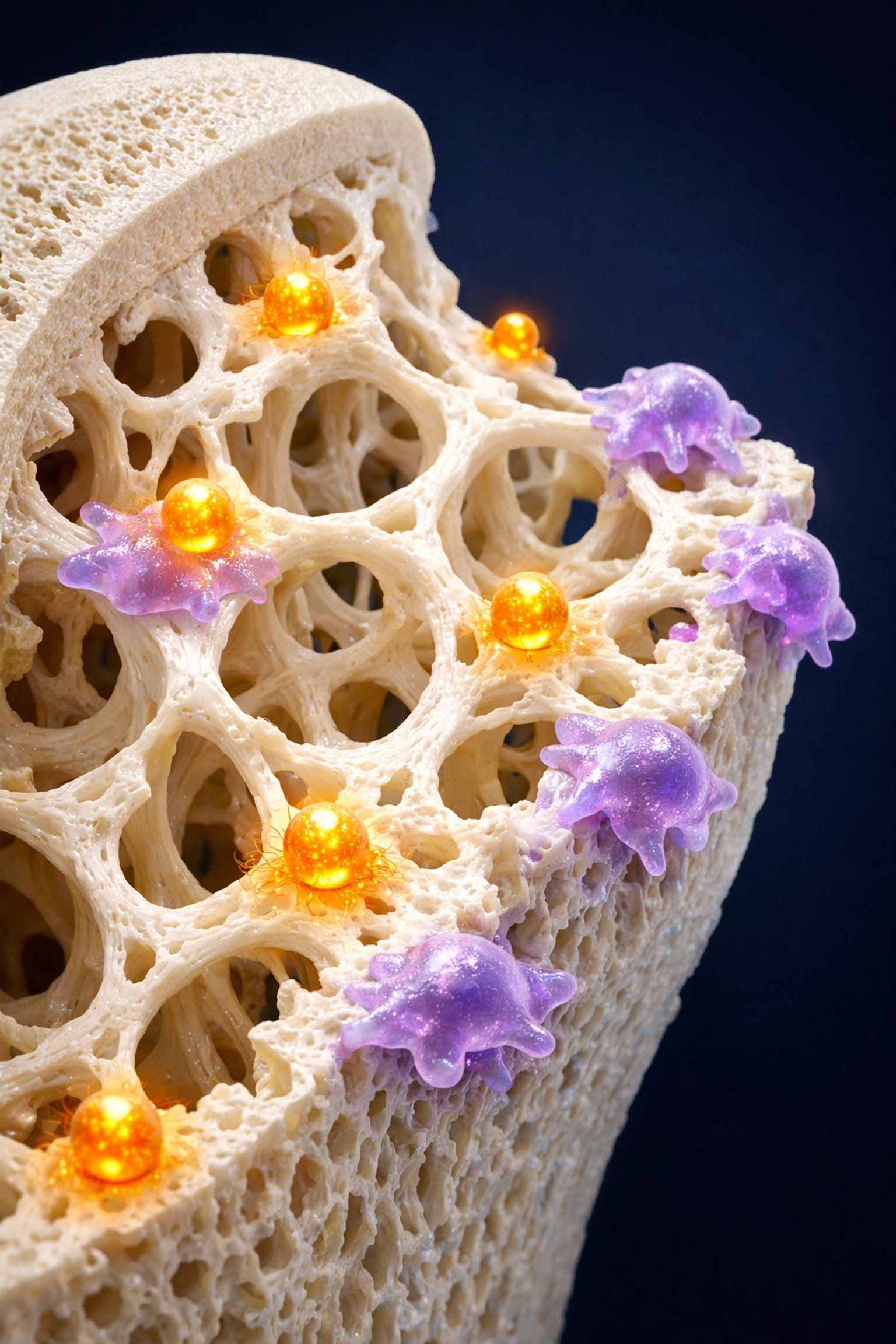
To understand why your 30s matter, we have to look at the cellular machinery of bone remodeling. Your skeleton is constantly being broken down and rebuilt through two primary types of cells:
- Osteoclasts: These are the "demolition crew." They break down old, brittle bone tissue (resorption).
- Osteoblasts: These are the "construction crew." They lay down new mineralized bone (formation).
During your teens and early 20s, the construction crew is working overtime. You are in a state of net gain. Research shows that roughly 90% of peak bone mass is acquired by age 18 in girls and age 20 in boys. However, the window doesn't slam shut immediately. You continue to make small gains until your late 20s.
Once you cross the threshold into your 30s, the demolition crew (osteoclasts) begins to outpace the construction crew (osteoblasts). This is the "Tipping Point."
Bone Density Lifecycle: A Snapshot
| Life Stage | Bone Activity Status | Primary Goal |
|---|---|---|
| Ages 0-20 | Rapid Growth / Net Gain | Maximize Peak Bone Mass (PBM) |
| Ages 20-30 | Consolidation / Equilibrium | Finalize PBM and stabilize structure |
| Ages 30-45 | Early Maintenance / Slow Loss | Prevent "Leaking" of density; start defense |
| Ages 50+ | Accelerated Loss (especially post-menopause) | Mitigation and fracture prevention |
Why the 30s are the "Golden Window" for Preservation
You might wonder: If I can't build much more bone after 30, why is this decade the most critical?
The answer lies in the rate of decay. If you enter your 30s with high bone density but live a sedentary, nutrient-poor lifestyle, you can lose up to 1% of your bone mass per year. By the time you reach age 50, you’ve lost 20% of your structural integrity before you’ve even hit the accelerated loss phase of menopause or andropause.
In your 30s, your body is still resilient. Your hormonal profile (Estrogen and Testosterone) is generally high enough to support bone maintenance. If you intervene now, you can effectively "freeze" your bone density in place, ensuring that when the inevitable decline of your 50s and 60s hits, you are starting from a much higher baseline.
The "Big Five" Nutrients for Skeletal Defense
Forget the old "drink your milk" advice. Skeletal health in 2026 is a complex orchestration of minerals and vitamins that work synergistically. If you take Calcium alone, you might actually be doing more harm than good (calcifying your arteries instead of your bones).
1. Calcium: The Raw Material
You need roughly 1,000mg to 1,200mg daily. However, the source matters. Bioavailable calcium from sardines (with bones), leafy greens, and high-quality dairy is superior to carbonate-based supplements which have poor absorption rates.
2. Vitamin D3: The Gatekeeper
Without D3, your gut cannot absorb calcium. In 2026, we aim for "optimal" levels (50–80 ng/mL) rather than just "sufficient" levels. D3 acts as a hormone that signals the intestines to pull calcium into the bloodstream.
3. Vitamin K2 (MK-7): The Traffic Controller
This is the most underrated nutrient in bone health. If D3 gets calcium into the blood, K2 tells the calcium where to go. It activates osteocalcin, a protein that binds calcium to the bone matrix, preventing it from ending up in your heart valves or kidneys.
4. Magnesium: The Structural Support
About 60% of the body’s magnesium is stored in the bones. It helps convert Vitamin D into its active form. Without magnesium, the entire bone-building process grinds to a halt.
5. Boron and Trace Minerals
Trace minerals like Boron, Zinc, and Manganese act as catalysts. Boron, in particular, extends the half-life of Vitamin D and Estrogen, both of which are vital for maintaining the bone you already have.

Training for Density: Wolff’s Law in Action
If you want to keep your bones, you have to stress them. This is based on Wolff’s Law, which states that bone grows or remodels in response to the forces or demands placed upon it.
Yoga and swimming are great for cardiovascular health, but they are nearly useless for bone density. To trigger bone growth (osteogenesis), you need Mechanical Loading.
The Hierarchy of Bone-Building Exercise
- High-Impact Loading: Jumping, plyometrics, and running. These create "ground reaction forces" that send a signal to your femur and hips to get stronger.
- Heavy Resistance Training: Lifting weights that are 70-85% of your one-rep max. The muscle pulling on the bone via the tendon creates a "bending" force that stimulates osteoblasts.
- Multi-Directional Movement: Sports like tennis or soccer. Bones respond better to "surprising" forces from different angles than they do to repetitive, linear motions like cycling.
The 30s Protocol: Aim for at least two sessions of heavy lifting per week and 50-100 "impact events" (jumps or heavy steps) per day.
Lifestyle Thieves: What’s Robbing Your Bone Bank?
In your 30s, the "lifestyle creep" of a successful career and family life can silently erode your skeleton.
- Chronic Stress & Cortisol: High cortisol levels are "catabolic," meaning they break down tissue. Chronic stress inhibits bone formation and increases the rate of resorption.
- The Sedentary Desk Job: "Sitting is the new smoking" applies to bones too. Lack of weight-bearing activity tells your body that it doesn't need a heavy, mineral-dense skeleton, so it begins to dump calcium to save energy.
- Ultra-Processed Foods (UPFs): High sodium intake causes you to excrete calcium through your urine. Additionally, the phosphoric acid in many sodas can leach minerals from the bone to balance blood pH.
- Alcohol & Smoking: Both are direct toxins to osteoblasts. Smoking, in particular, reduces blood flow to the bone and interferes with Vitamin D absorption.

How to Test Your "Real" Skeletal Age in 2026
Standard medicine usually waits until you are 65 to give you a DXA scan. In the longevity community, we believe that is 30 years too late. If you are in your 30s, you should establish a baseline now.
1. DXA Scan (Dual-Energy X-ray Absorptiometry)
Ask for a baseline DXA to find your Z-score (which compares your bone density to others your own age). If you are already in the bottom 25th percentile in your 30s, you need to take aggressive action immediately.
2. Blood Markers (Bone Turnover Markers)
If you want to know what’s happening right now, look at:
- P1NP: A marker of bone formation (how fast you are building).
- CTX (Beta-CrossLaps): A marker of bone resorption (how fast you are breaking down).
If your CTX is high and your P1NP is low, you are actively losing bone, regardless of what your current density is.
Summary: Your 30s Action Plan
- Audit your Nutrients: Ensure you’re getting the D3/K2/Magnesium trifecta daily.
- Lift Heavy: Transition from "toning" to "loading." Focus on squats, deadlifts, and overhead presses.
- Jump Daily: 20 vertical jumps every morning can significantly improve hip bone mineral density over time.
- Baseline Testing: Get a DXA scan or at least a Vitamin D and Magnesium blood panel.
- Manage Stress: Don't let cortisol "melt" your bones during your most productive career years.
Your bones are the silent scaffolding of your life. By treating your 30s as the critical decade for maintenance, you aren't just preventing a break in the future: you are building the physical resilience necessary to stay active, mobile, and independent well into your 90s.
About the Author: Malibongwe Gcwabaza
Malibongwe Gcwabaza is the CEO of blog and youtube and a passionate advocate for proactive longevity and functional fitness. With a background in executive leadership and a deep interest in the "Centenarian Decathlon" philosophy, Malibongwe focuses on translating complex medical research into actionable lifestyle protocols for busy professionals. He believes that health is the ultimate currency and that the 30s are the most leveraged decade for long-term ROI in wellness. When not leading his team, he can be found practicing what he preaches in the weight room or exploring the latest in bio-monitoring technology.
About the Author