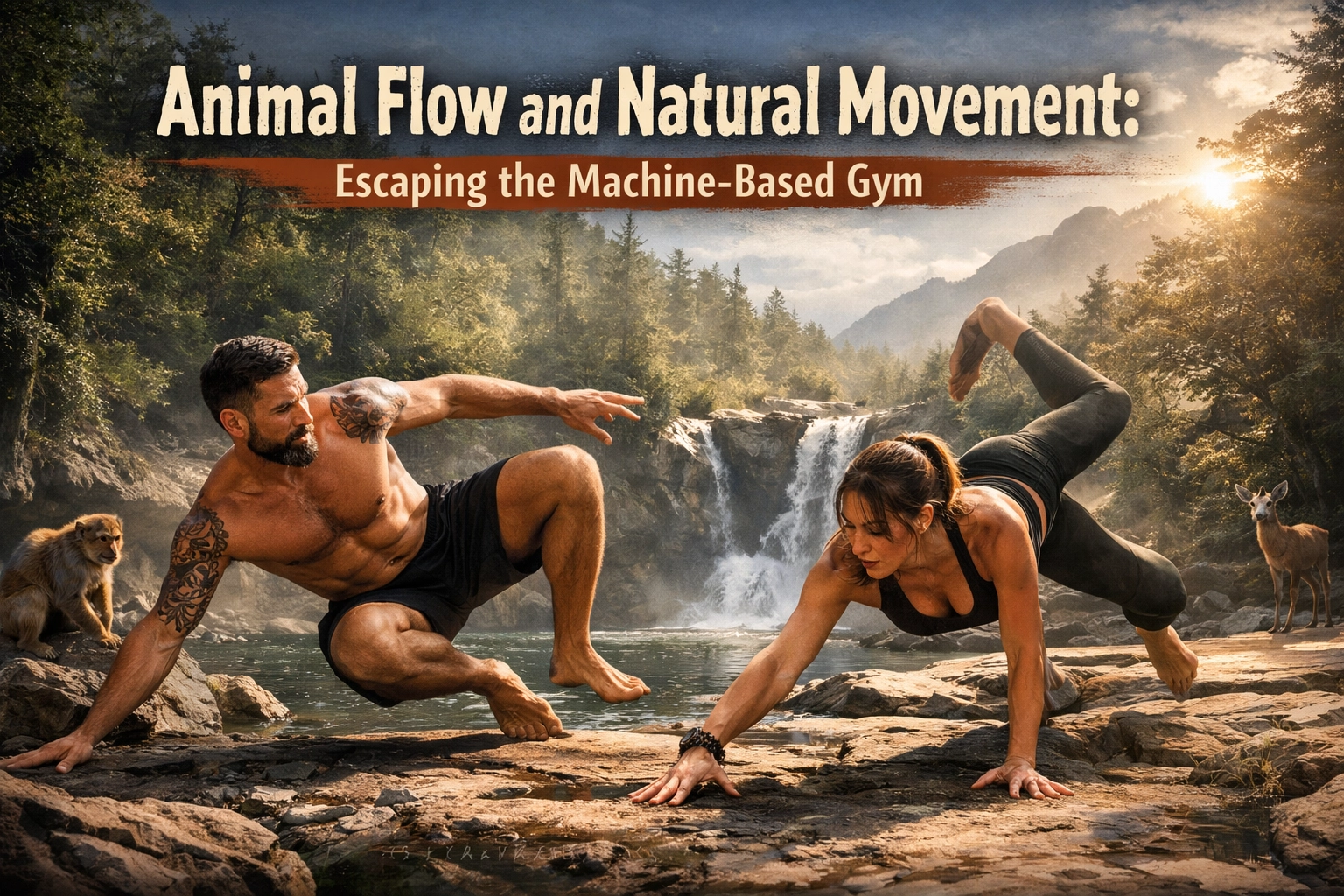
For decades, the fitness industry has been built around the "machine." We walk into a gym, sit on a padded bench, and move a lever along a fixed, one-dimensional path. While this is great for isolating muscles for hypertrophy (bodybuilding), it fails to address how the human body actually evolved to move.
In 2026, we are seeing a massive shift toward Natural Movement and systems like Animal Flow. We are moving away from being "gym strong" and toward being "biologically capable." This guide dives deep into why escaping the machine-based gym and returning to ground-based, quadrupedal movement is the most technical and effective way to bulletproof your body for the long haul.
The Biomechanical Failure of Fixed Machines
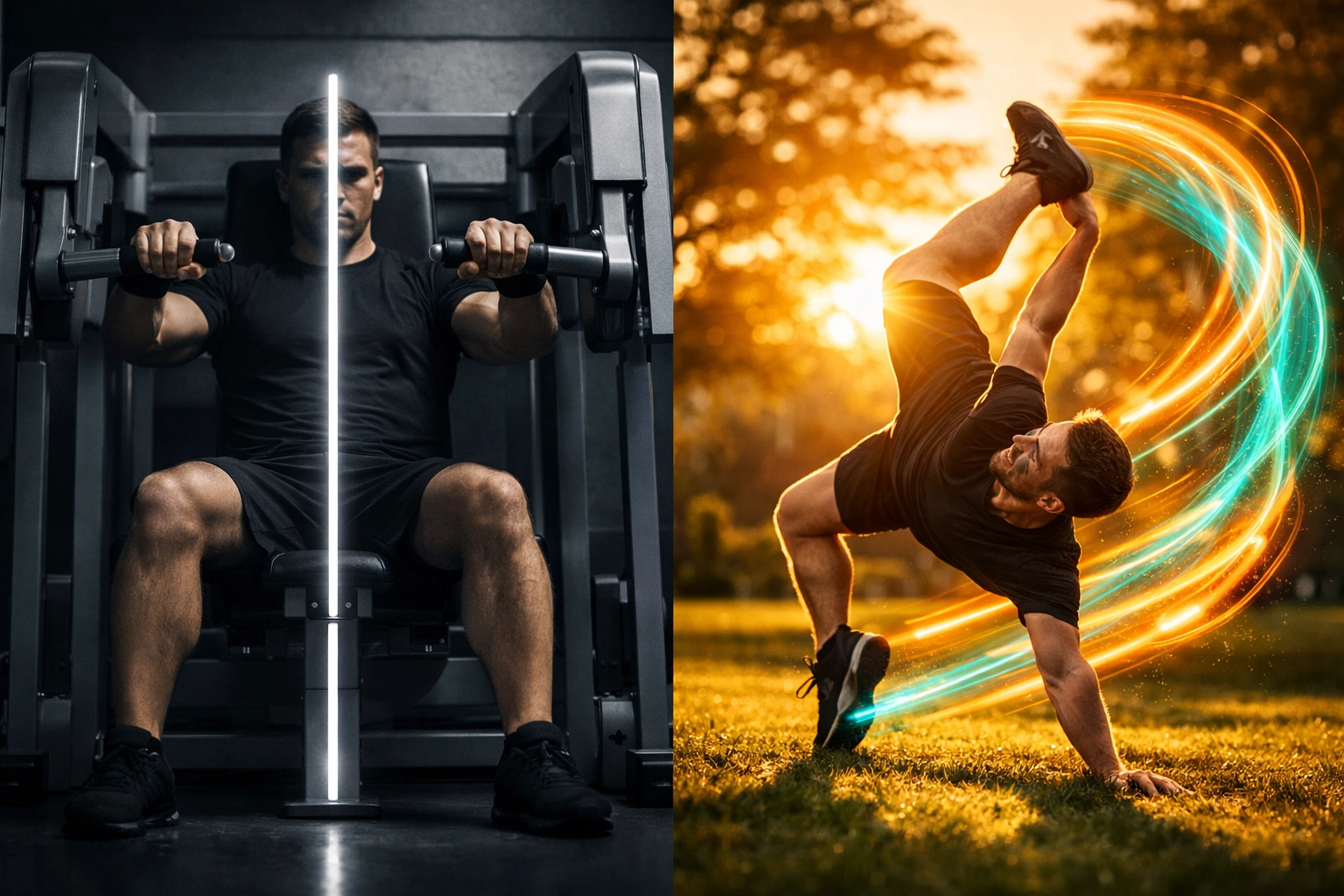
The primary issue with traditional gym machines is that they create "artificial stability." When you sit in a chest press machine, the machine provides the stability, allowing your nervous system to "turn off" the stabilizer muscles (the rotator cuff, the serratus anterior, and the deep core).
In contrast, natural movement relies on Closed Kinetic Chain (CKC) exercises. In a CKC movement, your hands or feet are fixed to an immovable object (usually the ground), and your body moves through space. Research in the Journal of Strength and Conditioning Research consistently shows that CKC movements recruit more muscle fibers and create higher levels of functional strength compared to Open Kinetic Chain (OKC) movements like leg extensions or machine presses.
Why Your Body Craves Multi-Planar Movement
Most machines operate in the Sagittal Plane (forward and backward). However, life happens in the Frontal (side to side) and Transverse (rotational) planes. Animal Flow forces you to navigate all three planes simultaneously. This doesn't just build muscle; it strengthens the connective tissue and fascia, creating a "web" of strength rather than isolated "islands" of muscle.
The Six Components of Animal Flow: A Technical Breakdown
Developed by Mike Fitch, Animal Flow is a structured, ground-based movement system. It is often mistaken for "just crawling around," but it is a highly technical discipline governed by six specific pillars.
1. Wrist Mobilizations
Because we spend our lives typing or holding phones, our wrists have become a weak link. Animal Flow begins with specific mobilizations to prepare the joint for weight-bearing. This increases the production of synovial fluid and improves the range of motion (ROM) in the carpal bones.
2. Activations
These are static holds designed to "wake up" the connection between the brain and the body. The two primary positions are Beast and Crab.
- Static Beast: On all fours, knees hovering just one inch off the ground.
- Static Crab: A reverse tabletop position, focusing on shoulder extension and glute activation.
3. Form Specific Stretches (FSS)
These are full-body starts that begin in a base position and move through a wide range of motion. Examples include the "Ape Reach" or "Scorpion Reach." These aren't passive stretches; they are active, loaded end-range movements that build "strength in length."
4. Traveling Forms
This is the "Locomotion" phase. It mimics how animals move.
- Ape: Lateral movement focusing on hip mobility.
- Beast: Forward/backward crawling that challenges the anterior sling.
- Crab: Backward/forward movement that opens the chest and challenges the posterior sling.
5. Switches and Transitions
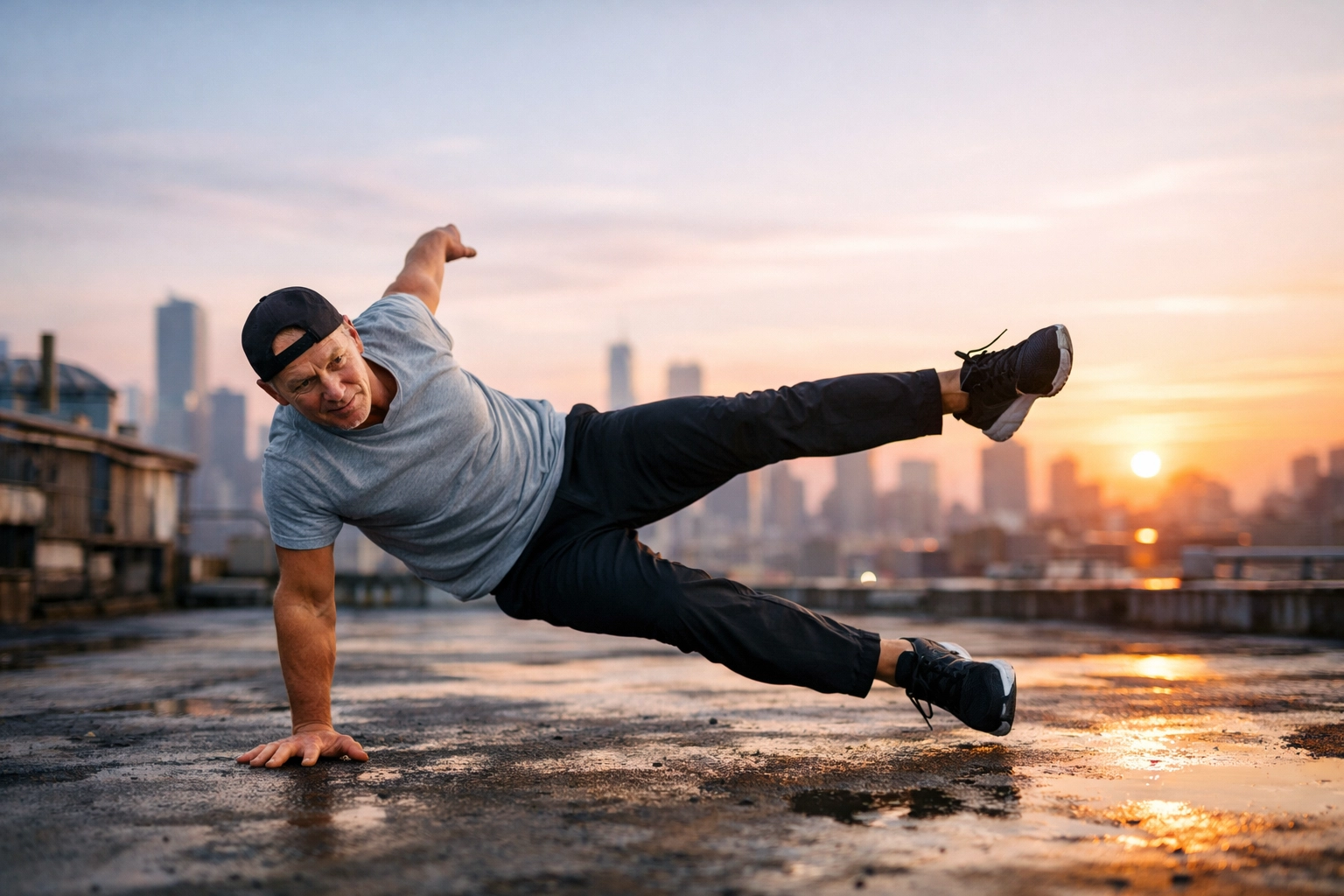
This is where the "Flow" happens. These are dynamic movements like the "Underswitch," "Side Kickthrough," and "Front Kickthrough." They require significant core rotation and stability to execute without losing balance.
6. Flows
The final stage is the integration of all the above into a seamless sequence. This creates a state of "moving meditation" while pushing the heart rate into Zone 3 and Zone 4 territory.
Comparative Analysis: Machines vs. Natural Movement
| Feature | Machine-Based Training | Animal Flow / Natural Movement |
|---|---|---|
| Stability | Provided by the machine | Provided by the user (Internal) |
| Neurological Load | Low (Fixed path) | High (Multi-planar/Complex) |
| Joint Impact | Repetitive / Linear | Varied / Multi-directional |
| Core Integration | Minimal | Constant / High |
| Proprioception | Low | Very High (Spatial Awareness) |
| Equipment Needed | Expensive / Fixed Location | None (Bodyweight) |
The "ABC" of Natural Movement: Ape, Beast, Crab
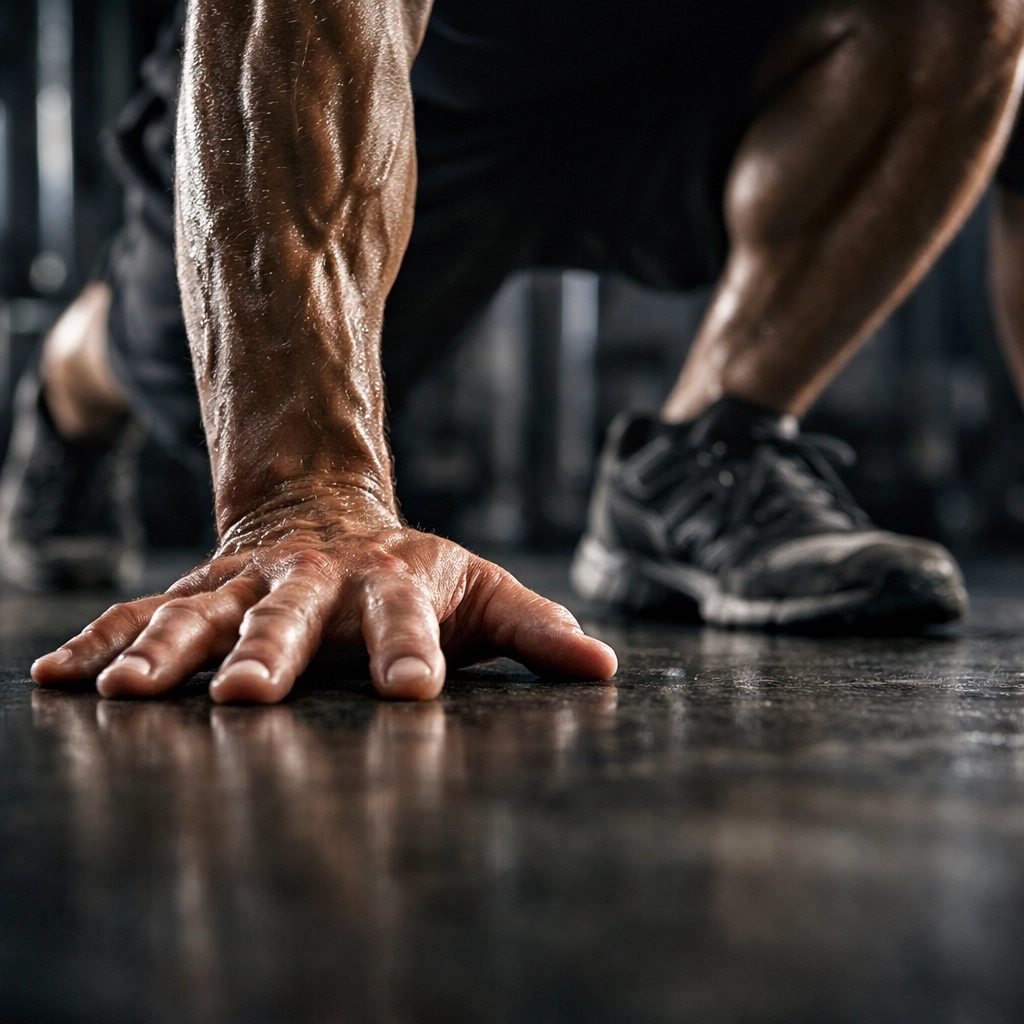
If you want to transition away from machines, you must master the three foundational archetypes of human movement.
The Ape (Hip Dominant)
The Ape position is a deep squat. In Western societies, we have lost the ability to sit in a deep squat due to chairs. Master the Ape to reclaim ankle dorsiflexion and hip opening. This is essential for preventing lower back pain as you age.
The Beast (Anterior Chain Dominant)
The Beast mimics the "crawl" pattern. It is the ultimate core exercise. Unlike a plank, which is static, the Beast is dynamic. It engages the Anterior Functional Sling, connecting the pec major to the opposite external oblique and adductors.
The Crab (Posterior Chain Dominant)
Most of our modern lives are "flexion-biased" (hunched forward). The Crab is the antidote. It forces "extension-bias," opening the shoulders and activating the entire back body (glutes, hamstrings, and erector spinae).
Neurological Benefits: Training the Brain
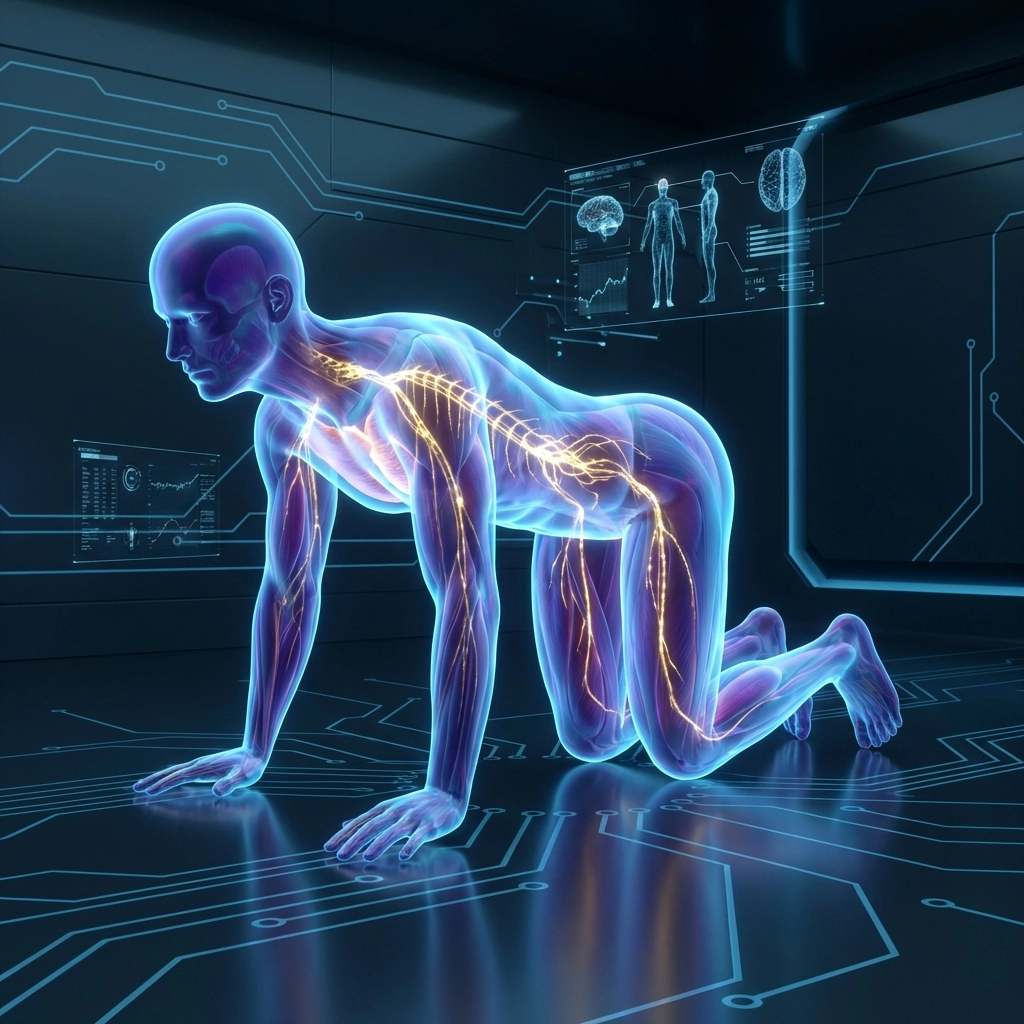
One of the most overlooked aspects of Animal Flow is its impact on the brain. Because the system utilizes Contralateral Movement (moving the opposite arm and leg simultaneously), it requires the left and right hemispheres of the brain to communicate intensely across the corpus callosum.
A 2021 study published in Scientific Reports indicated that quadrupedal movement training improved cognitive flexibility and joint repositioning sense (proprioception) significantly more than traditional weightlifting. Essentially, by escaping the machine, you aren't just getting stronger: you're getting smarter and more coordinated.
How to Transition: A 4-Week Progression
You don't need to quit the gym entirely, but you should begin integrating natural movement to "undo" the damage of fixed-path training.
- Week 1: The Foundations. Spend 10 minutes a day on Wrist Mobilizations and Static Activations (Beast and Crab holds). Aim for 60 seconds without breaking form.
- Week 2: Locomotion. Start "Traveling." Practice the Forward Beast and Lateral Ape for 3 sets of 20 feet. Focus on keeping the hips low and the back flat.
- Week 3: The Switches. Introduce the "Underswitch." This is the foundational transition that allows you to move from Beast to Crab. It builds incredible shoulder stability.
- Week 4: Minimalist Flows. Connect three movements. Example: Beast to Left Leg Underswitch to Crab to Right Leg Underswitch back to Beast. Repeat for 5 minutes.
Conclusion: Movement for the Centenarian Decathlon
In the words of longevity expert Peter Attia, we should be training for the "Centenarian Decathlon": the 10 physical tasks we want to be able to do at age 100. Most of those tasks involve getting off the floor, reaching for things, and maintaining balance.
Gym machines will help you look good in a mirror, but they won't help you get up off the floor when you're 90. Animal Flow and Natural Movement provide the "biological currency" you need for a lifetime of autonomy. By mastering your own body weight and moving through the ground, you are building a body that is not just muscular, but truly capable.
About the Author: Malibongwe Gcwabaza
Malibongwe Gcwabaza is the CEO of blog and youtube and a dedicated advocate for functional longevity and bio-optimized fitness. With a background in executive leadership and a passion for high-performance health, Malibongwe explores the intersection of ancient movement patterns and 2026 cutting-edge wellness technology. He believes that true fitness is the ultimate leverage for personal and professional success.
About the Author