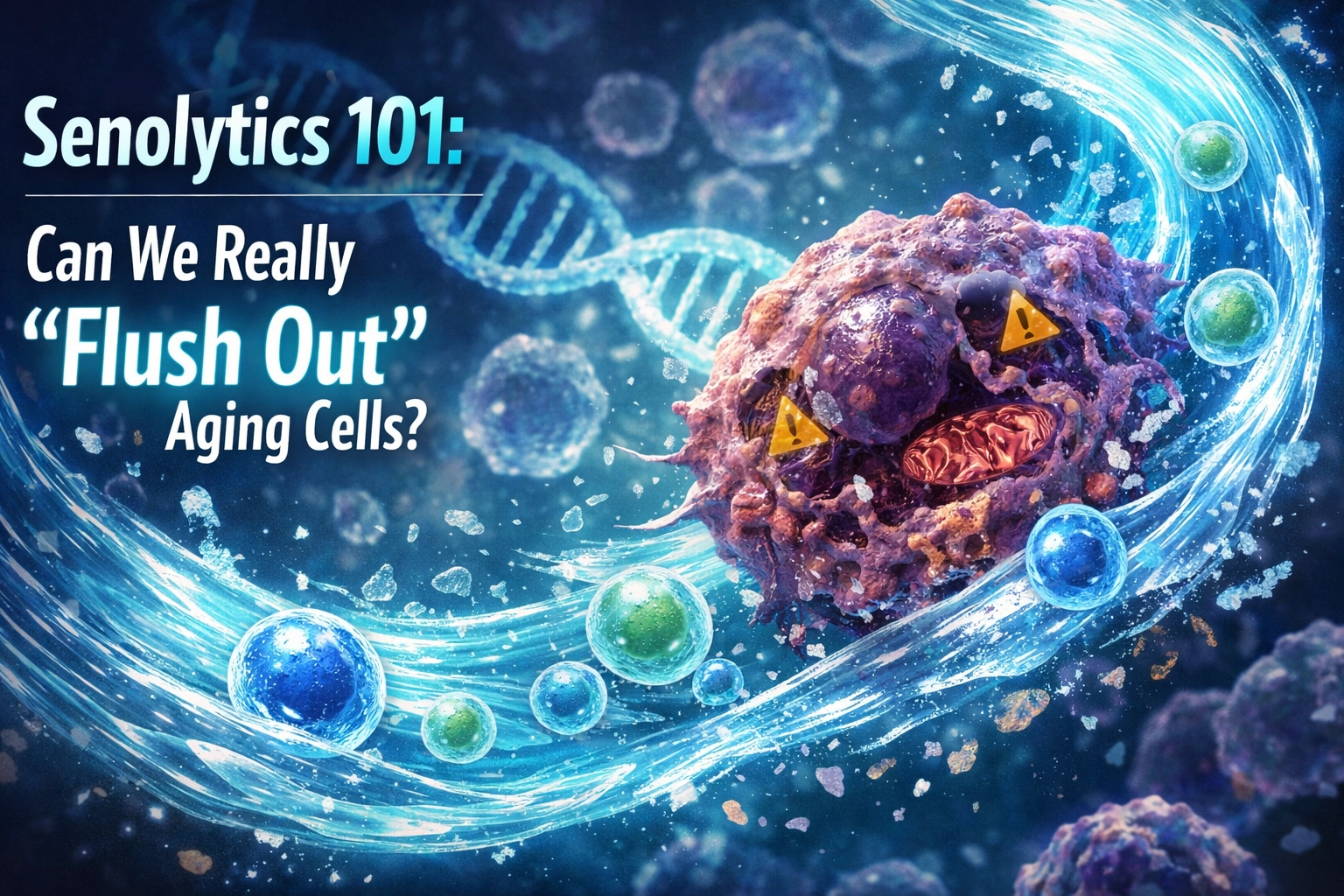
For decades, the medical community treated age-related diseases, like arthritis, diabetes, and heart disease, as separate entities. We waited for the "check engine" light to come on, then tried to fix the specific part. In 2026, the paradigm has shifted. We are no longer just managing symptoms; we are targeting the biological drivers of aging itself.
At the center of this revolution are senolytics. Often marketed as "age-cleansing" supplements, senolytics are a class of small molecules designed to selectively eliminate senescent cells. These are cells that have stopped dividing but refuse to die, lingering in the body and secreting a toxic cocktail of inflammatory signals.
This guide dives into the high-level science of senolytics, the current clinical landscape as of 2026, and whether we can truly "flush out" the biological debris of aging.
What Are Senescent Cells? The "Zombie" Problem
Every cell in your body has a shelf life. Under normal conditions, when a cell becomes too damaged or reaches its Hayflick Limit (the maximum number of times a cell can divide), it is supposed to undergo apoptosis, programmed cell death.
However, some cells take a third path. They stop dividing, but they don't die. These are senescent cells, colloquially known as "zombie cells." While senescence is a vital safeguard against cancer in our youth (stopping a damaged cell from replicating uncontrollably), as we age, our immune system loses its ability to clear these cells.
The SASP: Why One Bad Apple Spoils the Bunch
The real danger isn't just that these cells are "taking up space." It’s what they produce: the Senescence-Associated Secretory Phenotype (SASP).
The SASP is a chemical factory that pumps out:
- Pro-inflammatory cytokines (like IL-6 and IL-8)
- Chemokines
- Growth factors
- Proteases (enzymes that break down tissue structure)
This toxic "ooze" spreads to neighboring healthy cells, causing them to become senescent or dysfunctional as well. This chronic, low-grade inflammation is a primary driver of inflammaging, the process that accelerates biological decline.

How Senolytics Work: The Molecular "Sniper"
The challenge in anti-aging medicine has always been specificity. How do you kill a "zombie" cell without harming the healthy, high-functioning cells right next to it?
Senolytics solve this by targeting SCAPs (Senescent Cell Anti-Apoptotic Pathways). Senescent cells are incredibly resilient; they "hijack" specific survival pathways to resist the very inflammatory signals they produce. Senolytics essentially cut the brake lines on these survival mechanisms, allowing the cell to finally undergo apoptosis.
Key Targeting Mechanisms
- BCL-2 Family Inhibition: Senescent cells often overexpress BCL-2, a protein that prevents cell death. Compounds like Navitoclax block this protein, forcing the cell into self-destruction.
- p53/FOXO4 Interaction: The protein p53 is a master regulator of cell death. In senescent cells, a protein called FOXO4 binds to p53 and keeps it inactive. Specialized peptides can break this bond, freeing p53 to do its job and kill the zombie cell.
- Tyrosine Kinase Interference: Some senolytics disrupt the signaling enzymes that senescent cells use to ignore "stop" commands from the immune system.
| Compound | Type | Primary Target | Common Source/Use |
|---|---|---|---|
| Quercetin | Flavonoid | PI3K/AKT pathways | Onions, Apples, Capers |
| Fisetin | Flavonoid | BCL-2, NF-κB | Strawberries, Persimmons |
| Dasatinib | Chemotherapy Drug | Tyrosine Kinases | Prescription Cancer Med |
| Navitoclax | Experimental Drug | BCL-XL, BCL-2 | Clinical Research |
| Piperlongumine | Alkaloid | Glutathione S-transferase | Long Pepper |
The Big Three: Most Studied Senolytics in 2026
While the field is expanding, three interventions have dominated clinical research and "biohacking" circles.
1. Dasatinib + Quercetin (D+Q)
This is the "original" senolytic cocktail. Dasatinib, a leukemia drug, is combined with Quercetin, a common plant pigment.
- The Science: In Mayo Clinic trials, D+Q was shown to reduce senescent cell burden in human fat tissue and improve physical function in patients with idiopathic pulmonary fibrosis.
- The Logic: Quercetin targets senescent endothelial cells, while Dasatinib targets senescent adipocytes (fat cells). Together, they provide a broader "sweep" than either could alone.
2. Fisetin
Fisetin has emerged as the "darling" of the longevity community because it is naturally occurring and remarkably low in toxicity.
- Data Insight: Research on aged mice showed that Fisetin could extend remaining lifespan by nearly 35%.
- The 2026 Protocol: Many clinicians now use a "hit and run" protocol, high doses of Fisetin for two consecutive days once a month, rather than daily supplementation. This mimics the clearance of debris without interfering with the beneficial aspects of temporary senescence (like wound healing).
3. Navitoclax (ABT-263)
This is a more potent, pharmaceutical-grade senolytic. While highly effective at clearing senescent cells in the bone marrow and muscle, it carries more significant side effects, such as transiently lowering platelet counts (thrombocytopenia). It is currently reserved for clinical settings targeting specific diseases of aging.

Can We Really "Flush" Them Out?
The term "flush out" is a bit of a misnomer. You aren't peeing out dead cells. When a senolytic drug triggers apoptosis, the senescent cell shrivels and breaks into small vesicles. Your macrophages (the "garbage trucks" of your immune system) then recognize these fragments and consume them.
The success of a senolytic treatment depends on two things:
- The Potency of the Drug: Can it break the cell's defenses?
- The Efficiency of the Immune System: Can your body actually clear the resulting debris?
This is why many longevity experts in 2026 emphasize Immunosenescence, the aging of the immune system. If your immune system is weak, even the best senolytics will leave "biological trash" lingering in your tissues.
The Risks: Why You Shouldn't DIY Senolytics
It is tempting to see senolytics as a simple "clean-up" tool, but biology is rarely that straightforward. There are significant risks to indiscriminate cellular clearance:
- Wound Healing Interference: Senescence is a necessary part of the healing process. If you take senolytics immediately after surgery or a major injury, you may prevent your body from properly closing wounds or forming scar tissue.
- Liver and Kidney Toxicity: Pharmaceutical senolytics like Dasatinib are powerful drugs with systemic side effects.
- Off-Target Effects: If a drug targets BCL-2, it might accidentally trigger apoptosis in healthy stem cells or platelets if the dosage is incorrect.
The "Hit and Run" Method
Unlike traditional vitamins, senolytics are generally not meant to be taken every day. The prevailing theory in 2026 is that we only need to clear senescent cells occasionally. Taking them daily would be like trying to take out the trash while the garbage truck is still in your driveway; it disrupts the natural cycle of cellular turnover.
Future Outlook: Personalized Senolytics
As we look toward the end of the decade, the focus is moving from "general" senolytics to targeted senolytics.
We are seeing the rise of Senolytic CAR-T therapy, where a patient's own T-cells are engineered to recognize and destroy senescent cells. Additionally, "senomorphic" drugs are being developed, these don't kill the cell, but they "turn off" the toxic SASP, effectively silencing the zombie cell without the risks associated with mass cell death.
How to Support Natural Clearance Today
While we wait for more human data on pharmaceutical cocktails, you can support your body’s natural ability to manage senescent cells through:
- Autophagy-Inducing Fasting: Periods of 24–48 hours of fasting can trigger cellular cleanup.
- Vigorous Exercise: High-intensity interval training (HIIT) has been shown to reduce markers of senescence in skeletal muscle.
- Flavonoid-Rich Diets: Consuming strawberries (Fisetin), apples (Quercetin), and green tea (EGCG) provides a "micro-dose" of natural senolytic activity.
Summary: The Final Verdict
Can we "flush out" aging cells? Yes, but with caveats.
Senolytics represent one of the most promising pillars of the "Hallmarks of Aging" framework. By selectively removing the "rotten apples" from the barrel, we can theoretically slow the progression of multiple age-related diseases simultaneously. However, the science is still in its "101" phase. Dosage, timing, and individual biological age matter immensely.
If you are considering senolytic protocols, the priority should be data-backed interventions under medical supervision, focusing on high-purity compounds and intermittent "pulsed" dosing.
Author Bio
Malibongwe Gcwabaza is the CEO of blog and youtube, a platform dedicated to demystifying the cutting edge of human longevity and performance. With a focus on data-driven wellness and functional fitness, Malibongwe works to bridge the gap between complex biotechnological research and everyday health optimization. When not analyzing clinical trials, he is an advocate for "The Centenarian Decathlon," training to remain functionally elite well into his 90s.
About the Author