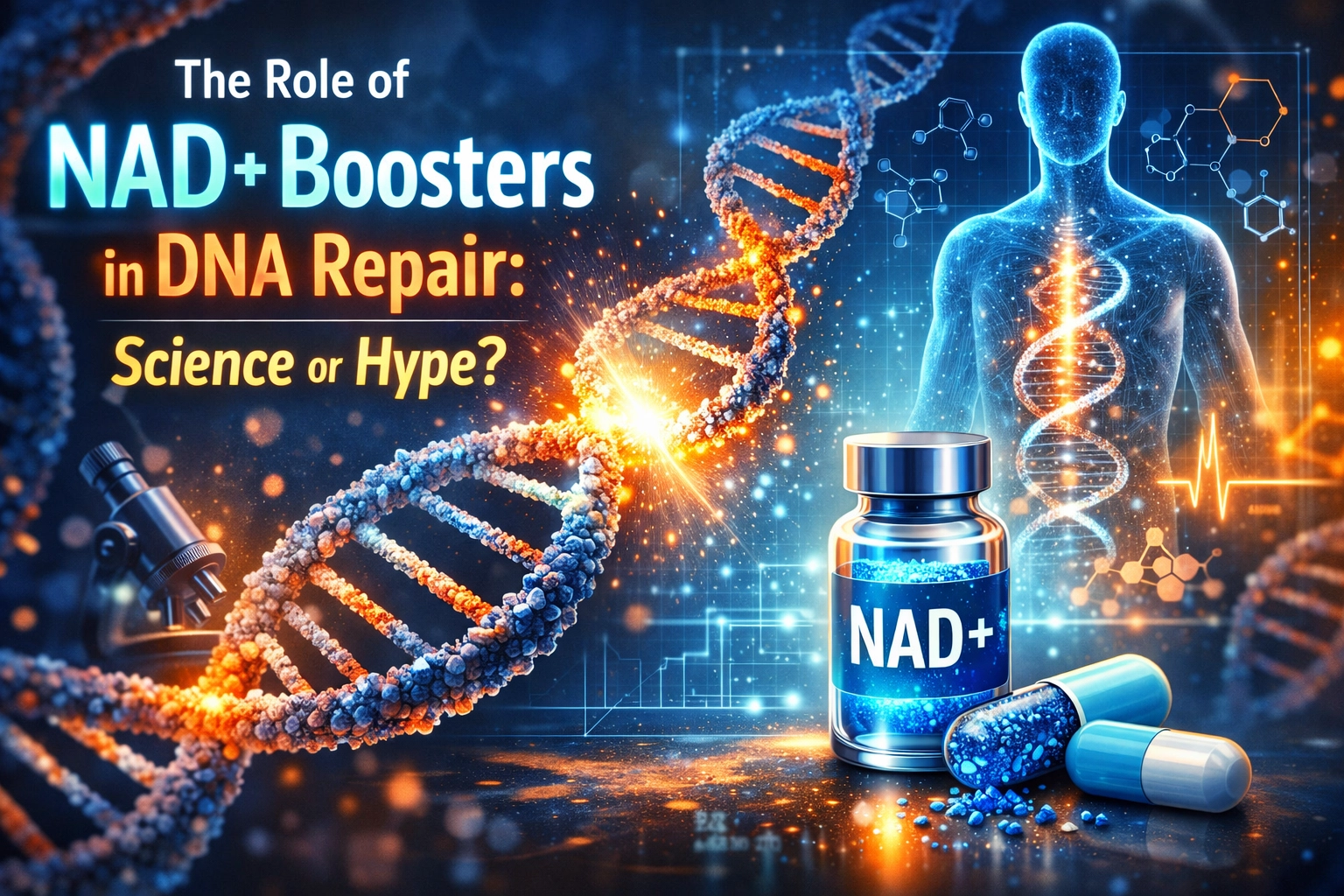
By March 2026, the longevity industry has moved past generic multivitamins and entered the era of "cellular maintenance." At the heart of this revolution is a molecule called Nicotinamide Adenine Dinucleotide (NAD+). Once a niche topic discussed only in high-level biology labs, NAD+ boosters like NMN and NR are now household names for anyone chasing a longer "healthspan."
But as the market floods with supplements promising to "reverse aging," it’s time to separate the rigorous molecular biology from the marketing glitter. Is raising your NAD+ levels actually the key to fixing broken DNA, or are we just paying for expensive "bio-hacker" urine?
What is NAD+ and Why Does it Disappear?
NAD+ is a coenzyme found in every single living cell. It has two primary roles:
- Energy Metabolism: It helps turn nutrients into ATP (cellular fuel).
- Cellular Defense: It acts as a mandatory co-factor for enzymes that repair DNA and regulate gene expression.
The problem is that NAD+ levels aren't static. As we age, our "NAD+ pool" begins to drain. By the time you hit age 50, your levels are roughly half of what they were in your 20s. This decline happens for two reasons: we produce less of it, and we consume more of it due to chronic inflammation and accumulated DNA damage.
The DNA Repair Squad: How NAD+ Works at the Bench
To understand why NAD+ matters for DNA repair, we have to look at the "workers" that use it. Your body has a constant surveillance system looking for double-strand breaks and oxidative damage. The two most important players in this system are PARPs and Sirtuins.
1. PARP Enzymes (The First Responders)
PARP (Poly ADP-ribose polymerase) enzymes are like the emergency road crew of your genome. When a strand of DNA breaks, PARP1 rushes to the site. However, to do its job, it must consume NAD+. Specifically, PARP1 uses NAD+ to create "scaffolds" that recruit other repair proteins to the site of the damage.
Research shows that high levels of DNA damage can consume up to 90% of a cell's NAD+. If your NAD+ levels are already low due to age, the "road crew" (PARP) shows up to the crash site but doesn't have the materials (NAD+) to fix the road. This leads to genomic instability, a hallmark of aging and cancer.
2. Sirtuins (The Quality Control Managers)
Sirtuins, particularly SIRT1 and SIRT6, are longevity-linked proteins that rely entirely on NAD+. SIRT6 is often called the "longevity sirtuin" because of its critical role in DNA repair and telomere maintenance. Without sufficient NAD+, sirtuins remain inactive, leaving your DNA vulnerable to "epigenetic noise": essentially, your cells start forgetting what they are supposed to do.
Comparison: PARPs vs. Sirtuins
| Feature | PARP Enzymes | Sirtuins (SIRT1/6) |
|---|---|---|
| Primary Role | Direct DNA repair (strand breaks) | Gene expression & genomic stability |
| NAD+ Usage | High (can deplete the cell) | Moderate (regulatory) |
| Impact of Aging | Overactive due to damage | Underactive due to low NAD+ |
| Benefit of Boosting | Provides "fuel" for repair | Restores "youthful" gene signaling |
The 2026 Guide to NAD+ Boosters: NMN vs. NR
Since you can’t effectively "eat" NAD+ (it’s too large a molecule to cross cell membranes easily), we use precursors. The two most researched are Nicotinamide Mononucleotide (NMN) and Nicotinamide Riboside (NR).
Nicotinamide Mononucleotide (NMN)
In 2026, NMN remains the heavyweight champion of the bio-hacking world. NMN is one step closer to the final NAD+ molecule than NR. Recent studies have identified specific transporters (like Slc12a8) in the gut that allow NMN to be absorbed directly into the bloodstream, making it highly efficient.
- The Science: Animal studies have shown NMN can maintain telomere length and improve mitochondrial function.
- The Human Data: Recent clinical trials in 2025 and early 2026 confirm that daily NMN supplementation (250mg–1000mg) can raise blood NAD+ levels by 50–100% within 30 days.
Nicotinamide Riboside (NR)
NR has been on the market longer and has a wealth of safety data. It’s highly effective at raising NAD+ in the blood, though some researchers argue it may be less effective at raising levels within specific tissues like skeletal muscle compared to NMN.
Data-Driven Insights: Does it Actually Fix DNA?
The most critical question is: Does higher NAD+ translate to better DNA repair in humans?
In a landmark study updated in late 2025, researchers used "Comet Assays" (a way to visualize DNA damage) on human participants. Those who took 1,000mg of NMN daily for six weeks showed a 25% reduction in detectable DNA fragmentation in peripheral blood mononuclear cells.
Furthermore, NMN has been shown to boost the activity of SIRT1, which indirectly helps the body manage oxidative stress. By reducing the amount of damage that happens in the first place, NAD+ boosters act as both a shield and a repair kit.
The "Hype" Check: What the Supplement Companies Don't Tell You
While the science of the "PARP-NAD-SIRT axis" is robust, we must be realistic. Here is where the hype outpaces the reality:
- It’s Not a "Cure" for Aging: Boosting NAD+ will not make an 80-year-old 20 again. It is a maintenance strategy. It helps your cells function at their current biological ceiling rather than falling below it due to deficiency.
- The "Sinks" Problem: You can't just keep pouring NAD+ into a leaky bucket. An enzyme called CD38 increases as we age and "eats" NAD+. If you have high systemic inflammation (inflammaging), your CD38 levels might be so high that they consume your supplements before they ever reach your DNA.
- Bioavailability Issues: Not all supplements are created equal. NAD+ is unstable. Cheap, poorly manufactured NMN often degrades into regular Nicotinamide (Vitamin B3) on the shelf, which can actually inhibit sirtuins if taken in massive doses.
How to Optimize Your NAD+ Levels in 2026
If you want to move beyond the hype and actually support your DNA repair mechanisms, a holistic approach is required. Supplementing is only one piece of the puzzle.
1. Strategic Supplementation
If you choose to use boosters, look for:
- Third-party testing: Ensure the purity is >99%.
- Enteric coating: To protect the precursor from stomach acid.
- Dosage: Most current research suggests 500mg to 1,000mg per day for adults over 40.
2. Combine with Methyl Donors
When you increase NAD+, your body processes it and eventually excretes it. This process requires "methyl groups." Taking TMG (Trimethylglycine) alongside NMN is a common 2026 protocol to ensure you don't deplete your body's methyl pool, which is also necessary for DNA methylation (epigenetic health).
3. Natural "Boosters" (Hormesis)
You can stimulate your body to produce its own NAD+ through metabolic stress:
- Fasting: 16-18 hour fasts trigger the NAMPT enzyme, which recycles NAD+.
- High-Intensity Interval Training (HIIT): Exercise is the most potent natural NAD+ booster known to science.
- Cold Exposure: Cold plunges activate SIRT1 and increase NAD+ demand, forcing the cell to produce more.

The Verdict: Science or Hype?
The verdict for 2026 is clear: The mechanism is science; the timeline is hype.
The "Science" is indisputable: NAD+ is the literal fuel for DNA repair. Without it, your PARP enzymes fail, and your sirtuins go dormant. The "Hype" lies in the promise of immediate, felt results. You likely won't "feel" your DNA being repaired. This is a long-term play: an insurance policy for your genome.
As we continue to map the human "longevityome," NAD+ boosters remain one of the most promising tools for maintaining biological integrity. Just remember that no pill can replace the DNA-protective power of a good night's sleep, a clean diet, and consistent movement.
About the Author: Malibongwe Gcwabaza
CEO of "blog and youtube"
Malibongwe is a forward-thinking leader in the health and wellness tech space. With a focus on translating complex biotechnological advancements into actionable lifestyle changes, he has spent the last decade exploring the intersection of longevity science and digital health. When he’s not deep-diving into the latest 2026 clinical trials, he is an advocate for functional fitness and holistic wellness. Malibongwe believes that the future of health is personalized, data-driven, and accessible to everyone.
About the Author