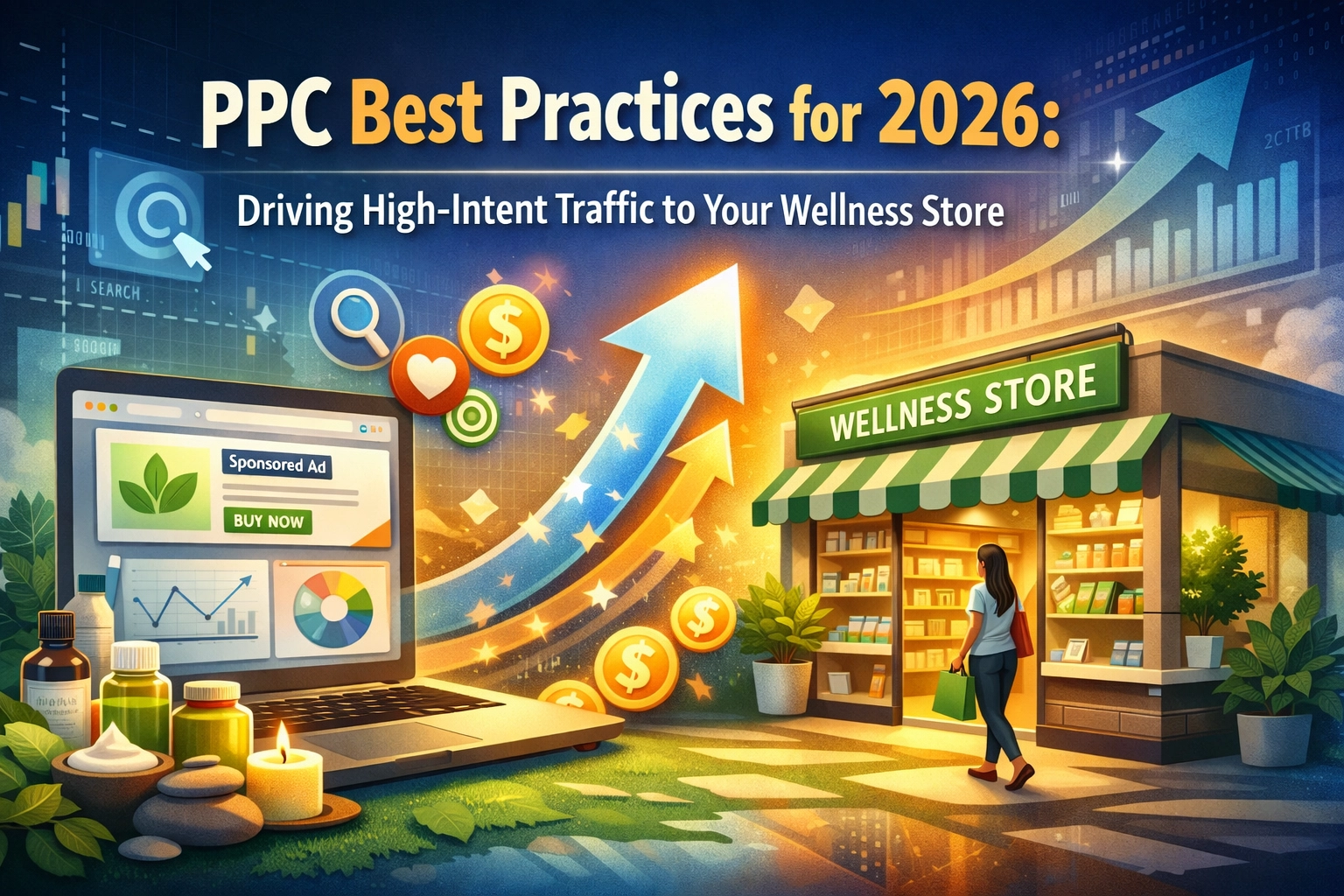
The digital landscape for wellness brands in 2026 is no longer about who can shout the loudest; it’s about who can be the most relevant at the exact moment a consumer decides to take control of their health. We’ve moved past the era of "spray and pray" advertising. Today, Pay-Per-Click (PPC) success is defined by technical precision, privacy-compliant tracking, and a deep understanding of high-intent search behavior.
If you’re running a wellness store, whether you're selling functional mushrooms or wearable longevity tech, your PPC strategy needs to evolve. Consumers are more skeptical of health claims and more protective of their data than ever before. To win, you need a guide that balances high-level technical execution with the simple, human needs of your customers.
The Shift to High-Intent Wellness Keywords
In 2026, broad keywords like "supplements" or "fitness gear" are budget-killers. They attract "window shoppers" who are in the awareness phase, not the buying phase. High-intent traffic comes from users who have moved past the "what is this?" stage and are now asking "which one is best for my specific problem?"
Targeting Functional Outcomes
Instead of bidding on product categories, bid on functional outcomes. Consumers in 2026 search by the physiological or psychological result they want to achieve.
- Low Intent: "CBD oil"
- High Intent: "Third-party tested CBD for cortisol regulation"
- Low Intent: "Red light therapy"
- High Intent: "Targeted red light device for knee inflammation recovery"
By shifting your keyword research toward these long-tail, outcome-based phrases, you capture users who are ready to convert. They aren't just curious about red light; they have a specific pain point (knee inflammation) and a specific requirement (targeted device).
The Power of Negative Keywords
A massive part of PPC efficiency in 2026 is knowing what not to pay for. Wellness is a broad field, and you don’t want your ads appearing for "free health advice" or "symptoms of [condition]" if you are selling a premium product. Use negative keyword lists to filter out:
- Educational intent (e.g., "what is," "how to," "history of")
- Low-cost seekers (e.g., "cheap," "free," "discount code")
- Irrelevant categories (e.g., "jobs," "books," "courses")

Structuring Your 2026 Campaigns
The way you organize your account dictates how well the AI algorithms: like Google’s Performance Max or Meta’s Advantage+: can optimize your spend. In 2026, the "Outcome-Based Campaign Structure" is the gold standard for wellness brands.
Outcome-Based Grouping
Instead of grouping ads by "Capsules," "Powders," and "Teas," group them by the benefit:
- Metabolic Health: CGMs, berberine, and apple cider vinegar complexes.
- Cognitive Performance: Nootropics, lion's mane, and focus-tracking wearables.
- Longevity & DNA Repair: NAD+ boosters, resveratrol, and biological age tests.
This structure allows you to tailor your ad creative and your landing pages to a singular psychological profile. A person looking for metabolic health has different anxieties and goals than someone looking for cognitive performance.
Ad Creative: Evidence Over Aesthetics
In the 2026 wellness market, "vibe-based" marketing is secondary to "evidence-based" marketing. Your ad copy and visuals must lean heavily into trust signals and data.
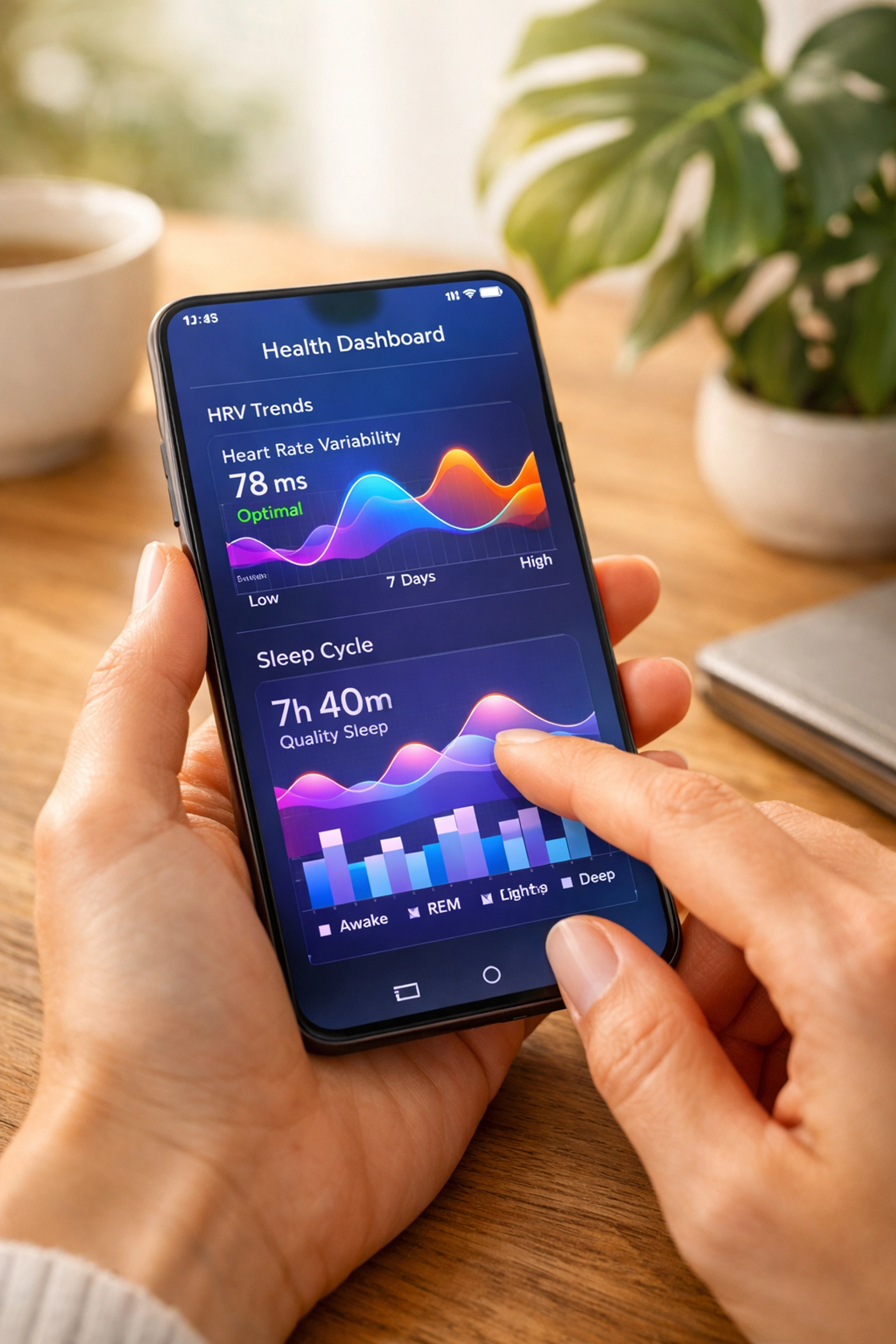
- Use Biomarkers: Mention specific metrics like VO2 max, HRV, or HbA1c in your ad copy.
- Highlight Certifications: "NSF Certified for Sport" or "Double-Blind Placebo Controlled" carry more weight than "Amazing Taste."
- UGC 2.0: Use User-Generated Content that looks like a clinical review rather than a lifestyle vlog. Show customers tracking their results with data.
Landing Page Optimization: The Trust Architecture
A click is a cost; a conversion is a return. If your PPC traffic is bouncing, your landing page is likely failing to bridge the "Trust Gap." In 2026, a high-converting wellness landing page needs to be a "Trust Architecture."
Speed and Mobile-First Technicals
With the majority of wellness searches happening on mobile devices, your page must load in under 1.5 seconds. Use Core Web Vitals as your North Star. If your Largest Contentful Paint (LCP) is slow, your Quality Score drops, and your Cost Per Click (CPC) goes up. It’s that simple.
The Anatomy of a High-Intent Wellness Page
- Immediate Benefit Header: "Optimize Your Deep Sleep" (not "Our New Supplement").
- Scientific Backing: A dedicated section for "The Science," linking to white papers or clinical studies.
- Comparison Tables: High-intent buyers love data. Show a table comparing your ingredients and dosages against "The Leading Competitor."
- Social Proof with Context: Instead of "I love this product," use "This lowered my resting heart rate by 5 bpm in 30 days."
Cross-Channel Tracking in a Privacy-First World
The biggest technical hurdle in 2026 is the death of the third-party cookie. If you are relying on the standard browser-based pixel, your tracking is likely 30-40% inaccurate.
Server-Side GTM
Wellness brands must move to Server-Side Google Tag Manager (sGTM). This allows you to send data directly from your server to the ad platform (Google, Meta, TikTok) without relying on the user's browser. This preserves data accuracy and respects user privacy by allowing you to "scrub" PII (Personally Identifiable Information) before it’s sent.
The "Full Funnel" Measurement
Stop looking at ROAS (Return on Ad Spend) in a vacuum. In 2026, we focus on POAS (Profit on Ad Spend) and LTV (Lifetime Value).
- First-Party Data: Use your PPC ads to capture emails or SMS sign-ups. The first click might not result in a sale, but if you capture the lead, the second "free" touchpoint via email will.
- Post-Purchase Surveys: Since tracking isn't 100% perfect, ask your customers "How did you hear about us?" This qualitative data often reveals that a "Direct" sale actually started with a Google Search ad three weeks prior.
| Metric | 2020 Focus | 2026 Focus |
|---|---|---|
| Primary KPI | ROAS | LTV / POAS |
| Tracking | Browser Pixel | Server-Side / CAPI |
| Targeting | Demographics | Intent & Biomarkers |
| Creative | Lifestyle Images | Data & Clinical Proof |
Dynamic Bidding and AI Integration
AI-driven bidding is no longer an "option": it's the engine. However, the AI is only as good as the data you give it.
Feeding the Machine with Conversion Values
Don't just track "Purchases." Assign different values to different actions. A subscription purchase is worth more than a one-time purchase. A "Biological Age Test" lead might be worth more than a "Vitamin C" sale because the former has a higher upsell potential. By feeding these weighted values back into Google or Meta, the AI will automatically hunt for the higher-value customers.
Seasonality and The Wellness Calendar
In 2026, wellness seasonality has shifted. It’s no longer just "New Year, New Me."
- Q1: Focus on metabolic health and habit stacking.
- Q2: Shift to "Pre-tox" and outdoor performance/longevity.
- Q3: Recovery and immune resilience (preparing for winter).
- Q4: Stress management and "Biohacking the Holidays."

Conclusion: The Path to PPC Profitability
Driving high-intent traffic to your wellness store in 2026 requires a blend of technical rigor and radical transparency. You must move away from generic keywords, embrace server-side tracking, and build landing pages that prioritize scientific proof over marketing fluff.
The brands that will dominate the 2026 landscape are those that treat their PPC budget not as an expense, but as an investment in data. By capturing high-intent searchers and providing them with a seamless, evidence-backed experience, you aren't just getting a click: you're starting a long-term relationship with a customer invested in their own longevity.
About the Author: Malibongwe Gcwabaza
Malibongwe Gcwabaza is the CEO of blog and youtube, a premier digital strategy firm specializing in the intersection of health-tech and content marketing. With over a decade of experience in the wellness industry, Malibongwe focuses on helping brands scale through data-driven storytelling and high-intent customer acquisition. When not optimizing conversion funnels, he is an avid researcher into the future of preventative health and longevity.
About the Author