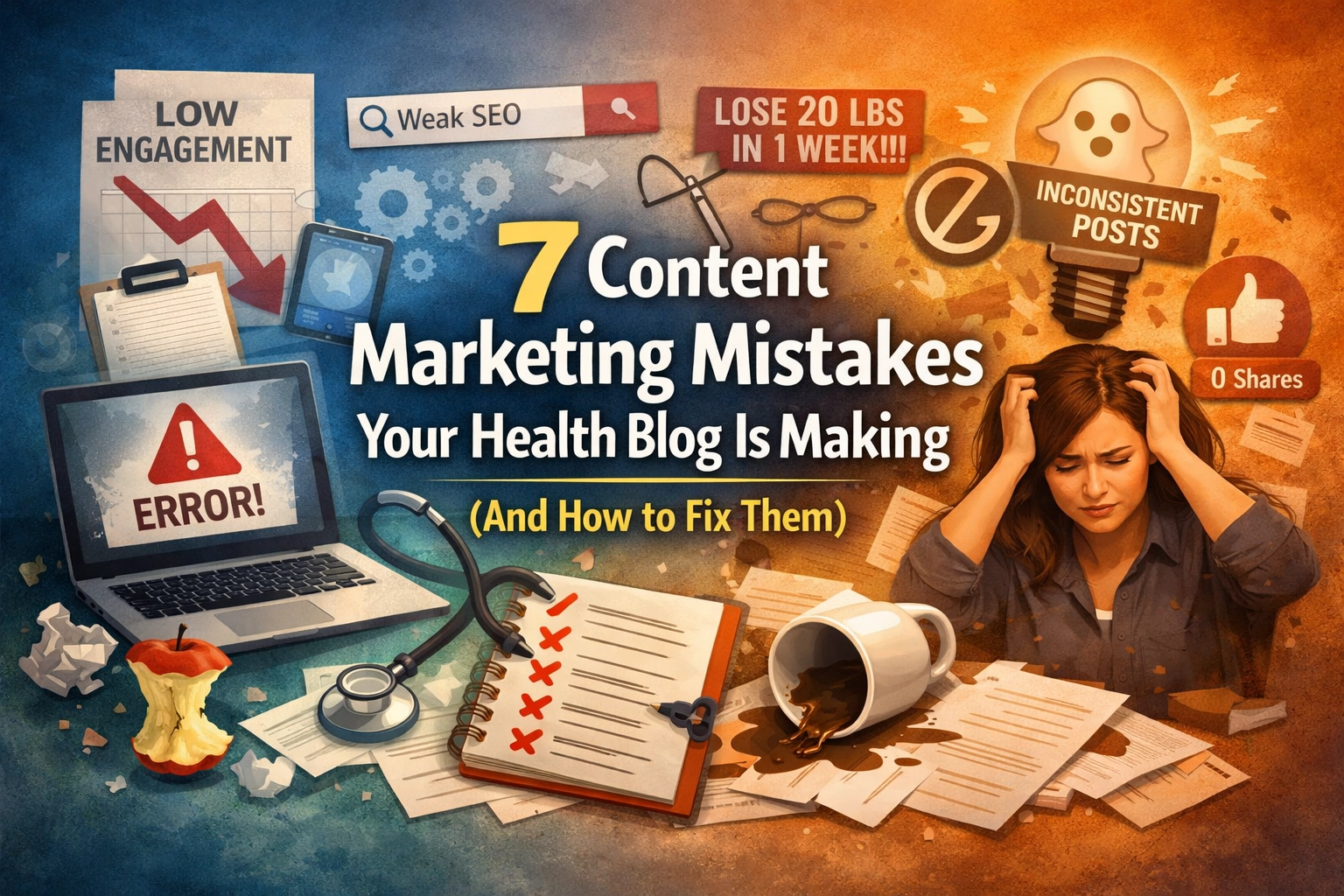
The wellness industry is more crowded than a morning spin class. Whether you are a nutritionist, a fitness coach, or a mental health advocate, you are competing with millions of other voices for a slice of your audience's attention. Most health bloggers start with the best intentions, they want to help people live better lives. However, many find themselves stuck on a plateau, seeing low traffic and even lower engagement.
The reason often isn’t a lack of knowledge; it’s a failure in content marketing strategy. Writing about health requires a delicate balance of authority, empathy, and clarity. If your blog feels like it’s shouting into a void, you might be falling into one of these seven common traps.
Here is a deep dive into the mistakes holding your health blog back and exactly how to fix them.
1. The "Sales Pitch" Trap: Over-Promotion
One of the fastest ways to lose a reader is to make them feel like a sales lead rather than a person seeking help. In the wellness space, trust is the primary currency. If every article ends with a hard sell for your $499 detox program or your private coaching sessions, readers will stop seeing you as a guide and start seeing you as a salesperson.
The Problem
Healthcare and wellness audiences are naturally skeptical. They are often looking for solutions to vulnerable problems, weight loss, chronic pain, or mental health. When you lead with a "buy now" mentality, you break the rapport needed to actually help them.
The Fix: The 80/20 Rule
Shift your focus toward providing value first. Follow the 80/20 rule: 80% of your content should be purely educational, helpful, or inspiring, with no strings attached. The remaining 20% can be promotional.
Actionable Step: Create a "Value Ladder." Start with free, high-quality blog posts that solve a small problem. Once the reader trusts your free advice, they will be much more likely to explore your paid offerings.

2. Overcomplicating the Message with Jargon
You’ve spent years studying your craft. You know the difference between "hypertrophy" and "atrophy," or "macronutrients" and "micronutrients." But your reader might not. Using dense, clinical language might make you feel like an expert, but it makes your reader feel confused.
The Problem
When readers are stressed or looking for health advice, their cognitive load is already high. If they have to Google every third word in your blog post, they will click away and find a source that is easier to digest.
The Fix: The "Friend Test"
Write like you are talking to a friend over coffee. You wouldn't use 14-syllable medical terms with a friend; you would explain the concept simply.
- Instead of: "The implementation of high-intensity interval training facilitates metabolic efficiency."
- Try: "Short, intense workouts help your body burn fat faster, even after you've finished exercising."
Actionable Step: Use tools like the Hemingway Editor to keep your reading level between Grade 6 and Grade 8. This ensures your content is accessible to everyone.
3. Creating "One-Size-Fits-All" Content
A common mistake is trying to write for "everyone interested in health." If you try to speak to everyone, you end up speaking to no one. A 22-year-old athlete has very different needs than a 55-year-old woman going through menopause, yet many health blogs treat them as the same audience.
The Problem
Generic content is forgettable. It lacks the specific nuances that make a reader think, "Wow, this person really understands what I’m going through."
The Fix: Define Your Core Personas
Stop writing for "people." Start writing for three specific people. Define your personas based on:
- Their Goals: (e.g., losing 10 pounds, managing anxiety, training for a marathon).
- Their Pain Points: (e.g., no time to cook, joint pain, lack of motivation).
- Their Barriers: (e.g., limited budget, misinformation, busy work schedule).
Actionable Step: Before writing your next post, pick one specific persona. Write the entire article as if you are sending a personal email to that one person.
4. Making Claims Without Evidence (The Trust Killer)
In 2026, Google and readers alike are stricter than ever about "Your Money or Your Life" (YMYL) content. If you claim that a certain herb cures insomnia or that a specific exercise prevents back pain without backing it up, you are risking your credibility and your SEO rankings.
The Problem
Vague assertions like "studies show" or "experts say" without links to those studies or experts make your blog look like "bro-science" or "fake news."
The Fix: Standardize Your Citations
Treat your blog like a professional publication. Every health claim should be backed by a reputable source.
| Source Type | Examples |
|---|---|
| Academic Journals | PubMed, The Lancet, JAMA |
| Government Agencies | CDC, NHS, WHO |
| Educational Institutions | Harvard Health, Mayo Clinic |
Actionable Step: Use superscript numbers or clear hyperlinks to cite your sources. This not only builds trust with readers but signals to search engine algorithms that your content is authoritative.

5. Using Generic, "Robot-Sounding" Language
With the rise of AI tools, the internet is being flooded with generic, "beige" content. It’s grammatically correct but has no soul. If your blog sounds like a textbook, people won't connect with your brand.
The Problem
Health is deeply personal. Readers want to know there is a human behind the screen who understands the struggle of staying healthy in a modern world. AI-generated or overly sanitized corporate writing lacks the "Experience" part of Google's E-E-A-T (Experience, Expertise, Authoritativeness, and Trustworthiness).
The Fix: Inject Your "Unique Angle"
Share personal anecdotes, client success stories (with permission), and your own opinions. Don't just report the facts; interpret them through your unique lens.
Actionable Step: Use the "So What?" technique. After stating a fact, explain why it matters to the reader's life. Instead of just saying "hydration is important," say "staying hydrated means you won't hit that 3 PM energy slump at the office."
6. Failing to Connect Content to Business Impact
Many health bloggers fall into the trap of "content for content's sake." They publish a post because it’s Tuesday, but they have no idea how that post helps their business grow.
The Problem
High traffic is a vanity metric if it doesn't lead to a desired action. If you have 10,000 readers but no one signs up for your newsletter or clicks your affiliate links, your content marketing is failing.
The Fix: Use a Clear Call-to-Value (CTV)
Every post should have a purpose. Ask yourself: What do I want the reader to do next?
- Sign up for a recipe meal plan?
- Download a workout PDF?
- Book a discovery call?
Actionable Step: Don't just use a generic "Contact Us" button. Use a Call-to-Value that relates to the post. If the post is about gut health, the CTV should be "Download my 3-day gut-reset grocery list."

7. The "Ghosting" Effect: Inconsistency and Zero Engagement
Consistency is the backbone of successful content marketing. If you post three times in one week and then disappear for a month, you lose momentum and signal to your audience (and search engines) that you aren't a reliable source.
The Problem
Inconsistency kills trust. Furthermore, many bloggers hit "publish" and then close their laptops. Content marketing doesn't end when the post goes live; that’s where the "marketing" part begins.
The Fix: Create an Editorial Calendar and Engagement Routine
You don't need to post every day. Posting one high-quality, 1,500-word guide every two weeks is better than posting five mediocre 300-word snippets.
Actionable Step:
- Schedule: Commit to a frequency you can actually maintain.
- Promote: Spend as much time promoting the post (social media, email, forums) as you did writing it.
- Engage: Set aside 30 minutes after publishing to respond to comments and answer questions on social media.
Summary Checklist for Health Bloggers
To ensure your next post hits the mark, run it through this quick checklist:
- Is the tone conversational and easy to understand?
- Did I cite at least 2-3 reputable sources for my health claims?
- Is the "sales pitch" kept to a minimum (under 20% of the post)?
- Does the post address a specific persona's pain point?
- Is there a clear, relevant Call-to-Value at the end?
Building a successful health blog is a marathon, not a sprint. By avoiding these seven mistakes, you’ll stop shouting into the void and start building a loyal community of readers who trust your expertise and value your guidance.
About the Author: Malibongwe Gcwabaza
Malibongwe Gcwabaza is the CEO of blog and youtube, a digital media firm dedicated to helping health and wellness brands navigate the complex world of content marketing. With a focus on simple, effective communication and data-driven strategies, Malibongwe has helped dozens of practitioners turn their blogs into authoritative industry leaders. When he’s not strategizing for clients, he’s exploring the latest in digital growth and sustainable wellness.
About the Author