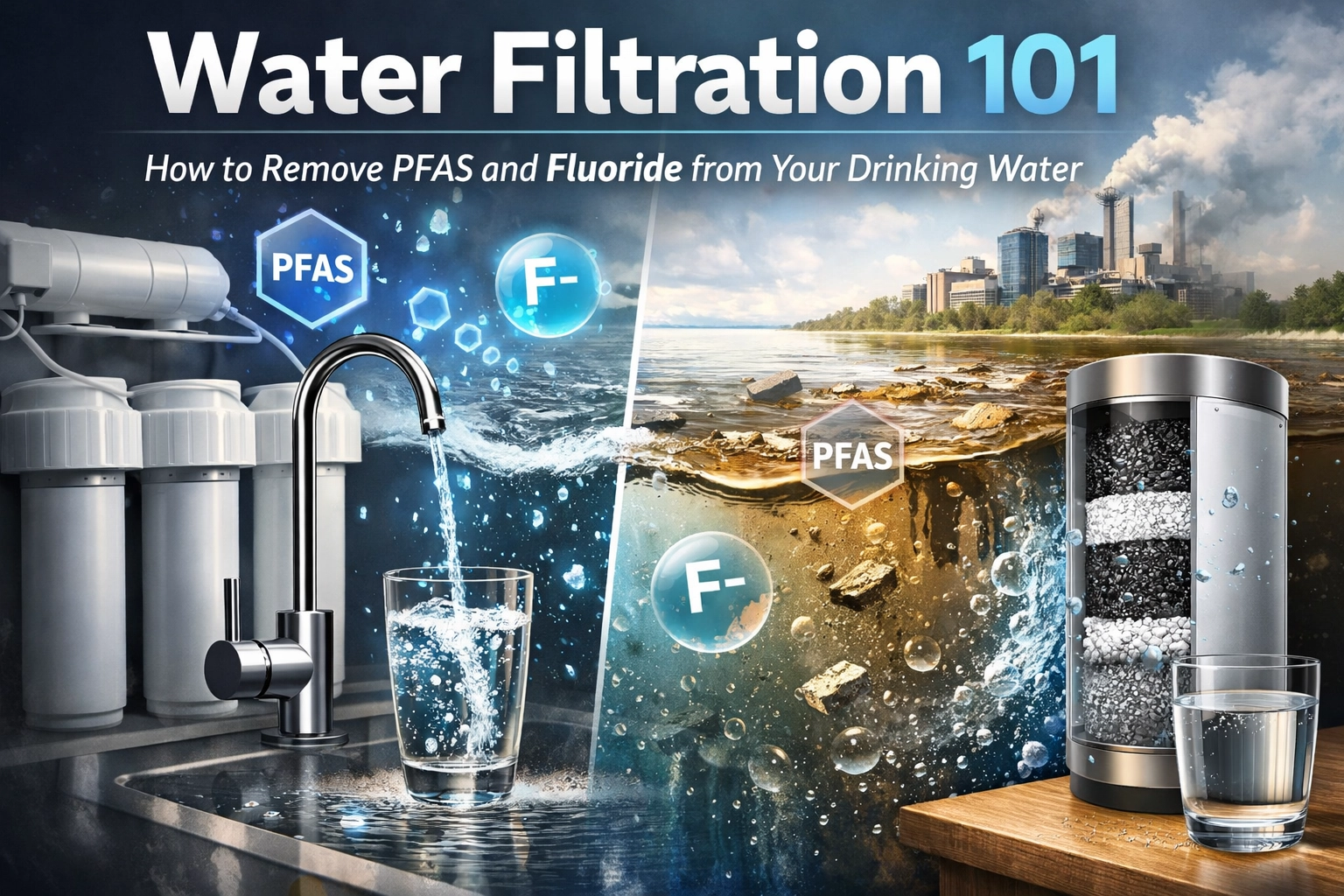
By 2026, the conversation around tap water has shifted from "Is it safe?" to "How clean can we actually get it?" While municipal water treatment plants do a hero's job of keeping us safe from cholera and dysentery, they weren't exactly designed to handle the chemical complexity of the 21st century. Specifically, two contaminants dominate the headlines: PFAS (Per- and polyfluoroalkyl substances) and Fluoride.
If you are looking to optimize your healthspan, your water source is the lowest-hanging fruit. You drink it every day, you cook with it, and it makes up the bulk of your cellular environment. In this guide, we’re going deep into the technical weeds of how to scrub these specific molecules out of your life for good.
The Chemistry of "Forever": Understanding PFAS
PFAS are a group of synthetic chemicals used since the 1940s to make products resistant to heat, oil, stains, grease, and water. You’ll find them in non-stick cookware, firefighting foam, and water-repellent clothing. The problem? They contain one of the strongest bonds in organic chemistry: the Carbon-Fluorine bond.
Because this bond is so difficult to break, these chemicals do not biodegrade. They accumulate in the environment and, eventually, in your blood. As of 2026, clinical data has linked long-term PFAS exposure to:
- Endocrine Disruption: Interference with thyroid hormones and estrogen.
- Immune Suppression: Reduced vaccine response and increased susceptibility to infections.
- Metabolic Issues: Increased cholesterol levels and altered liver enzyme function.
- Oncological Risks: Links to kidney and testicular cancers.
The EPA recently set enforceable limits for several PFAS variants at 4 parts per trillion (ppt). To put that in perspective, that is like identifying four specific drops of water in an Olympic-sized swimming pool. Standard "pitcher" filters often lack the contact time or media density to catch these.

The Fluoride Debate in 2026
Fluoride is more controversial. While it has been added to public water for decades to prevent dental cavities, 2026 health standards emphasize the "dose makes the poison" rule. High levels of fluoride exposure, particularly in developing children and those with thyroid conditions, have been scrutinized in recent longitudinal studies.
The primary concerns involve:
- Neurotoxicity: Some studies suggest a correlation between high prenatal fluoride exposure and lower IQ scores in children.
- Skeletal Fluorosis: Weakening of bone structure over decades of high intake.
- Thyroid Interference: Fluoride can compete with iodine for uptake in the thyroid gland, potentially exacerbating hypothyroidism.
Unlike lead or chlorine, fluoride is an ion. It is incredibly small and difficult to strain out with mechanical "sieve" filters. You need chemical attraction or molecular rejection to remove it.
Top 3 Filtration Technologies for PFAS and Fluoride
Not all filters are created equal. If you buy a generic carbon pitcher from a grocery store, you’re mostly just improving the taste by removing chlorine. To hit PFAS and Fluoride, you need the "big three" of filtration science.
1. Reverse Osmosis (RO): The Gold Standard
Reverse Osmosis works by forcing water through a semi-permeable membrane under high pressure. The pores in an RO membrane are approximately 0.0001 microns. For context, a human hair is about 70 microns.
- How it handles PFAS: RO is highly effective against both long-chain and short-chain PFAS. It physically rejects the molecules, sending them down a waste line.
- How it handles Fluoride: It typically removes 85% to 95% of fluoride.
- The Trade-off: RO systems produce "brine" or wastewater. In 2026, modern high-efficiency RO systems have a 1:1 ratio (one gallon wasted for every gallon cleaned), whereas older systems wasted four gallons for every one gallon cleaned.
2. Activated Carbon (GAC and Solid Block)
Activated carbon works through adsorption. Think of it like a chemical magnet. The carbon is "activated" to create millions of tiny pores, giving it a massive surface area. One gram of activated carbon has a surface area of over 3,000 square meters.
- How it handles PFAS: Carbon is excellent for "long-chain" PFAS (like PFOA and PFOS). However, "short-chain" PFAS can sometimes slip through if the water moves too fast or the filter is old.
- How it handles Fluoride: Standard carbon does not remove fluoride. You need a specific type of media called "Activated Alumina" or a multi-stage carbon block specifically treated for ions.
- Pro-Tip: Always look for NSF/ANSI 53 certification for PFAS reduction.
3. Ion Exchange (IX)
Ion exchange systems use specialized resins that act like a "swap meet" for ions. In the case of PFAS, the resin is positively charged to attract the negatively charged PFAS molecules.
- How it handles PFAS: It is arguably the most effective method for total PFAS removal, often outperforming carbon for short-chain molecules.
- How it handles Fluoride: Specific anionic resins can be used to target fluoride, though this is more common in industrial or whole-house settings than under-sink units.

Comparison Table: Which Filter Wins?
| Feature | Activated Carbon | Reverse Osmosis | Ion Exchange |
|---|---|---|---|
| PFAS Removal | Good (Long-chain) | Excellent | Superior |
| Fluoride Removal | Poor (Unless modified) | Excellent | Good (Specific Resins) |
| Installation | Easy (DIY) | Moderate (Under-sink) | Moderate to Hard |
| Waste Water | None | 1:1 to 4:1 ratio | None |
| Mineral Stripping | Keeps minerals | Removes all minerals | Selective |
| Maintenance | Change every 3-6 months | Change every 12 months | Long-lasting |
The "Mineral" Problem: Should You Re-mineralize?
A common technical critique of Reverse Osmosis is that it creates "hungry water." Because RO removes everything: including beneficial minerals like magnesium, calcium, and potassium: the water becomes slightly acidic and lacks the electrolytes your body needs for optimal hydration.
In 2026, the best setups use a Post-Mineralization Stage. This is a final filter cartridge that adds a controlled amount of calcium and magnesium back into the water after it has been cleaned. This balances the pH and provides the "crisp" taste associated with mountain spring water.

How to Verify Your Filter (Don't Trust the Marketing)
The wellness industry is full of "miracle" filters that make big claims without data. To ensure you are actually removing PFAS and fluoride, you must look for third-party certifications.
- NSF/ANSI 53: This is the gold standard for filters designed to reduce contaminants with a health effect (like lead and PFAS).
- NSF/ANSI 58: This applies specifically to Reverse Osmosis systems.
- NSF/ANSI 401: This covers "emerging compounds," including some pharmaceuticals and newer pesticides.
- Third-Party Lab Reports: Reputable companies (like AquaTru, ZeroWater, or Berkey: though Berkey has had its own transparency struggles) should provide a full data sheet showing exactly what percentage of each chemical was removed in a lab setting.
Action Plan: Testing Your Own Water
Before spending $500 on a system, find out what is actually in your pipes.
- Consumer Confidence Report (CCR): If you are on city water, your utility provider is required to publish an annual report. Search "[Your City] Water Quality Report 2025/2026."
- Private Lab Testing: If you are on a well, or if you suspect your pipes are leaching lead, use a kit from a certified lab (like MyTapScore). Home TDS (Total Dissolved Solids) meters are great for checking if your RO membrane is working, but they cannot detect PFAS. PFAS are measured in parts per trillion; a TDS meter isn't sensitive enough to find them.
The Bottom Line
Water quality is a cornerstone of longevity. While the "Forever Chemical" crisis feels overwhelming, the technology to protect yourself is more accessible in 2026 than ever before.
If you want the absolute best protection against both PFAS and Fluoride, install a multi-stage Reverse Osmosis system with a remineralization cartridge. If you are a renter or on a budget, a high-quality countertop RO system or a specialized multi-stage pitcher (like ZeroWater, provided you change the filters frequently) is your next best bet.
Stop treating your body like a filter. Buy a filter so your kidneys don't have to be one.
About the Author: Malibongwe Gcwabaza
Malibongwe Gcwabaza is the CEO of blog and youtube, a leading digital platform dedicated to demystifying complex health sciences for the modern achiever. With a background in systems optimization and a passion for longevity, Malibongwe focuses on actionable biohacking strategies that bridge the gap between clinical research and daily lifestyle. When he's not researching water filtration or metabolic health, he’s exploring the intersection of AI and wellness.
About the Author