For decades, the "big three" of health were simple: eat your greens, hit the gym, and don't smoke. If you checked those boxes, you were considered a "healthy" person. However, as we move through 2026, the medical community has reached a definitive consensus: your social calendar might be just as important as your cardio routine.
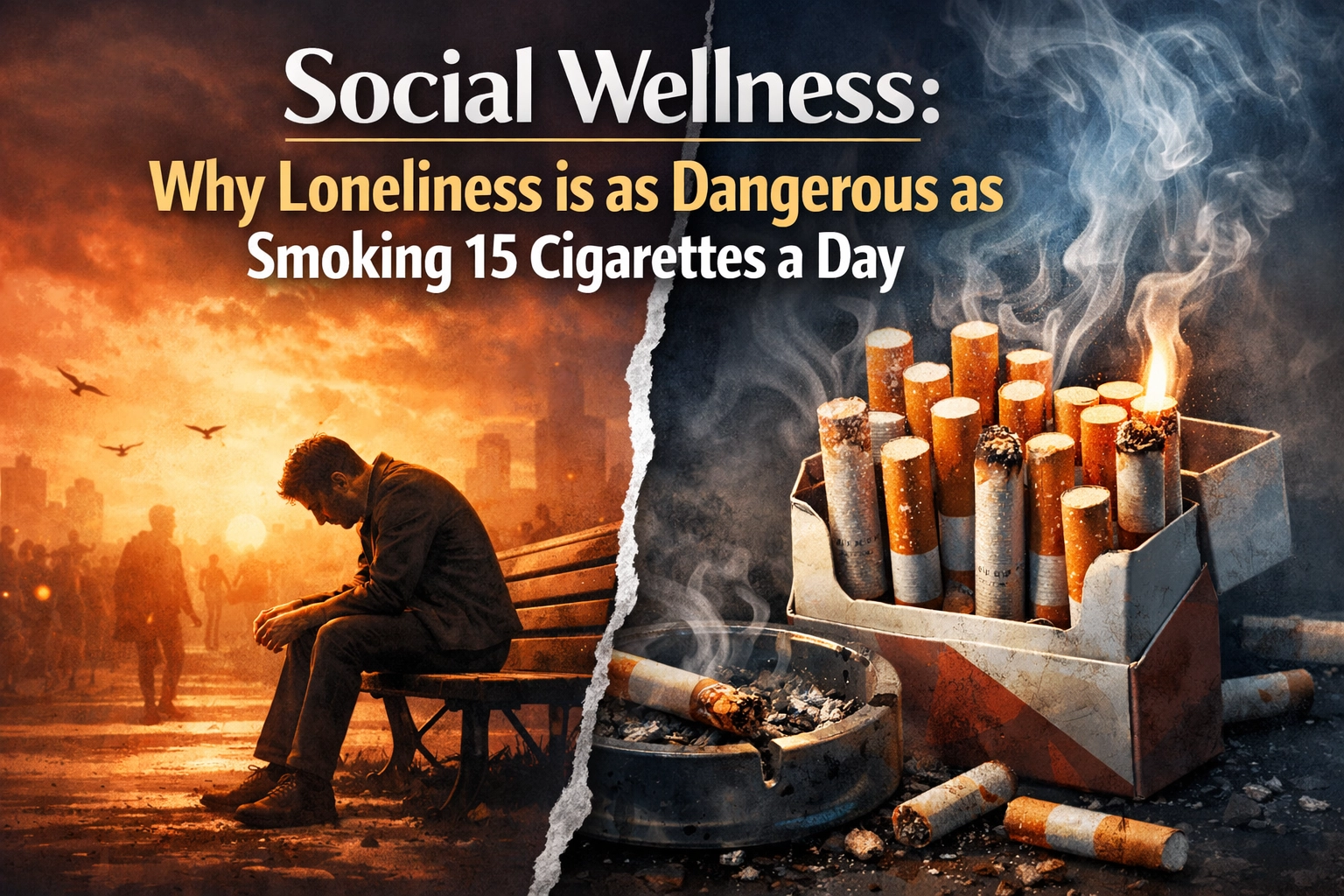
The headline that "loneliness is as lethal as smoking 15 cigarettes a day" isn't just a clickbait slogan; it’s a metric derived from meta-analyses of hundreds of thousands of individuals. While the comparison is a simplified public health tool, the underlying biology of social isolation reveals a staggering impact on human longevity, systemic inflammation, and cardiovascular integrity.
The Biological Mechanism: Why Isolation Triggers Decay
Humans are obligate social creatures. From an evolutionary perspective, being cast out of the "tribe" was a death sentence. Consequently, our brains developed a hyper-sensitive alarm system: the amygdala: that treats social isolation as a physical threat.
When you feel lonely or socially disconnected, your body enters a state of chronic "social threat." This activates the sympathetic nervous system (fight or flight) and the HPA (hypothalamic-pituitary-adrenal) axis.
The Cortisol Cascade
In a state of chronic loneliness, your body maintains elevated levels of cortisol. While cortisol is useful for escaping a predator, its constant presence leads to:
- Glucocorticoid Resistance: Your cells stop responding to anti-inflammatory signals.
- Hyper-inflammation: This is the root of "Inflammaging," where your biological age outpaces your chronological age.
- Reduced Immune Response: Loneliness has been shown to downregulate genes involved in antiviral responses while upregulating pro-inflammatory genes.

Decoding the "15 Cigarettes" Claim: Fact vs. Nuance
The claim that loneliness equals 15 cigarettes a day originates from a landmark study by Dr. Julianne Holt-Lunstad. While later research, including data from the UK Biobank, suggests that smoking still carries a higher overall mortality risk for cancer, the comparison remains valid when looking at all-cause mortality and specific cardiovascular outcomes.
To understand the weight of social wellness, let’s look at how it stacks up against other common health risks:
Comparison of Mortality Risk Factors (2026 Data Insights)
| Risk Factor | Increased Risk of Early Death | Key Biological Impact |
|---|---|---|
| Social Isolation | ~29% – 32% | Chronic Inflammation & HPA Overdrive |
| Air Pollution | ~5% – 6% | Respiratory & Oxidative Stress |
| Obesity | ~20% | Metabolic Dysfunction |
| Physical Inactivity | ~20% | Muscular Atrophy & Poor Circulation |
| Heavy Smoking | ~50%+ | Carcinogenic & Vascular Damage |
| Alcohol Consumption | ~15% – 25% | Hepatic Stress & Neurotoxicity |
The takeaway? Social isolation is a more significant predictor of early death than physical inactivity or obesity. If you are training like a pro athlete but living like a hermit, your "longevity currency" is being drained at the source.
The Impact on Cardiovascular and Brain Health
The heart and brain are the primary targets of social dysfunction. In 2026, we categorize these impacts under "Neuro-social Health."
1. The Heart-Social Connection
Socially isolated individuals have a 29% higher risk of heart disease and a 32% higher risk of stroke. This isn't just because lonely people might eat more comfort food. It’s because social stress causes vasoconstriction and increases blood pressure. Over years, this leads to arterial stiffness and plaque buildup.
2. Cognitive Decline and Dementia
Loneliness is one of the strongest non-genetic predictors of Alzheimer’s disease. When we interact with others, our brains perform complex tasks: decoding non-verbal cues, predicting reactions, and retrieving memories. Without this "social workout," the brain's cognitive reserve diminishes.

Social Isolation vs. Loneliness: Understanding the Difference
It is crucial to distinguish between being alone and being lonely.
- Social Isolation is the objective lack of social contact. You can count it by the number of people you see in a week.
- Loneliness is the subjective feeling of being disconnected. This is the feeling of being "lonely in a crowd."
Both are dangerous, but loneliness is often more insidious because it can be masked by a busy schedule or a high "follower count" on digital platforms. In the era of 2026 hyper-connectivity, many individuals suffer from "Digital Loneliness": they have 5,000 connections but zero people they could call for a ride to the hospital at 3 AM.
The 2026 Social Wellness Toolkit: How to "Exercise" Your Connections
Social wellness requires the same intentionality as a gym split. You cannot wait for "the vibe" to happen; you have to engineer it. Here is an evidence-based framework for optimizing your social health.
1. The "Inner Circle" Audit
Research suggests we need three distinct tiers of social connection to thrive:
- The Intimate Tier (2-3 people): People who know your deepest struggles. These provide the "Safety Net."
- The Relational Tier (10-15 people): Friends you see regularly for dinner or hobbies. These provide "Social Joy."
- The Collective Tier (150+ people): Your neighborhood, gym community, or professional network. These provide "Belonging."
2. Micro-Interactions and the Vagus Nerve
You don’t always need deep, soul-searching conversations to improve social wellness. Small, "weak tie" interactions: chatting with the barista or nodding to a neighbor: stimulate the Vagus Nerve. This triggers a "safety signal" to the brain, lowering cortisol instantly.
3. The "Phone-First" Rule for 2026
With the rise of AI-driven social feeds, the 2026 recommendation for mental fitness is the "Analog Hour." Spend at least one hour a day in face-to-face contact with no screens present. Eye contact and physical proximity trigger oxytocin, a hormone that directly counteracts the damage caused by cortisol.

Table: Social Wellness Action Plan
| Level | Frequency | Action Item |
|---|---|---|
| Micro | Daily | Initiate one small-talk conversation with a stranger or acquaintance. |
| Meso | Weekly | Attend one group activity (sports, book club, community work) where you are a "regular." |
| Macro | Monthly | Host or organize a gathering. Being the "connector" increases your own social status and sense of agency. |
The Role of "Soft Wellness" and JOMO
In previous years, we suffered from "The Hustle Culture of Connection": trying to network everywhere. In 2026, we are pivoting toward JOMO (Joy Of Missing Out) on low-quality interactions to focus on high-quality ones.
Social wellness isn't about being an extrovert. It’s about the quality of the bond. For an introvert, social wellness might mean one deep conversation a week. For an extrovert, it might mean a busy team environment. The key is ensuring that the "Social Threat" alarm in your brain remains silent.
Final Perspective: Social Health is Public Health
We are currently living through a "Loneliness Epidemic" that the World Health Organization has flagged as a global priority. As we optimize our supplements, our sleep cycles, and our VO2 max, we must remember that a solitary life is a shorter life.
Prioritizing social wellness isn't "soft": it's a hard-boiled physiological necessity. If you want to live to 100, don't just look at your blood work. Look at your dinner table. Who is sitting there with you? The answer might be the most important biomarker you have.
About the Author: Malibongwe Gcwabaza
Malibongwe Gcwabaza is the CEO and lead strategist at blog and youtube. With over a decade of experience in health communications and digital wellness, Malibongwe focuses on the intersection of human biology and modern lifestyle stressors. He is a staunch advocate for "The Longevity Decathlon," emphasizing that mental and social fitness are the true foundations of physical health. When not analyzing the latest in 2026 wellness trends, he can be found exploring the Cape Town trails or hosting community-building workshops for local entrepreneurs.
About the Author