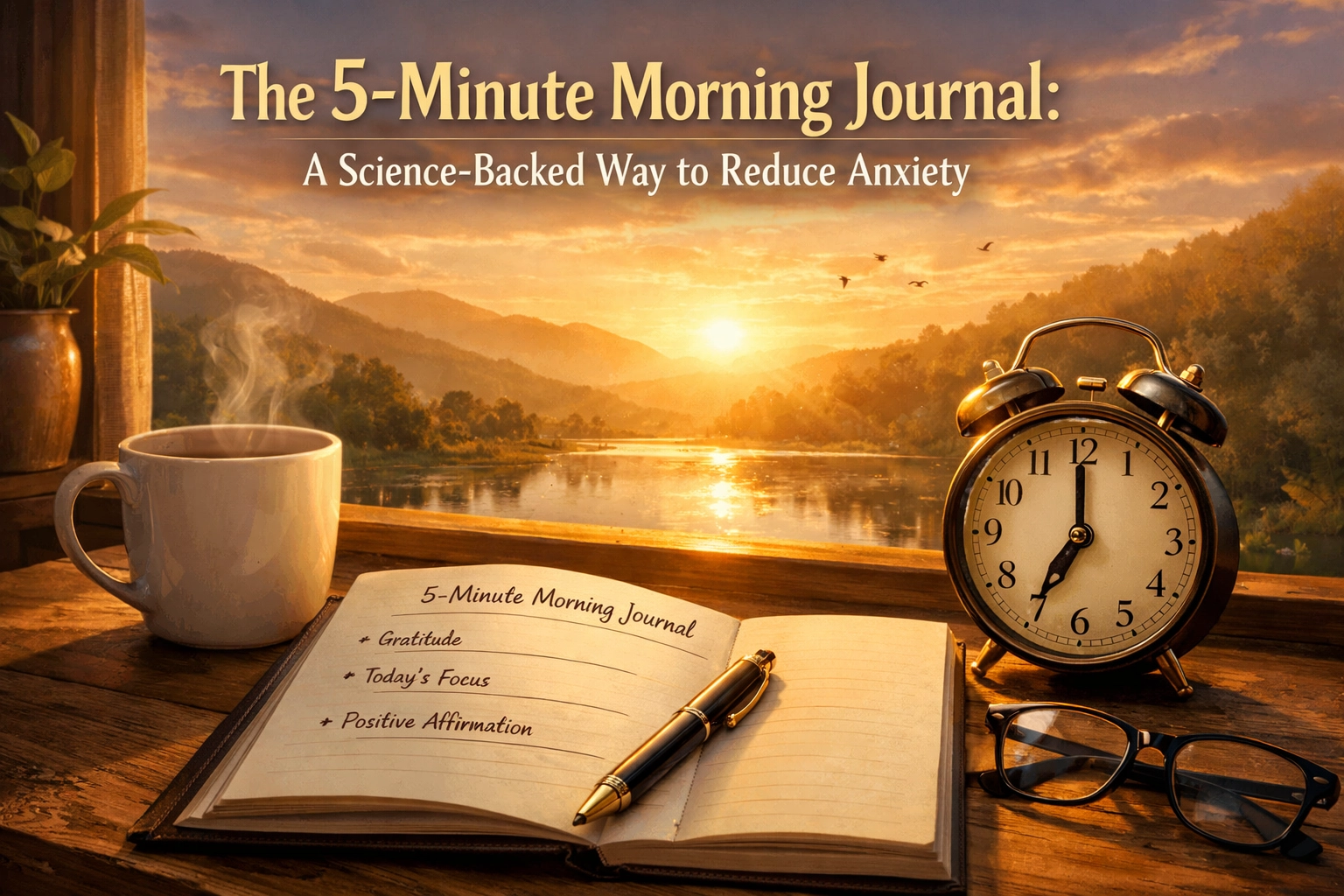
Anxiety often feels like a background hum: a low-frequency vibration that drains your battery before the day even begins. For most of us, the first instinct upon waking is to check notifications, effectively inviting the entire world’s chaos into our bed. There is a more effective, evidence-based alternative: the 5-minute morning journal.
This isn't about creative writing or keeping a "dear diary" record of your life. It is a targeted psychological intervention. By utilizing specific journaling frameworks, you can effectively "offload" the cognitive burden of anxiety, moving it from your nervous system onto paper.
The Neurobiology of "Affect Labeling"
When you feel anxious, your amygdala: the brain's emotional processing center: is in a state of hyper-arousal. It is scanning for threats and signaling the release of cortisol. Research from UCLA suggests that the simple act of putting feelings into words (a process called "affect labeling") reduces activity in the amygdala and increases activity in the right ventrolateral prefrontal cortex.
In simpler terms: when you write down "I am feeling overwhelmed by today’s meeting," you are shifting the brain's processing from the emotional center to the rational center. You are telling your brain that the "threat" has been identified, which allows the nervous system to begin de-escalating.

The Pennebaker Paradigm
Dr. James Pennebaker, a lead researcher in the field of expressive writing, found that people who journaled about stressful experiences for just 15 to 20 minutes a day, three to four days in a row, saw significant improvements in immune system function and a reduction in doctor visits. While his initial studies focused on longer sessions, modern iterations have shown that a consistent 5-minute daily practice yields similar results in emotional regulation and anxiety reduction.
The 3-Part Morning Framework
To maximize the benefits of morning journaling without it becoming another stressful task on your to-do list, we recommend a specific three-part structure. This framework is designed to move you through the cycle of awareness, exploration, and action.
1. The Brain Dump (Externalization)
Start by listing everything currently occupying your mental space. Don't worry about grammar or logic. This is about clearing the "RAM" of your brain.
- Prompt: What is currently bothering me?
- Examples: The passive-aggressive email from a client, the car's engine light, the fact that I haven't exercised in three days.
2. Emotional Exploration (Cognitive Defusion)
Pick the most pressing item from your dump and look at the feeling behind it. This creates "cognitive defusion": the ability to see your thoughts as just thoughts, rather than absolute truths.
- Prompt: Why does this feel heavy right now?
- Depth: Instead of just saying "I'm stressed," try "I'm worried that my technical skills aren't keeping up with the team, and I’m afraid of being found out."
3. Actionable Mitigation
End by identifying one small, tangible step you can take today to address one of these concerns. This shifts the brain from a state of "passive worrying" to "active problem-solving."
- Prompt: What is one thing I can control?
- Result: "I will spend 15 minutes watching a tutorial on the new software before the meeting."

Data-Driven Benefits of Journaling
| Benefit | Impact on Anxiety | Scientific Mechanism |
|---|---|---|
| Reduced Rumination | High | Breaks the loop of repetitive negative thinking. |
| Improved Working Memory | Moderate | Frees up cognitive resources by externalizing tasks. |
| Lower Cortisol | High | Calms the HPA axis through emotional regulation. |
| Enhanced Sleep | Indirect | Prevents "bedtime worry" by processing thoughts in the morning. |
Why "Morning" Matters: The Cortisol Awakening Response (CAR)
You might wonder why we specify the morning. This is due to the Cortisol Awakening Response. Your cortisol levels naturally spike within 30 to 45 minutes of waking up to help your body get moving. If you are already prone to anxiety, this natural spike can feel like a panic attack.
By journaling immediately after waking, you intercept this spike. You are providing a container for that morning energy, directing it toward clarity rather than allowing it to spiral into a day-long state of tension.

Implementation: How to Build the Habit
The biggest hurdle to journaling isn't the writing: it's the friction. To make this work, you need to treat it like a technical deployment: optimize for the lowest possible barrier to entry.
- Analog vs. Digital: Use a physical notebook. Digital devices come with notifications and blue light, both of which are triggers for the anxious brain. A physical pen and paper provide tactile feedback that helps ground the user in the physical world.
- Habit Stacking: Place your journal on top of your coffee maker or next to your toothbrush. Link the new habit to an existing one.
- The "Two-Sentence Rule": On days when you are extremely busy or overwhelmed, give yourself permission to write only two sentences. The goal is the neurological reinforcement of the habit, not the word count.
Advanced Techniques for High-Stress Periods
If you are going through a particularly intense period (product launches, personal transitions, etc.), you can integrate Cognitive Behavioral Therapy (CBT) prompts into your 5-minute window:
- Evidence Check: "Is there any objective evidence that this catastrophic thought is 100% true?"
- The "So What?" Drill: "If the thing I'm worried about happens, what is my Plan B?"
- Gratitude Integration: Research shows that practicing gratitude can stimulate the release of dopamine and serotonin. Adding just one specific thing you are grateful for (e.g., "The way the light hits my desk in the morning" rather than just "my health") adds a layer of positive priming to your brain.

Frequently Asked Questions (SEO Structured Data)
Does journaling work for severe anxiety?
While journaling is a powerful tool for managing symptoms and improving emotional regulation, it is not a replacement for clinical treatment or therapy for severe GAD (Generalized Anxiety Disorder). It is best used as a complementary practice.
How long does it take to see results?
Most people report an immediate sense of "lightness" after their first session. However, the structural changes in the brain (neuroplasticity) and significant reductions in baseline anxiety typically become measurable after 4 to 8 weeks of consistent daily practice.
What if I don't know what to write?
Use the 3-part framework mentioned above. If you're still stuck, write "I don't know what to write" repeatedly until a thought emerges. Usually, the "block" itself is a form of resistance that, once acknowledged, dissolves.
Conclusion: The ROI of 5 Minutes
In the world of mental performance, few interventions offer a higher return on investment than the morning journal. For the cost of 300 seconds, you gain cognitive clarity, a regulated nervous system, and a proactive stance against the day's challenges.
The goal isn't to be a "writer." The goal is to be a person who has mastered their own internal environment. Grab a pen, set a timer, and start offloading the noise.
About the Author: Malibongwe Gcwabaza
Malibongwe Gcwabaza is the CEO of blog and youtube, a media company dedicated to simplifying complex self-improvement and technical concepts for a modern audience. With a background in organizational leadership and a passion for data-driven wellness, Malibongwe focuses on providing actionable insights that help professionals optimize their mental performance. He believes that the most powerful tools are often the simplest ones, provided they are backed by rigorous science and consistent execution.
About the Author