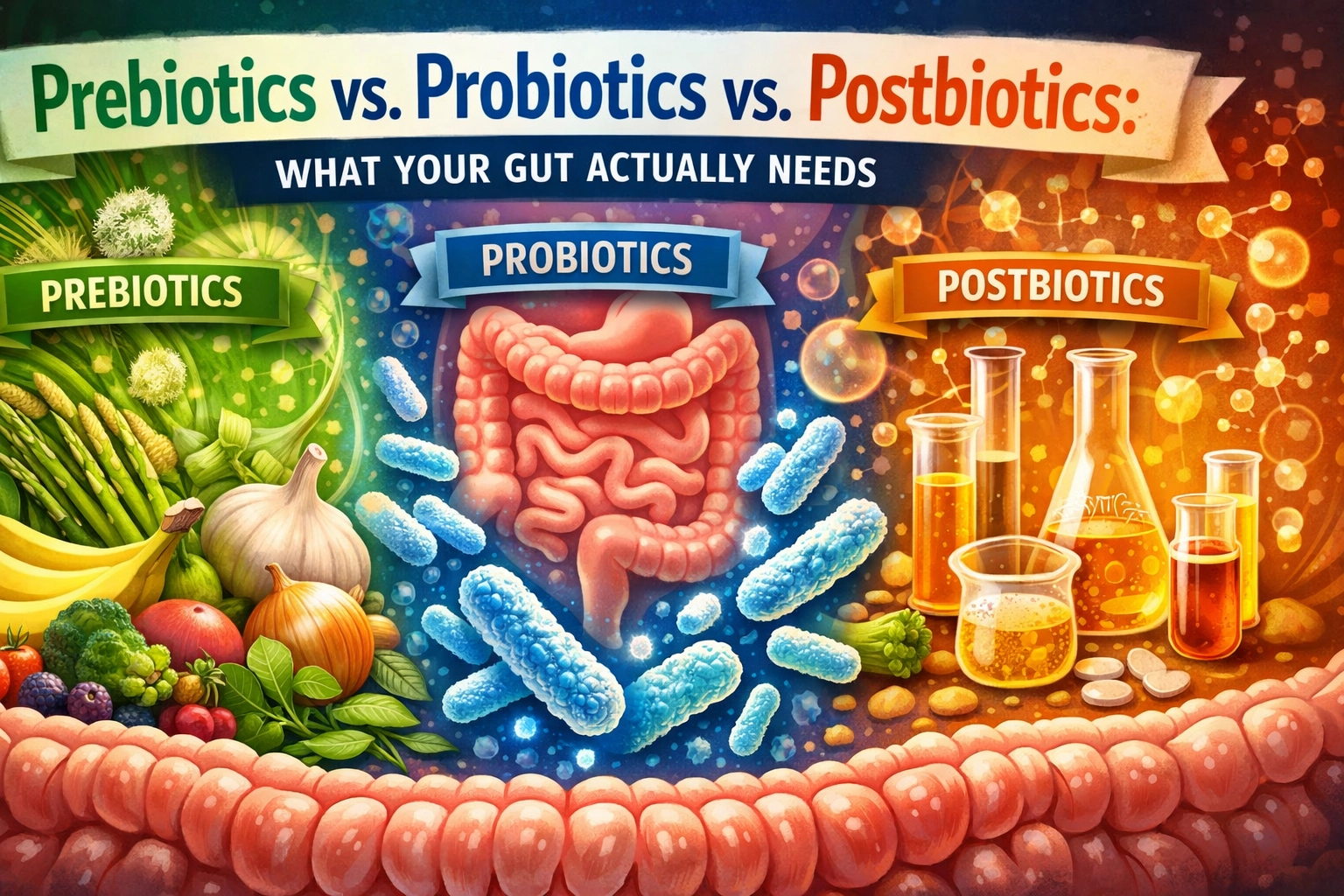
By 2026, the conversation around gut health has shifted from "take a pill and hope for the best" to a sophisticated understanding of the "Biotic Cascade." For years, we focused almost exclusively on probiotics: the live bacteria. But as our ability to sequence the microbiome has evolved, we’ve realized that the bacteria themselves are just one part of a complex three-stage factory.
To truly optimize your health, you need to understand the relationship between the fuel (prebiotics), the workers (probiotics), and the product (postbiotics). If you are missing any piece of this puzzle, you aren’t just wasting money on supplements; you’re missing out on the primary drivers of metabolic health, immune resilience, and cognitive clarity.
In this deep dive, we are breaking down the technical differences between pre-, pro-, and postbiotics and showing you how to build a gut health protocol that actually works.
The Biotic Cascade: A 30,000-Foot View
Think of your gut as a high-tech manufacturing plant.
- Prebiotics are the raw materials (the fuel).
- Probiotics are the specialized machinery (the living organisms).
- Postbiotics are the finished goods (the health-promoting compounds).
Historically, we thought that as long as we kept adding "machinery" (probiotics), the factory would run fine. We now know that without high-quality raw materials, the machines sit idle. Even more importantly, we’ve discovered that it’s the finished goods: the postbiotics: that actually do the heavy lifting in our bloodstream.
The Technical Comparison Table
| Feature | Prebiotics | Probiotics | Postbiotics |
|---|---|---|---|
| Nature | Non-living fibers/compounds | Living microorganisms | Bioactive byproducts |
| Primary Role | Feed beneficial bacteria | Diversify the microbiome | Regulate systemic health |
| Stability | Highly stable (heat/acid) | Fragile (dies in stomach acid) | Extremely stable |
| Key Examples | Inulin, FOS, Polyphenols | Lactobacillus, Bifidobacterium | Butyrate, Acetate, Enzymes |
| Source | Garlic, Onions, Green Bananas | Kimchi, Yogurt, Supplements | Fermentation byproducts |
1. Prebiotics: The Precision Fuel
Prebiotics are technically defined as non-digestible food ingredients that selectively stimulate the growth and activity of beneficial bacteria. In 2026, we’ve moved beyond generic "fiber" and into Precision Prebiotics.
The human small intestine lacks the enzymes to break down these complex carbohydrates. They arrive in the colon intact, where your resident microbes ferment them.
Key Types of Prebiotics to Target
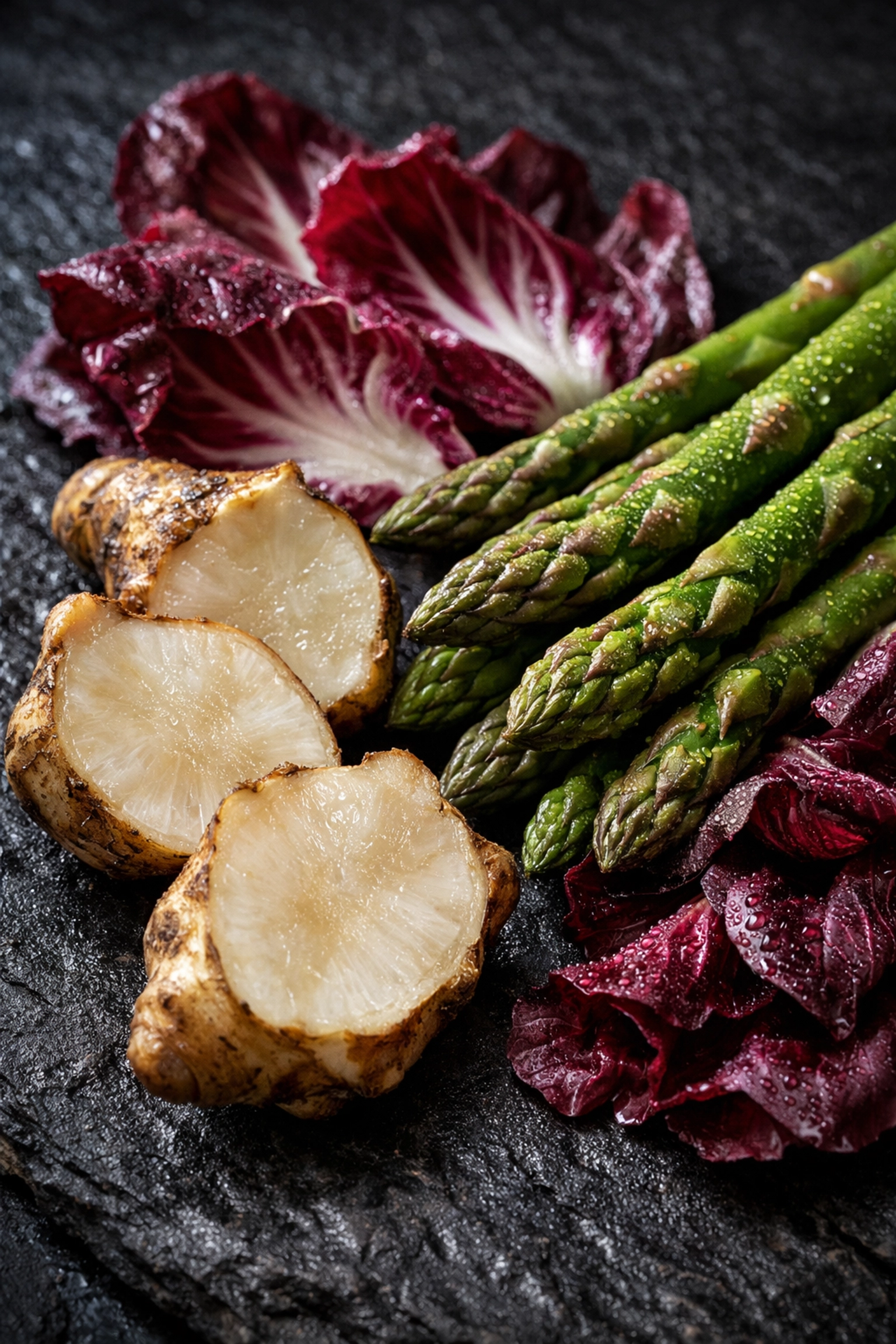
- Fructooligosaccharides (FOS) & Galactooligosaccharides (GOS): These are the "gold standard" for boosting Bifidobacteria. They are found in chicory root, asparagus, and Jerusalem artichokes.
- Resistant Starch (RS): Found in cooled potatoes and legumes, RS is the preferred fuel for bacteria that produce butyrate: a critical postbiotic for colon health.
- Polyphenols: Once considered just antioxidants, we now categorize many polyphenols (from dark berries, green tea, and cocoa) as prebiotics because they selectively "starve" pathogenic bacteria while feeding the good guys.
2. Probiotics: The Transient Guests
The biggest myth about probiotics is that they "colonize" your gut and stay there forever. Research in 2026 confirms that most supplemental probiotics are transient. They pass through your system, interacting with your immune cells and resident bacteria, and then they leave.
However, their impact while "passing through" is profound. They can crowd out pathogens, secrete antimicrobial proteins, and signal the immune system to lower inflammation.
The Shift to "Next-Generation" Probiotics
We are moving away from the generic Lactobacillus and Bifidobacterium blends. Modern gut health focuses on specific strains:
- Akkermansia muciniphila: The "weight loss" microbe. It strengthens the gut lining and improves insulin sensitivity.
- Lactobacillus reuteri: Studied extensively for its role in oxytocin production and skin health.
- Bacillus coagulans: A spore-forming probiotic that survives stomach acid much better than traditional strains.
The Probiotic Trap: Taking a probiotic without a prebiotic is like hiring workers for a factory but giving them no electricity. They won't be able to produce the postbiotics you need.
3. Postbiotics: The New Frontier of Longevity
This is where the real magic happens. Postbiotics are the "waste products" of fermentation, but calling them waste is a massive understatement. They are the signaling molecules that travel from your gut to your brain, heart, and muscles.
Because postbiotics are not alive, they are incredibly stable. They don't need refrigeration, and they aren't destroyed by stomach acid. This makes them the most potent tool for people with sensitive guts or compromised immune systems.
The Power of Short-Chain Fatty Acids (SCFAs)
The most researched postbiotics are SCFAs, specifically Butyrate, Acetate, and Propionate.
- Butyrate: This is the primary energy source for the cells lining your colon. It prevents "leaky gut" and has been shown to turn off inflammatory genes through a process called HDAC inhibition.
- Urolithin A: A postbiotic produced when your gut bacteria process pomegranate or walnuts. It triggers "mitophagy": the cleaning out of old, tired mitochondria: making it a holy grail for anti-aging.
What Does Your Gut Actually Need?
If you are looking to optimize your health in 2026, the answer isn't "one or the other." It’s about synergy.
Level 1: The Food-First Approach (Maintenance)
For a healthy individual, you don't necessarily need expensive powders.
- Prebiotics: Eat 30+ different plants per week. Focus on leeks, garlic, and high-polyphenol foods like blueberries.
- Probiotics: Incorporate "The Big Four" fermented foods: Kimchi, Kefir, Kombucha, and Sauerkraut.
- Postbiotics: By eating the fiber (pre) and the fermented foods (pro), your body naturally manufactures the postbiotics.
Level 2: The Supplement Protocol (Correction)
If you have IBS, brain fog, or chronic inflammation, you may need a targeted approach:
- Morning: Take a Synbiotic (a supplement that combines a prebiotic with a probiotic strain). This ensures the "worker" has "food" the moment it enters your system.
- Evening: Supplement with Tributyrin (a highly bioavailable form of the postbiotic Butyrate). This helps repair the gut lining while you sleep.
Level 3: Precision Biotics (Optimization)
In 2026, we recommend a Microbiome Sequencing Test. These tests (like Viome or DayTwo) tell you exactly which bacteria you are missing. If you have plenty of Lactobacillus but zero Akkermansia, taking a standard probiotic is a waste of money. You would instead focus on the specific prebiotics (like pomegranate husk) that feed Akkermansia.
The 2026 Guide to Avoiding "Health Washing"
As gut health becomes a multi-billion dollar industry, "health washing" is rampant. Here is how to spot high-quality products:
- CFU vs. Strain Transparency: Don't buy a probiotic that just says "50 Billion CFU." Look for specific strain numbers (e.g., Lactobacillus acidophilus DDS-1). The strain number is like a GPS coordinate; without it, you don't know what the bacteria actually does.
- Delayed-Release Capsules: Probiotics are sensitive. Ensure the supplement uses acid-resistant technology to get the bacteria past the stomach and into the colon.
- Third-Party Testing: Look for certifications that ensure the "live" count is accurate at the time of expiration, not just at the time of manufacture.
Summary: The Gut Health Checklist
To move the needle on your health, follow this hierarchy:
- Prioritize Prebiotics: They are the foundation. No amount of probiotics can fix a low-fiber diet.
- Use Probiotics for Specific Goals: Use specific strains for specific outcomes (e.g., sleep, digestion, or immunity).
- Leverage Postbiotics for Repair: If you have gut sensitivity, go straight to postbiotics like Butyrate to heal the lining without the gas and bloating sometimes caused by fiber.
The future of medicine is in the microbiome. By mastering the Biotic Cascade, you aren't just fixing your digestion: you are upgrading your entire biological operating system.
About the Author: Malibongwe Gcwabaza
CEO of blog and youtube
Malibongwe Gcwabaza is a visionary leader and wellness advocate dedicated to bridging the gap between complex biotechnological research and everyday health optimization. With a background in strategic health communications and a passion for longevity science, Malibongwe has spent years exploring the intersection of nutrition, AI-driven diagnostics, and human performance. As the CEO of blog and youtube, he focuses on delivering high-integrity, data-backed content that empowers individuals to take control of their biological data in the modern age. When he’s not deep-diving into microbiome sequencing reports, he can be found exploring the latest in functional fitness and bio-monitoring technology.
About the Author