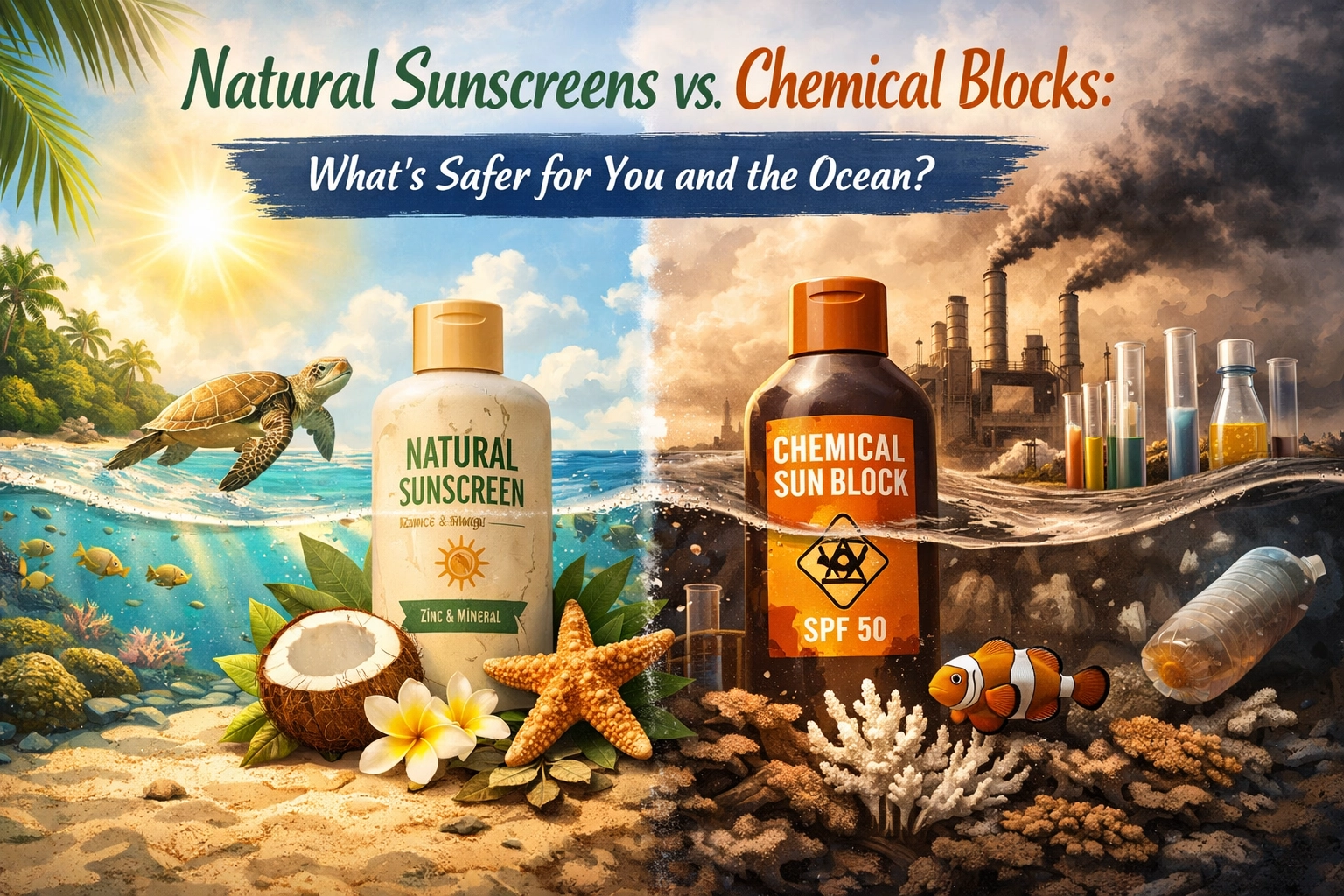
For decades, the advice from the health community was singular: wear sunscreen. It didn't matter what kind, as long as the SPF number was high enough to prevent a burn. However, as we move through 2026, the conversation has shifted from basic protection to molecular safety. We are no longer just asking if a sunscreen works, but what happens to those chemicals once they soak into our skin or wash off into the sea.
The debate between "natural" (mineral) sunscreens and chemical blocks is often framed as a battle between "clean" and "toxic." The reality is far more technical. Both categories have specific chemical structures that interact with ultraviolet (UV) radiation in different ways, and both carry specific environmental footprints. This guide breaks down the high-level science of photoprotection to help you make an informed choice for your health and the planet.
The Mechanics of Photoprotection: How They Actually Work
A common misconception: often repeated in marketing: is that mineral sunscreens act like a mirror to reflect light, while chemical sunscreens absorb it. Modern spectroscopy tells a more nuanced story.
Chemical Filters: The Energy Converters
Chemical sunscreens use organic (carbon-based) compounds such as avobenzone, octisalate, and oxybenzone. These molecules are designed to absorb UV rays. When UV radiation hits these molecules, it excites their electrons. As those electrons return to a ground state, they release the energy as a tiny amount of heat, which dissipates from the skin.
Mineral Filters: The Hybrid Blockers
Mineral sunscreens utilize inorganic compounds, specifically Zinc Oxide and Titanium Dioxide. While it is true that they reflect and scatter about 5% to 10% of incoming UV light (giving them that "physical block" reputation), the remaining 90% is actually absorbed and converted to heat, much like chemical filters. Zinc Oxide is particularly prized because it is a "broad-spectrum" giant, covering both UVA (aging) and UVB (burning) rays more effectively than almost any single chemical filter.

Human Health: Bloodstream Absorption and Endocrine Concerns
In the last few years, the FDA has significantly updated its stance on sunscreen safety. In 2020 and 2021, pilot studies showed that several common chemical filters are absorbed through the skin and enter the bloodstream at levels far exceeding the threshold for systemic safety concerns.
The Systemic Absorption Issue
A study published in JAMA found that active ingredients like oxybenzone, avobenzone, and octocrylene were present in the blood of participants after just one application. While "presence" does not automatically equal "toxicity," it has triggered a massive push for more data.
- Oxybenzone: This is the most controversial chemical filter. It has been linked to hormone disruption (acting as a weak estrogen) and has been detected in human breast milk and amniotic fluid.
- Octocrylene: Recent research suggests that over time, octocrylene can degrade into benzophenone, a known carcinogen and endocrine disruptor.
- Mineral Safety: Zinc Oxide and Titanium Dioxide are currently the only two ingredients "Generally Recognized as Safe and Effective" (GRASE) by the FDA. Because these minerals sit on top of the stratum corneum (the outermost layer of skin), they are not absorbed into the bloodstream, provided they are not in ultra-small nanoparticle form.
Environmental Impact: The Coral Reef Crisis
The "ocean-safe" movement isn't just a marketing gimmick; it’s a response to a biological catastrophe. It is estimated that 14,000 tons of sunscreen end up in the world's oceans every year.
How Chemical Blocks Kill Coral
Chemicals like oxybenzone and octinoxate are "xenobiotics" for marine life. Even in concentrations as low as 62 parts per trillion: equivalent to one drop of water in six-and-a-half Olympic-sized swimming pools: these chemicals cause:
- Coral Bleaching: They lower the temperature at which corals bleach, making them more susceptible to climate change.
- DNA Damage: They act as "genotoxicants," damaging the DNA of coral larvae and causing them to become encased in their own skeletons.
- Endocrine Disruption in Fish: These chemicals can cause "feminization" in male fish and impair reproductive health across marine species.
The "Nano" Problem in Mineral Sunscreens
Just because a bottle says "Zinc Oxide" doesn't mean it’s 100% safe for the ocean. The size of the mineral particle matters.
- Nanoparticles (<100nm): These are small enough to be ingested by coral polyps and can cause internal oxidative stress.
- Non-Nano Particles (>120nm): These are too large to interfere with the cellular biology of marine life. When choosing a mineral block, "Non-Nano" is the technical gold standard for reef safety.

The "34% Problem": Why Labels Can Be Deceiving
A startling 2024 investigation found that roughly 34% of sunscreens marketed as "mineral" or "natural" actually contained "booster" chemical filters that weren't listed as active ingredients. Manufacturers sometimes use these to increase the SPF rating without the "white cast" associated with heavy zinc.
To ensure you are getting a truly mineral, reef-safe product, you must look at the Active Ingredients panel, not just the front of the bottle. If you see terms like Homosalate, Octisalate, or Octocrylene alongside Zinc, it is a hybrid product, not a pure mineral block.
Comparative Analysis: Mineral vs. Chemical
| Feature | Mineral (Inorganic) | Chemical (Organic) |
|---|---|---|
| Primary Ingredients | Zinc Oxide, Titanium Dioxide | Avobenzone, Oxybenzone, Octinoxate |
| Application Time | Works immediately upon application | Requires 15-20 minutes to "set" |
| Skin Sensitivity | Low; recommended for rosacea/eczema | Higher; can cause "heat" stinging or rashes |
| Duration | Lasts longer under direct UV; rubs off easily | Breaks down under UV; requires reapplication |
| Environmental Impact | Safe (if Non-Nano) | High risk to coral and marine hormones |
| Aesthetics | Can leave a "white cast" on darker skin | Usually clear and easy to spread |
2026 Innovation: The Rise of "Biotech" Sunscreens
As we move deeper into 2026, the gap between "white, pasty mineral" and "clear, toxic chemical" is closing. New formulations are using:
- Micronized Zinc: Larger than nano, but smaller than traditional zinc, offering transparency without the coral toxicity.
- Botanical Boosters: Ingredients like Pongamia seed oil and Astaxanthin (from algae) are being used to naturally boost SPF ratings, reducing the need for high concentrations of synthetic filters.
- Bio-Fermented Squalane: Used as a vehicle to help mineral blocks spread more evenly, eliminating the "chalky" feel.
Practical Recommendations for the Conscious Consumer
If you are looking to optimize for both personal health (longevity) and environmental stewardship, follow these technical guidelines:
- Prioritize Zinc Oxide: It offers the most stable UVA protection. If you find Zinc too heavy, look for "Sheer Zinc" formulations that use non-nano, micronized technology.
- Avoid the "O-Chemicals": Stay away from Oxybenzone, Octinoxate, and Octocrylene. These are the primary offenders in both human endocrine disruption and coral bleaching.
- Check for "Non-Nano": This ensures the particles are large enough to be safe for your skin barrier and the marine ecosystem.
- Consider the Vehicle: High-quality sunscreens are now formulated with antioxidants like Vitamin C or Green Tea extract. These help neutralize the free radicals that UV rays produce, providing a second layer of defense.
- Reapply Correctly: No matter how "natural" a sunscreen is, its efficacy drops with sweat and friction. Aim for 2mg of product per square centimeter of skin: roughly a nickel-sized amount for the face alone.
Summary
The choice between natural and chemical sunscreen is no longer a matter of opinion: it is a matter of biology and ecology. Mineral sunscreens, specifically non-nano Zinc Oxide, remain the superior choice for those prioritizing long-term hormonal health and the preservation of our oceans. While chemical blocks offer convenience and transparency, the systemic absorption and marine toxicity associated with their primary ingredients make them a difficult sell in a world moving toward "clean" longevity.
About the Author: Malibongwe Gcwabaza
Malibongwe Gcwabaza is the CEO of blog and youtube and a dedicated advocate for functional wellness and bio-hacking. With a background in analyzing emerging health trends, Malibongwe focuses on the intersection of human performance and environmental sustainability. When not researching the latest in cellular repair or metabolic flexibility, he can be found exploring the rugged coastlines of South Africa, always wearing non-nano zinc.
About the Author