For decades, the fitness industry told anyone over the age of 40 to "slow down." The advice was predictable: lift weights slowly, walk on a treadmill, and maybe try some low-impact yoga. While that advice isn't inherently bad, it ignored a critical biological reality: we lose muscle power significantly faster than we lose muscle strength as we age.
By the time you hit 40, your "Rate of Force Development" (RFD): the ability to generate force quickly: begins to decline at a rate of about 1.5% to 2% per year. This is the "Power Gap." Strength is what allows you to lift a heavy grocery bag; power is what allows you to catch yourself when you trip on the curb. If you want to stay truly functional into your 70s and 80s, you need to stop avoiding explosive movements and start mastering them.
This guide explores how to safely integrate plyometrics into your routine after 40 to reclaim your athleticism, protect your bones, and sharpen your nervous system.
Power vs. Strength: Why You’re Losing One Faster Than the Other
To build a high-performance body in 2026, you have to understand the distinction between these two metrics. Strength is the maximal force a muscle can exert (think: a slow, heavy deadlift). Power is force multiplied by velocity (think: a jump or a sprint).
Research in the Journal of Aging and Physical Activity highlights that "dynapenia" (the loss of muscle power) is a more accurate predictor of future disability than "sarcopenia" (the loss of muscle mass).
| Feature | Strength | Power (Plyometrics) |
|---|---|---|
| Focus | Moving heavy loads | Moving quickly/explosively |
| Nervous System | Motor unit recruitment | Rate coding (speed of signals) |
| Daily Application | Carrying luggage, pushing a car | Avoiding a fall, climbing stairs fast |
| Aging Decline | ~1% per year after 40 | ~1.5% – 2% per year after 40 |
| Primary Goal | Muscle hypertrophy & force | Reactive capacity & bone density |

The Three Pillars of Longevity Benefits
Why should you risk jumping when you're 45 or 55? Because the rewards are specifically tailored to the problems of aging.
1. Bone Mineral Density (BMD)
Bones require "osteogenic loading" to stay strong. While heavy lifting helps, the high-impact nature of plyometrics creates a unique "strain rate" on the bone. This signals the body to deposit more minerals, particularly in the femoral neck (the hip), which is the most common site for life-altering fractures in older age.
2. Neuromuscular Efficiency
Plyometrics train the brain to talk to the muscles faster. As we age, the communication between our motor cortex and our fast-twitch muscle fibers (Type II) gets sluggish. Plyometrics act as a "system update" for your nervous system, keeping your reflexes sharp.
3. Metabolic Health
Explosive movements are metabolically expensive. A session involving short bursts of high-intensity plyos can elevate your insulin sensitivity and metabolic rate more effectively than a steady-state jog, helping you manage body composition more easily as your hormones shift.
The Pre-Flight Checklist: Are Your Joints Ready?
Before you start jumping off boxes, you need to earn the right to impact. In 2026, we use a "minimal effective dose" approach to ensure we don't blow out an Achilles tendon.
Do not start plyometrics if:
- You cannot perform 20 controlled bodyweight squats with perfect form.
- You have active, sharp joint pain in your knees or ankles.
- You haven't done any resistance training in the last six months.
The "Can I Jump?" Test:
Stand on one leg for 30 seconds without wobbling. If you lack the lateral stability to balance, your joints won't be able to handle the force of a landing. Start with balance work first.
Mechanics First: The Art of the "Silent Landing"
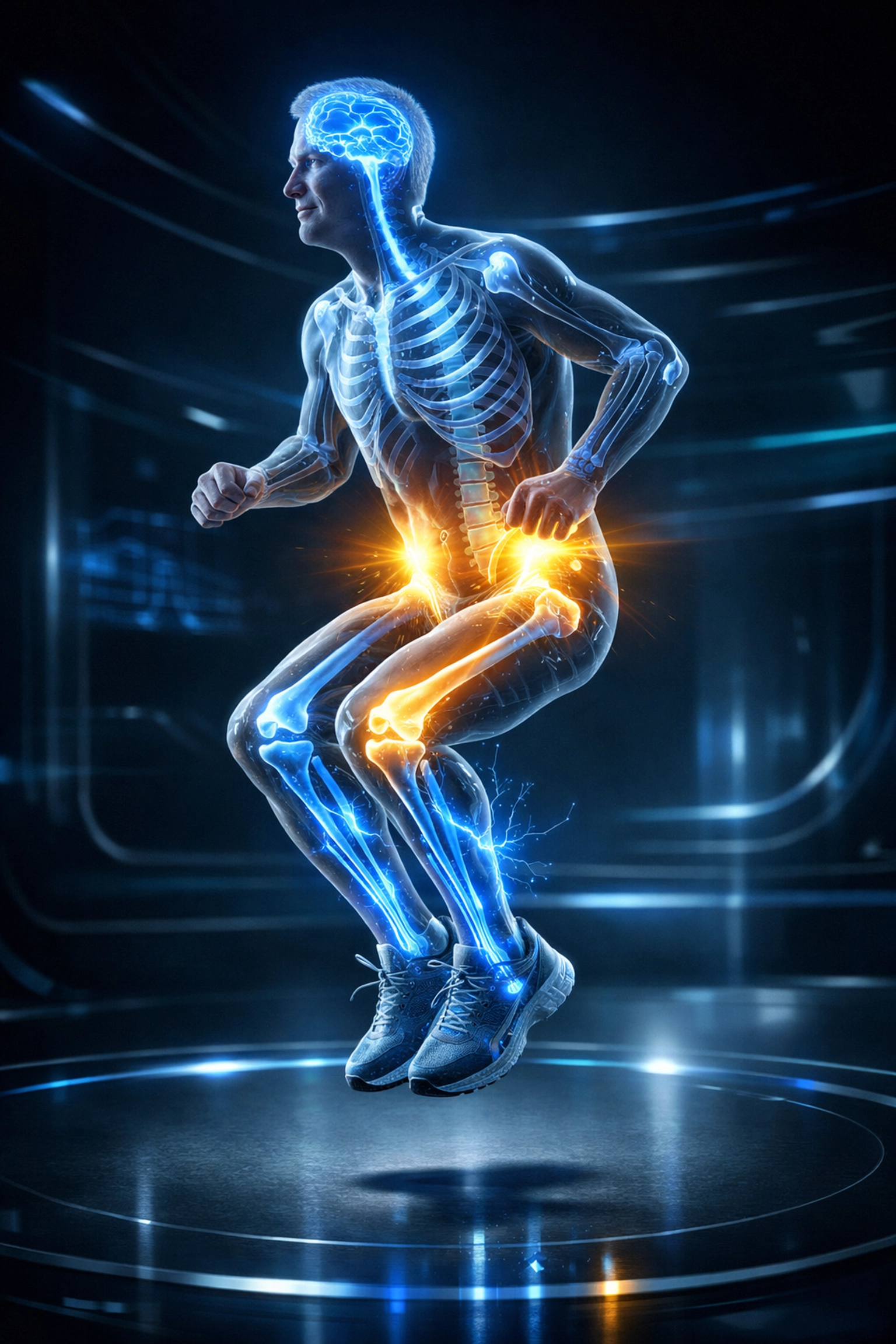
The biggest mistake 40+ athletes make is focusing on the "up" instead of the "down." In plyometrics, the landing is where the magic (and the injury) happens. We utilize the Eccentric Loading Phase to absorb force.
When you land, you should be as quiet as a cat. If your landing sounds like a sack of potatoes hitting the floor, you are putting a massive, unmitigated load on your cartilage and spinal discs.
Cues for a perfect landing:
- Land mid-foot to heel: Do not land exclusively on your toes (this torches the calves/Achilles) or exclusively on your heels (this sends a shockwave to the brain).
- Hips back: Think of your hips as the "shocks" on a mountain bike. They should move backward to absorb the weight.
- Knees out: Never let your knees cave inward (valgus) during a landing.
The Progressive Plyometric Framework for 40+
We don't start with "Max Height Box Jumps." We start with "Impact Absorption." Follow this progression over 12 weeks.
Level 1: The Foundation (Weeks 1-4)
Focus: Learning to land and controlling deceleration.
- Snap Downs: Stand on your tiptoes, reach for the sky, then "snap" down into a quarter-squat position as fast as possible. Hold for 2 seconds.
- Box Step-Ups (Explosive): Step up onto a 12-inch box quickly, but step down slowly.
- Incline Push-Ups (Plyo): Push off a bench with enough force that your hands leave the surface for a split second.
Level 2: Controlled Impact (Weeks 5-8)
Focus: Short-range jumps and basic elasticity.
- Counter-Movement Jumps: A standard vertical jump, focusing on a 3-second hold on the landing.
- Broad Jumps (Short): Jump forward only 2-3 feet. Focus on sticking the landing perfectly.
- Med Ball Slams: Throw a non-bounce medicine ball at the ground as hard as possible. This is "upper body plyometrics" without the joint impact of jumping.
Level 3: The Athletic Tier (Weeks 9-12+)
Focus: Reducing ground contact time.
- Low Box Jumps: Jumping onto a box (which is actually safer for knees than jumping on flat ground because it reduces the landing distance).
- Lateral Skaters: Jumping side-to-side to build stability in the frontal plane: crucial for preventing hip injuries.
- Pogo Hops: Small, rhythmic hops focusing on using the ankles like springs.
Integrating Plyos into Your 2026 Routine
You don't need a "Plyometrics Day." In fact, for adults over 40, a full day of jumping is usually too much volume for the tendons to recover from.
The Golden Rules of Programming:
- Do them first: Always perform plyos after a warm-up but before your heavy lifting or cardio. You need a fresh nervous system to move fast.
- Low Volume, High Quality: Aim for 10 to 20 total "contacts" (jumps) per session. That’s it.
- Frequency: Twice a week is plenty. Your tendons need 48–72 hours to remodel after high-impact loading.
- Use Tech: If you use a wearable like an Oura Ring or Whoop, check your "Recovery" or "Readiness" score. If your CNS is fried (low HRV), skip the plyos that day and do steady-state mobility instead.
Recovery and Joint Support
As we age, our collagen synthesis slows down. To support a plyometric habit, focus on these three recovery pillars:
- Nutritional Timing: Consuming 15-20g of high-quality collagen peptides with Vitamin C about 40-60 minutes before your workout can help strengthen the "cross-linking" in your tendons.
- The 10% Rule: Never increase your total jump volume by more than 10% per week. Tendons adapt much slower than muscles.
- Surface Selection: Avoid concrete. Use rubber gym flooring, grass, or a firm sand surface to provide a natural "give" for your joints.

Final Thoughts
Maintaining explosive power isn't about trying to win a dunk contest in your 50s; it’s about maintaining the "biological youth" of your nervous system. By incorporating small, controlled, explosive movements, you aren't just building a better physique: you're building a body that is resilient to the mechanical stresses of aging.
Stay bouncy, stay safe, and remember: if you don't use your power, you lose it.
About the Author: Malibongwe Gcwabaza
Malibongwe Gcwabaza is the CEO of blog and youtube, a leading digital hub dedicated to cutting-edge health, fitness, and longevity science. With a background in executive leadership and a passion for functional fitness, Malibongwe focuses on translating complex physiological research into actionable habits for high-performers. His mission is to bridge the gap between clinical longevity data and everyday wellness, helping thousands of readers navigate the "Healthspan" era with clarity and confidence. When he isn't steering the company, he is an avid practitioner of hybrid athlete training and a vocal advocate for proactive aging.
About the Author